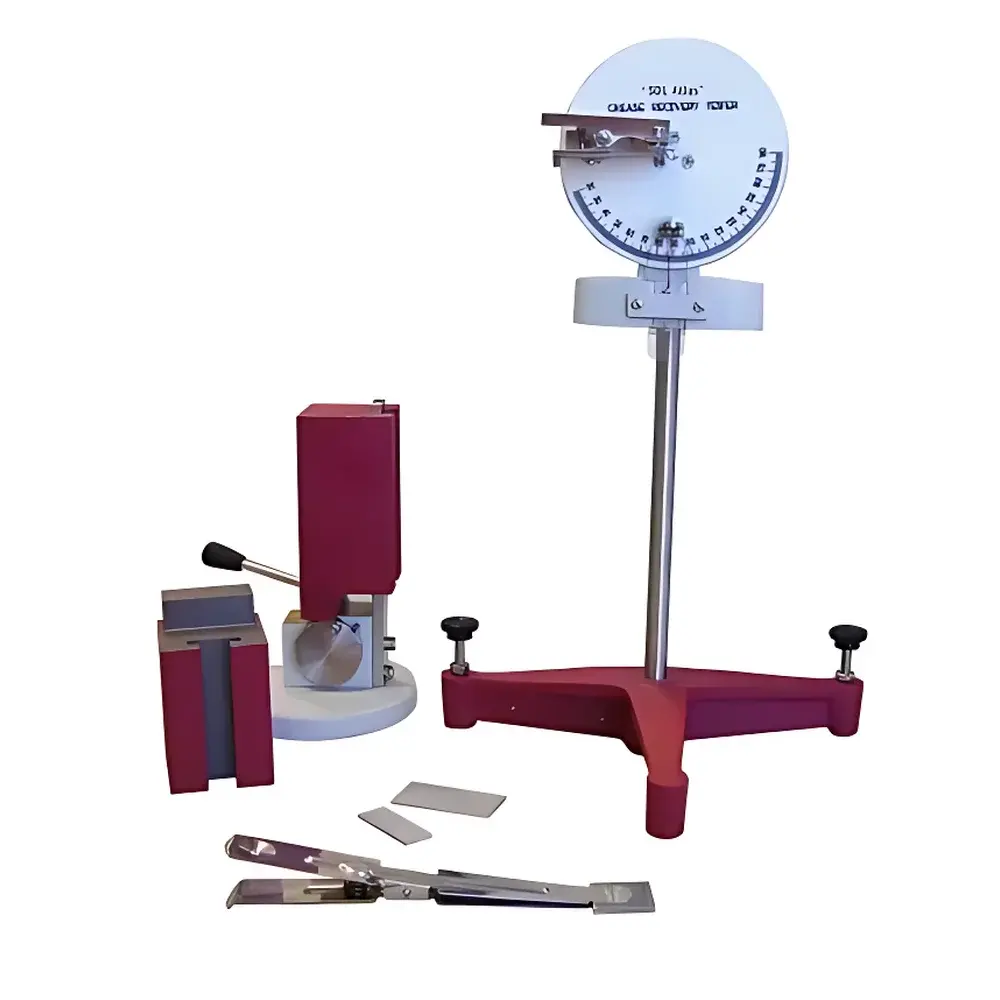
SDL Atlas M003A Wrinkle Recovery Angle Tester
| Brand | SDL Atlas |
|---|---|
| Model | M003A |
| Origin | Guangdong, China |
| Manufacturer Type | Direct Manufacturer |
| Regional Classification | Domestic (China) |
| Price Range | USD 7,000 – 14,000 |
| Compliance Standards | ISO 2313, BS 3760, AATCC 68 |
| Measurement Principle | Mechanical angle quantification of fabric recovery after controlled creasing |
| Test Output | Wrinkle Recovery Angle (WRA), expressed in degrees (°) |
Overview
The SDL Atlas M003A Wrinkle Recovery Angle Tester is an electromechanical precision instrument engineered for objective, repeatable quantification of fabric resilience following intentional deformation. It operates on the fundamental principle of mechanical angle measurement: a standardized rectangular fabric specimen is subjected to a defined compressive load under controlled time and temperature conditions, then released and allowed to recover freely for a fixed duration. The resulting wrinkle recovery angle (WRA) — measured as the acute angle formed between the two folded edges of the specimen — serves as a quantitative metric of dimensional stability and elastic memory in woven and knitted textiles. This test method is grounded in established physical textile mechanics, where recovery behavior reflects inter-fiber friction, yarn torsional rigidity, polymer chain mobility, and finishing agent efficacy. The M003A delivers traceable, operator-independent results critical for R&D validation, quality control benchmarking, and compliance verification across global supply chains.
Key Features
- Automated specimen positioning and load application mechanism ensuring consistent 700 g ± 5 g compressive force per test cycle, aligned with ISO 2313 Annex A requirements.
- Dual-scale angular measurement system: high-resolution digital protractor (0.1° resolution) coupled with calibrated optical reference lines for visual verification and cross-validation.
- Thermally stabilized test chamber (ambient ±2°C control) to minimize environmental influence on hygroscopic fiber response during conditioning and recovery phases.
- Modular sample holder assembly compatible with standard 100 mm × 25 mm specimens, accommodating both warp and weft orientation testing without reconfiguration.
- Robust stainless-steel frame and anodized aluminum components engineered for long-term dimensional stability and resistance to laboratory chemical exposure.
- Integrated timing circuitry synchronized with load release and recovery start, eliminating manual stopwatch dependency and reducing inter-operator variability.
Sample Compatibility & Compliance
The M003A supports natural fibers (cotton, wool, silk), regenerated cellulose (viscose, lyocell), synthetic filaments (polyester, nylon), and blended fabrics within standard thickness ranges (0.1–3.0 mm). Specimen preparation adheres strictly to pre-conditioning protocols specified in ISO 139 (standard atmosphere: 20°C ± 2°C, 65% RH ± 4%). Test execution complies fully with three internationally recognized standards: ISO 2313 (Textiles — Determination of wrinkle recovery angle — Vertical method), BS 3760 (Method for determination of wrinkle recovery of fabrics), and AATCC Test Method 68 (Wrinkle Recovery: Vertical Method). All calibration procedures follow ISO/IEC 17025 traceable practices, and instrument documentation supports GLP audit readiness for textile testing laboratories.
Software & Data Management
While the M003A operates as a standalone benchtop instrument, its measurement workflow integrates seamlessly with laboratory information management systems (LIMS) via RS-232 or optional USB-to-serial interface. Raw angular readings are timestamped and stored locally in non-volatile memory (up to 500 test records). Export functionality supports CSV format for statistical process control (SPC) analysis using external tools such as Minitab or JMP. Audit trail capabilities include operator ID logging, calibration date stamping, and environmental condition metadata capture—supporting FDA 21 CFR Part 11 compliance when paired with validated LIMS software. Calibration certificates are issued with NIST-traceable angular references.
Applications
- Quality assurance of durable press (DP) finishes: quantifying performance decay after multiple laundering cycles per AATCC TM135.
- Comparative evaluation of resin-based crosslinking agents (e.g., DMDHEU vs. BTCA) in cotton fabric treatment development.
- Validation of eco-friendly finishing alternatives (enzymatic, plasma, or bio-based polymers) against conventional formaldehyde-releasing systems.
- Raw material screening: assessing inherent wrinkle resistance of novel regenerated fibers (e.g., Tencel™ Modal, Sorona®) prior to weaving.
- Technical textile certification: meeting specification requirements for military uniforms (MIL-STD-810G), healthcare scrubs (ASTM F1670), and industrial workwear (EN 343).
FAQ
What standards does the M003A support out-of-the-box?
ISO 2313, BS 3760, and AATCC 68 — all implemented via mechanical fixtures and procedural logic embedded in the test sequence.
Can the instrument measure both warp and weft recovery angles simultaneously?
No; the M003A performs single-axis measurements per specimen. Warp and weft tests require separate specimen orientation and individual runs, as mandated by standard protocols.
Is operator training required for ISO-compliant operation?
Yes — while the interface is intuitive, full adherence to ISO 2313 requires documented training on specimen cutting, conditioning, load application timing, and angular reading interpretation to ensure inter-laboratory reproducibility.
Does the M003A require annual recalibration?
Yes — annual calibration against certified angular standards is recommended, with interim verification checks performed daily using the included reference wedge block.
How does humidity affect WRA results, and how is it managed?
Relative humidity directly influences hydrogen bonding in cellulose fibers; the M003A’s ambient stabilization and mandatory ISO 139 preconditioning mitigate this variable, but testing must occur in a climate-controlled lab meeting ISO 139 specifications.
Related Products