
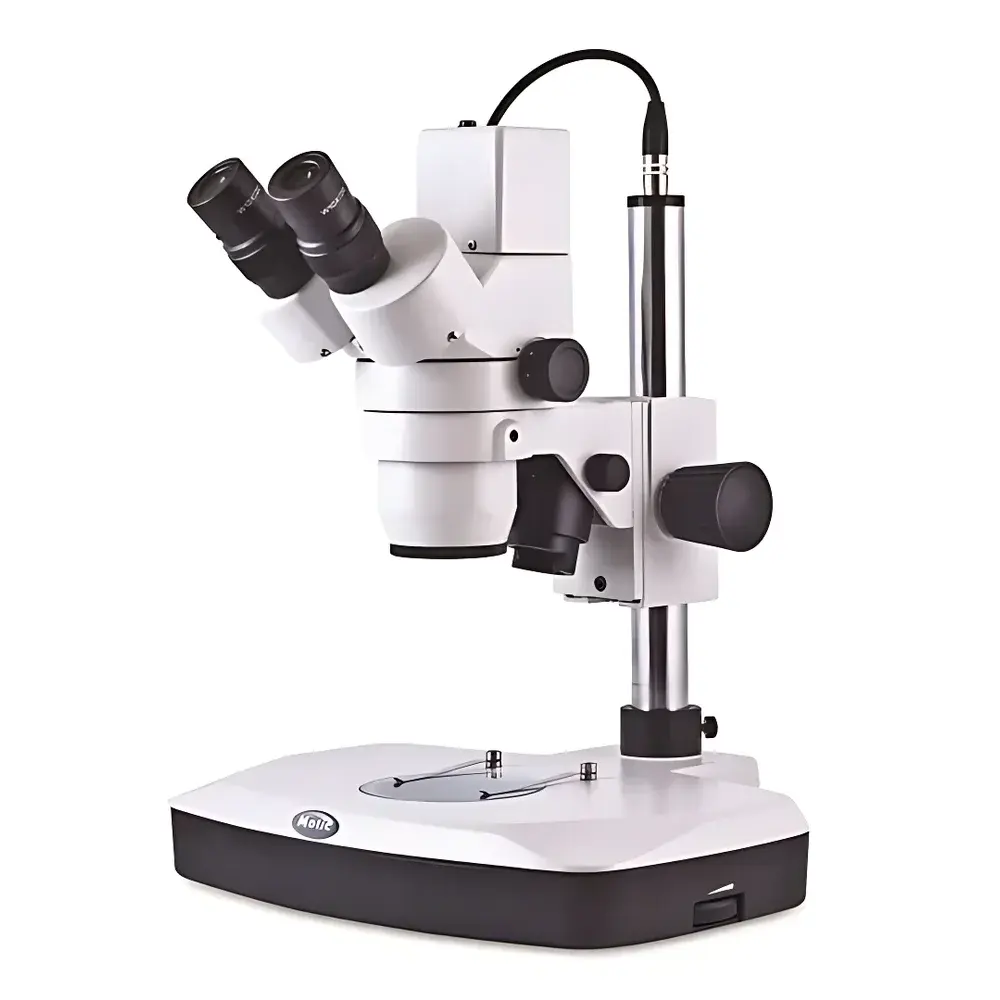
SDLATLAS G208F2 Digital Stereo Zoom Microscope Imaging System
| Brand | SDLATLAS |
|---|---|
| Origin | USA |
| Manufacturer Type | Original Equipment Manufacturer (OEM) |
| Import Status | Imported |
| Model | G208F2 |
| Pricing | Available Upon Request |
Overview
The SDLATLAS G208F2 Digital Stereo Zoom Microscope Imaging System is an engineered solution for high-fidelity 3D surface inspection, dimensional documentation, and qualitative morphological analysis in industrial quality control, electronics assembly verification, materials science laboratories, and academic research settings. Built upon a Galilean optical architecture with coaxial zoom optics, the system delivers true stereoscopic depth perception across its continuous 1×–4× magnification range—achieving a fixed 4:1 zoom ratio with parfocal alignment to maintain focus throughout magnification changes. The 45° inclined binocular head ensures ergonomic viewing during extended observation sessions, while the integrated high-resolution progressive-scan CCD sensor (1/2″ format, 1280 × 1024 pixels, monochrome or color variants available) captures optically faithful images without interpolation artifacts. Real-time image streaming is enabled via USB 2.0 interface, supporting lossless data transfer at up to 30 fps—critical for dynamic process monitoring and time-lapse documentation.
Key Features
- Ergonomic 45° inclined binocular viewing head with interpupillary adjustment (55–75 mm) and diopter compensation (±5 D) per eyepiece
- Continuous zoom optics with 4:1 ratio (1×–4×), calibrated for parfocality and minimal field curvature
- Standard 10× wide-field eyepieces (22 mm field number) providing full visual access to the entire imaging frame
- Dual independent illumination system: 10 W transmitted (bottom) and 10 W reflected (top) halogen lighting with adjustable intensity and heat-filtered output
- Frosted glass stage (150 × 150 mm) mounted on a vertical-height-adjustable pillar stand with coarse/fine dual-focus mechanism (2 mm coarse travel, 0.1 mm fine vernier scale)
- Integrated CCD camera and PCIe-compatible frame grabber board pre-installed; no external capture hardware required
- Bundled accessories include dust cover, calibration slide (NIST-traceable glass standard), S-Video and RCA analog video outputs, and USB cable
Sample Compatibility & Compliance
The G208F2 accommodates specimens up to 120 mm in height and 150 mm in width—ideal for PCBs, solder joints, composite laminates, biological tissue sections, and precision-machined components. Its open-stage design permits integration with optional motorized XY translation stages or environmental chambers (e.g., humidity-controlled enclosures). All optical components comply with ISO 10934-1 (Microscopy — Nomenclature of components) and ANSI Z80.10 (Ophthalmics — Specifications for microscopes). The halogen illumination meets IEC 62471 photobiological safety classification for Risk Group 1 (exempt), and the system’s electrical design conforms to UL 61010-1 and CE marking requirements under the EU Low Voltage Directive (2014/35/EU) and EMC Directive (2014/30/EU).
Software & Data Management
The system ships with SDLATLAS ImageStudio Pro v4.x—a modular, Windows-based application supporting live preview, multi-frame averaging, contrast enhancement (histogram equalization, unsharp masking), measurement annotation (line, angle, area, radius), and batch export in TIFF, BMP, JPEG2000, and lossless PNG formats. Measurement data logs include timestamp, magnification setting, illumination mode, and user ID—enabling traceability per GLP and ISO/IEC 17025 requirements. Audit trail functionality records all parameter modifications and image annotations, satisfying FDA 21 CFR Part 11 electronic record/electronic signature (ERES) criteria when configured with user authentication and digital certificate support. Raw image buffers are accessible via SDK (C++/C#/.NET), facilitating custom integration with LIMS or MES platforms.
Applications
- Non-destructive inspection of printed circuit board (PCB) solder fillets, pad wetting, and component placement accuracy per IPC-A-610 and J-STD-001 standards
- Surface defect mapping in additive manufacturing parts—including porosity, layer delamination, and powder residue analysis
- Forensic toolmark comparison and bullet striation documentation in accredited crime labs
- Botanical specimen documentation with depth-of-field stacking (via optional Z-stack module)
- In-process verification of medical device assembly—catheter tip bonding, stent crimping, and silicone gasket integrity
- Metallurgical grain boundary assessment and coating thickness estimation using edge-detection algorithms
FAQ
What is the working distance at maximum magnification (4×)?
At 4× magnification, the working distance is 68 mm—sufficient to accommodate probe insertion, micro-manipulation tools, or auxiliary lighting fixtures.
Can the system be calibrated for quantitative measurements?
Yes—calibration is performed using the included NIST-traceable glass stage micrometer (10 µm divisions); software supports pixel-to-micron conversion with sub-pixel interpolation accuracy.
Is the halogen illumination compatible with long-duration imaging?
The dual 10 W halogen sources incorporate infrared (IR) filters and thermal cutoff switches to limit sample heating; typical thermal rise at the stage surface remains below 2.5 °C after 60 minutes of continuous operation.
Does the system support live video output to external monitors?
Yes—S-Video and composite RCA outputs enable real-time analog display on clinical monitors, production line dashboards, or training stations without host PC dependency.
What operating systems are supported?
ImageStudio Pro v4.x supports Windows 10 (64-bit) and Windows 11 (64-bit); driver packages are WHQL-certified and compatible with Windows Server 2019/2022 in lab network environments.





