
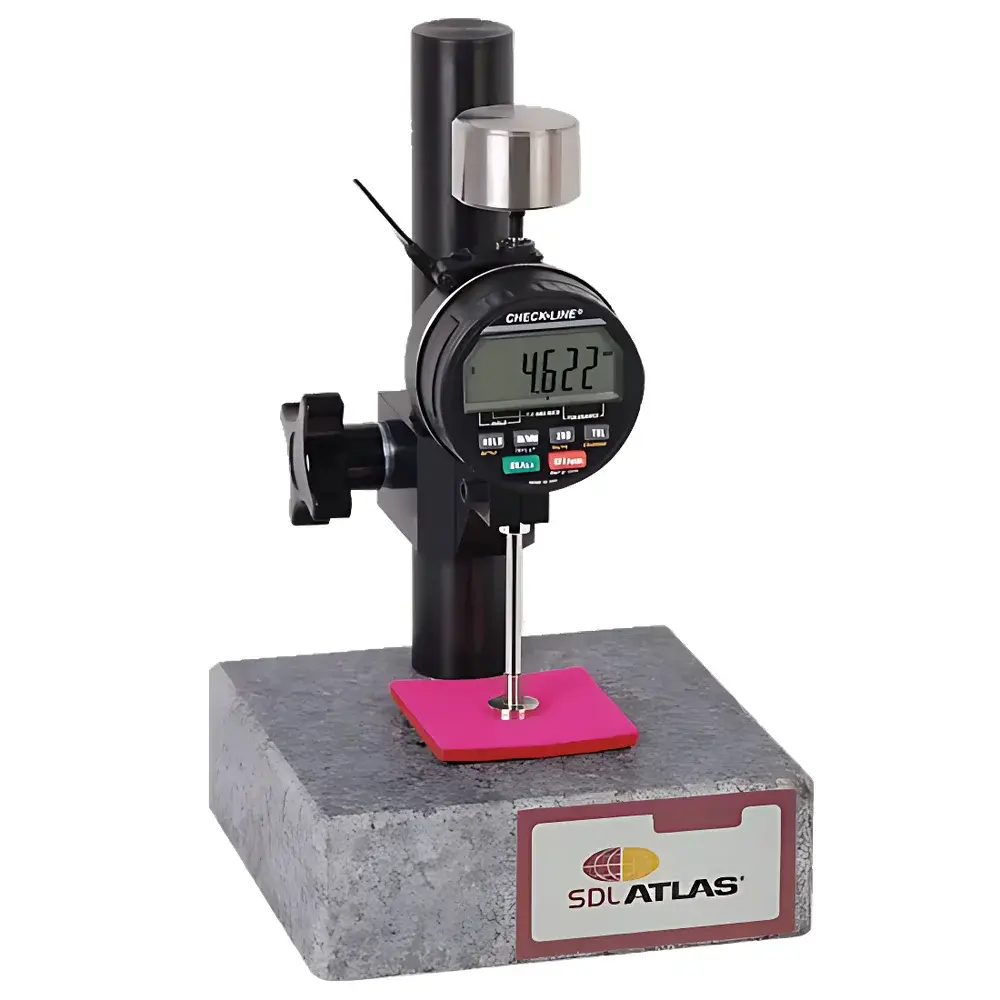
Feather Contact Digital Thickness Gauge M034E by SDL Atlas
| Brand | SDL Atlas |
|---|---|
| Origin | USA |
| Manufacturer Type | Manufacturer |
| Origin Category | Imported |
| Model | M034E |
| Price Range | USD 6,800 – 13,600 |
| Standard Compliance | ASTM D1777-2, ASTM D751-06, ISO 5084, ISO 9863-1, ISO 964-1 (2 kPa), ASTM D1621, D5199, D461, D3652 |
| Foot Diameter | 9.5 mm |
| Applied Load | 143 g (≈1.4 kPa) |
| Base Material | Laboratory-grade granite |
| Base Dimensions | 150 × 160 × 50 mm |
| Column Height | 200 mm |
| Indicator | Certified digital display with SPC output (RS-232), dual-language (English/metric), auto-power-off, left-hand lift handle |
Overview
The Feather Contact Digital Thickness Gauge M034E, engineered and manufactured by SDL Atlas in the United States, is a precision metrology instrument designed specifically for the objective, repeatable measurement of thickness in flexible sheet materials—primarily textiles, nonwovens, technical fabrics, coated substrates, foams, papers, and thin polymer films. It operates on the principle of controlled mechanical compression: a standardized circular foot applies a defined normal force to the specimen surface while resting on a rigid, optically flat granite reference plane; the vertical displacement between the foot and base is measured via a traceable digital indicator with micron-level resolution. This methodology conforms strictly to the fundamental requirements of contact-based thickness determination outlined in ASTM D1777 (Standard Test Method for Thickness of Textile Materials), ISO 5084 (Determination of thickness of textile fabrics and products), and related international standards governing compressive deformation under low-load conditions. The instrument’s architecture—granite base, vertically adjustable column, and calibrated load train—ensures minimal thermal drift, negligible deflection, and high reproducibility across daily use in QC laboratories and R&D environments.
Key Features
- Lab-grade black granite base (150 × 160 × 50 mm) providing exceptional dimensional stability, surface flatness (<0.002 mm), and vibration damping for metrological integrity.
- Vertically adjustable 200 mm stainless steel column with fine-threaded elevation mechanism, enabling precise positioning of the digital indicator over specimens up to 200 mm in height.
- Standard test configuration: 9.5 mm diameter anodized aluminum foot with 143 g deadweight—delivering a nominal pressure of ~1.4 kPa, fully compliant with ASTM D1777-2 and ASTM D751-06 test protocols.
- Certified digital indicator featuring NIST-traceable calibration, three SPC data output formats (ASCII, binary, and tab-delimited), dual-language interface (English/metric units), and automatic power-down after 5 minutes of inactivity.
- Ergonomic left-hand lift handle integrated into the indicator housing for one-handed repositioning without compromising alignment or zero stability.
- Modular foot and weight system supporting optional diameters (e.g., 25 mm, 50 mm) and corresponding calibrated loads (2 kPa, 10 kPa, 100 kPa) per ISO 964-1, ISO 9863-1, and ASTM D1621 specifications.
Sample Compatibility & Compliance
The M034E accommodates a broad spectrum of compliant and semi-compliant planar materials including woven and knitted fabrics, spunbond/meltblown nonwovens, laminated composites, geotextiles, filtration media, medical barrier fabrics, and elastomeric sheets. Its low-load design prevents permanent deformation in delicate structures such as lightweight synthetics or hydroentangled webs. All standard configurations meet the mechanical and procedural requirements of ASTM D1777-2 (thickness of textile materials), ASTM D751-06 (coated fabrics), ISO 5084 (textile thickness), ISO 9863-1 (nonwovens), and ISO 964-1 (foams at 2 kPa). Optional accessories extend compliance to ASTM D1621 (rigid cellular plastics), ASTM D5199 (polyethylene film), and ASTM D3652 (geotextiles). The granite base and indicator assembly are supplied with a full calibration certificate traceable to NIST and UKAS-accredited laboratories.
Software & Data Management
An optional Windows-based software suite enables real-time data acquisition, statistical process control (SPC) charting, batch reporting, and audit-ready export. The system supports RS-232 serial communication and records timestamped measurements—including operator ID, sample ID, test standard selected, foot size, applied load, and environmental notes. All data files are stored in CSV and PDF formats compatible with LIMS integration and 21 CFR Part 11–compliant electronic record systems. Audit trails log user actions, calibration events, and parameter modifications—supporting GLP and GMP documentation requirements in regulated textile testing facilities.
Applications
- Quality control of fabric thickness uniformity across loom batches and dye lots.
- Validation of calendering, compaction, and lamination processes in technical textile manufacturing.
- Thickness profiling of multi-layer composites used in automotive interiors and protective apparel.
- Comparative analysis of compressibility behavior between natural, synthetic, and biodegradable fibers.
- Pre-test conditioning verification per ASTM D1776 prior to tensile, abrasion, or air permeability evaluation.
- Research-grade thickness mapping for smart textiles incorporating conductive yarns or phase-change materials.
FAQ
What standards does the M034E support out-of-the-box?
ASTM D1777-2 and ASTM D751-06 using the standard 9.5 mm foot and 143 g weight; full compliance with ISO 5084, ISO 9863-1, and ISO 964-1 (2 kPa) is achievable with appropriate foot/weight selection.
Can the instrument be calibrated in-house?
Yes—the digital indicator accepts certified gauge blocks and is field-calibratable using NIST-traceable references; annual third-party certification is recommended for ISO/IEC 17025 accreditation.
Is the granite base sealed against moisture absorption?
Yes—laboratory-grade black granite is impregnated with a non-reactive silane sealer to prevent water ingress and maintain long-term flatness in humid environments.
Does the software support automated pass/fail decision logic?
Yes—the Windows application allows user-defined tolerance bands and generates immediate visual alerts and summary reports based on ASTM or internal specification limits.
What is the typical measurement repeatability for textile samples?
Under controlled lab conditions (23°C ±1°C, 50% RH ±5%), repeatability is ≤ ±1.5 µm for homogeneous cotton poplin and ≤ ±3.0 µm for heterogeneous nonwovens (n = 10, same operator, same location).
Related Products






