
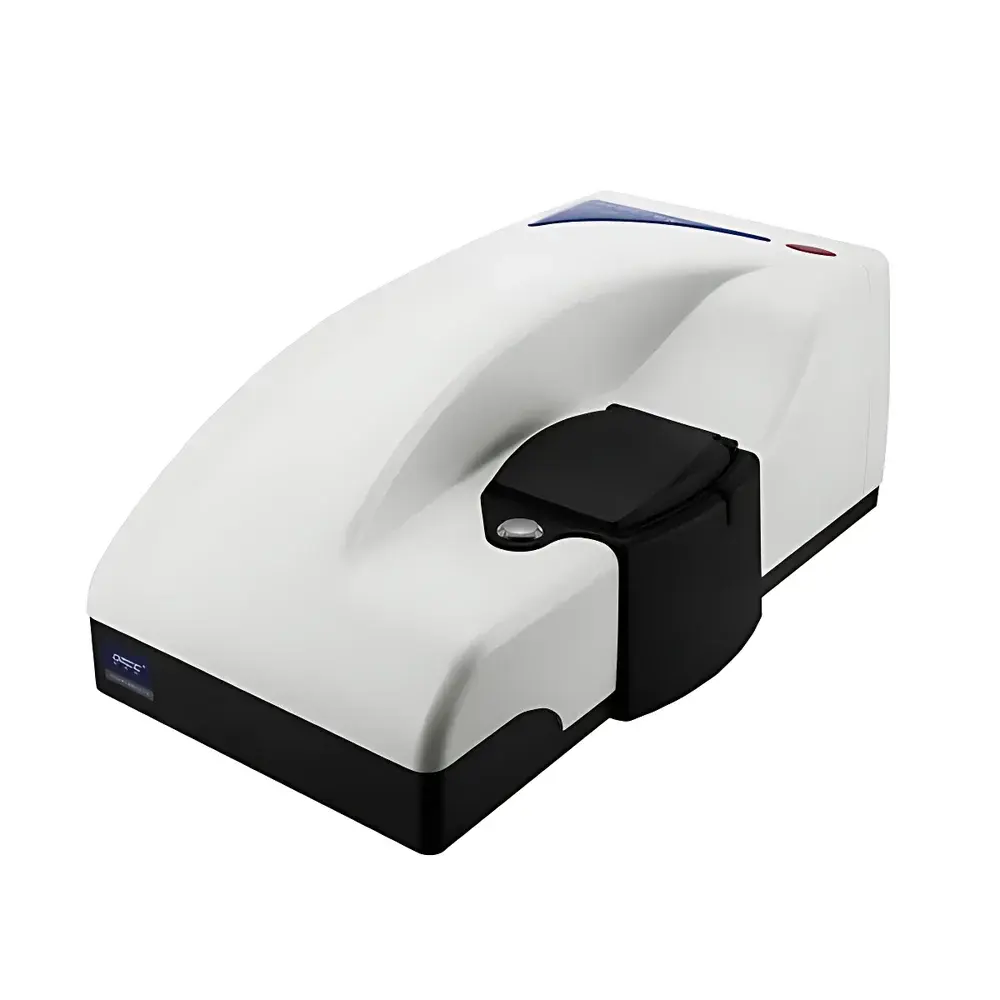
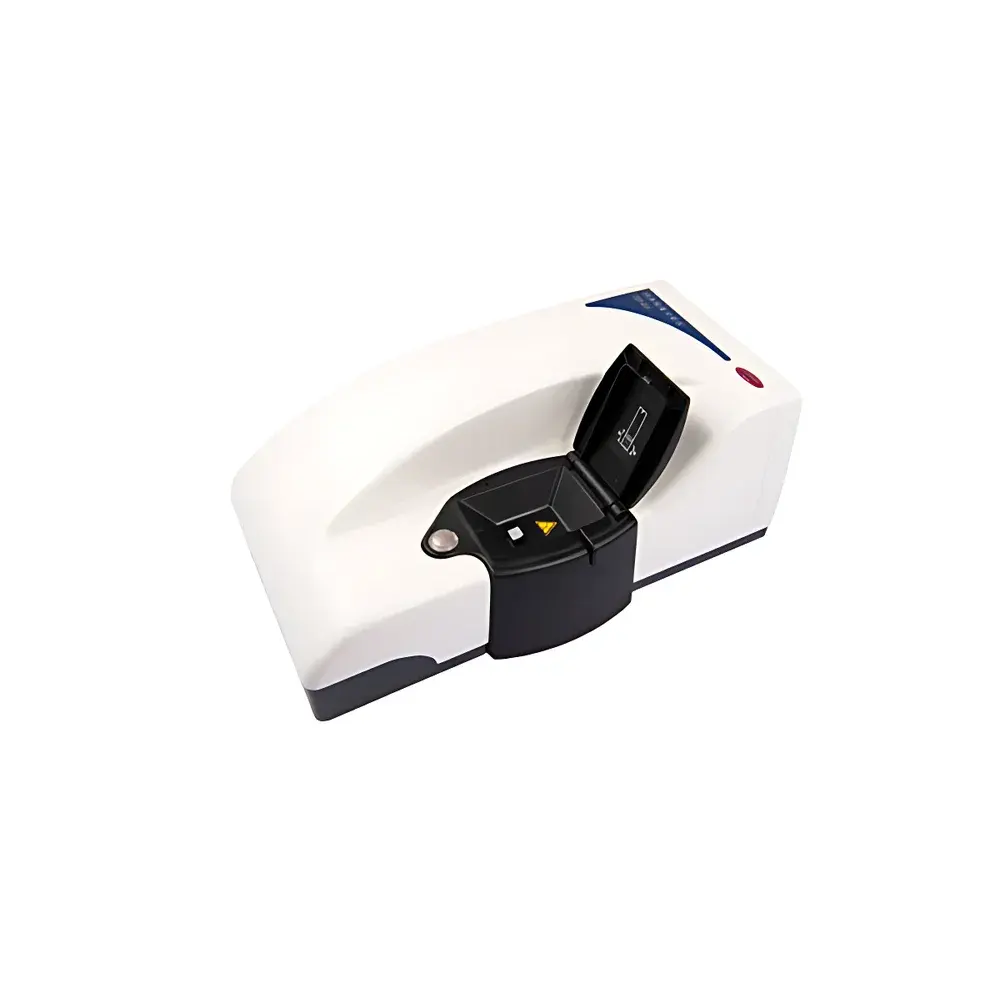
OMEC NS-90 Nanoparticle Size and Molecular Weight Analyzer
| Brand | OMEC |
|---|---|
| Origin | Guangdong, China |
| Manufacturer Type | Direct Manufacturer |
| Product Category | Domestic |
| Model | OMEC NS-90 |
| Price | Upon Request |
| Particle Size Range | 0.3 – 5000 nm |
| Size Measurement Repeatability | ≤ ±1% (NIST-traceable latex standards) |
| Temperature Control Range | 0°C – 90°C (optional 120°C thermostatic cell) |
| Temperature Stability | ±0.1°C |
| Correlator Sampling Time | 25 ns – 8000 s |
| Number of Autocorrelation Channels | >4000 |
| Primary Measurement Principle | Dynamic Light Scattering (DLS) at 90° detection angle |
| Secondary Measurement Principle | Static Light Scattering (SLS) |
| Sample Volume Requirement | 0.3–5000 nm (size range) |
| Zeta Potential Capability | Not integrated (ALL = N/A) |
| Typical Measurement Duration | ~10 minutes per run |
| Molecular Weight Range | <1000 Da – 2×10⁷ Da |
Overview
The OMEC NS-90 Nanoparticle Size and Molecular Weight Analyzer is a dual-mode light scattering instrument engineered for precision characterization of colloidal dispersions, proteins, synthetic polymers, and nanomaterials in liquid suspension. It implements two complementary optical techniques: 90° angle Dynamic Light Scattering (DLS), also known as Photon Correlation Spectroscopy (PCS), for hydrodynamic diameter determination; and Static Light Scattering (SLS) for absolute molecular weight quantification without calibration standards. The system operates on the fundamental physical principles of Brownian motion and Rayleigh-Gans-Debye scattering theory. In DLS mode, temporal fluctuations in scattered light intensity—induced by particle diffusion—are captured by a high-sensitivity Avalanche Photodiode (APD) detector and processed via a high-speed digital correlator with >4000 channels and 25 ns minimum sampling resolution. The resulting autocorrelation function is fitted using the Stokes-Einstein equation to derive particle size distribution (PSD) with a lower detection limit of 0.3 nm. In SLS mode, angular- and concentration-dependent time-averaged scattering intensities are measured to construct Debye plots, enabling calculation of weight-average molecular weight (Mw) and second virial coefficient (A2). This dual-capability architecture supports rigorous physicochemical analysis under GLP-compliant workflows.
Key Features
- Integrated dual-technique platform: Simultaneous DLS and SLS measurement in a single instrument, eliminating inter-system variability and reducing cross-laboratory calibration drift.
- High-sensitivity APD detection: Delivers superior signal-to-noise ratio compared to conventional PMT-based systems—critical for low-concentration or weakly scattering samples such as monoclonal antibodies or low-Da peptides.
- Stable He-Ne laser source (633 nm, 4 mW) with optional 532 nm solid-state laser (50 mW) for enhanced compatibility with UV-absorbing or highly absorbing colloids.
- Hermetically sealed optical path with active thermal management: Minimizes dust ingress, thermal lensing, and refractive index drift—ensuring long-term baseline stability and reproducibility.
- Precision temperature control: Independent recirculating thermostat with ±0.1°C accuracy across 0–90°C (optional upgrade to 120°C), enabling kinetic studies, aggregation onset detection, and thermodynamic stability profiling.
- Full-range Mie theory-based data inversion algorithm: Accommodates both spherical and non-spherical particles, with adjustable complex refractive index inputs for accurate polydispersity assessment.
Sample Compatibility & Compliance
The NS-90 accommodates aqueous and organic solvent-based dispersions—including water, ethanol, THF, DMF, and chloroform—with minimal sample preparation. Compatible sample types include protein solutions (e.g., IgG, BSA), polymer melts in solution (e.g., PEG, PLGA), lipid nanoparticles, silica and metal colloids, pigment dispersions, and pharmaceutical emulsions. The system supports compliance with ISO 22412:2017 (DLS), ISO 13321:2020 (SLS), USP , and ICH Q5E guidelines for biopharmaceutical comparability studies. All measurements adhere to ASTM E2490-22 for nanoparticle size distribution reporting. Audit trails, electronic signatures, and SOP-enforced parameter locking align with FDA 21 CFR Part 11 requirements when deployed in regulated environments.
Software & Data Management
The proprietary OMEC LightScatter™ software provides a validated, intuitive interface compliant with modern laboratory informatics infrastructure. Key capabilities include: automated SOP execution with pre-defined measurement protocols; real-time quality assessment scoring based on correlation curve linearity, baseline flatness, and polydispersity index (PDI) thresholds; customizable report generation with embedded Debye plot visualization, size distribution histograms, and trend overlays (temperature, time, concentration). Raw correlator data, metadata (instrument configuration, environmental logs), and processed results are stored in vendor-neutral HDF5 format, ensuring interoperability with LIMS and ELN platforms. Software supports full traceability—including operator ID, timestamped calibration events, and version-controlled algorithm updates—for GMP/GLP audit readiness.
Applications
- Biopharmaceutical development: Monitoring aggregation kinetics of monoclonal antibodies under stress conditions; assessing batch-to-batch consistency of liposomal drug carriers; validating excipient compatibility in formulation screening.
- Materials science: Quantifying nucleation/growth dynamics in sol-gel synthesis; evaluating surface functionalization efficiency on quantum dots and metallic nanoparticles; characterizing micelle formation CMC values.
- Food & cosmetics R&D: Stability assessment of oil-in-water emulsions (e.g., mayonnaise, sunscreen lotions); particle size evolution during thermal processing or pH titration.
- Academic research: Fundamental studies of protein folding/unfolding transitions; investigation of polymer conformational behavior in selective solvents; validation of theoretical models for soft matter physics.
- Quality control: Release testing of nanosuspensions per pharmacopeial monographs; incoming raw material verification for pigment and catalyst manufacturers.
FAQ
Does the NS-90 support zeta potential measurement?
No. The NS-90 is dedicated to size and molecular weight characterization via light scattering. Zeta potential requires electrophoretic light scattering (ELS), which is not implemented in this model.
Can the instrument measure samples with high absorbance or turbidity?
Yes—via optional 532 nm laser configuration and automatic neutral density filter adjustment across a 300,000:1 dynamic range, enabling robust measurement of carbon black dispersions, iron oxide nanoparticles, and dye-loaded micelles.
Is method transfer possible from Malvern Zetasizer systems?
Yes. The 90° detection geometry, He-Ne laser wavelength, and core DLS algorithms are aligned with industry-standard Malvern platforms, facilitating straightforward protocol migration and data comparability.
What validation documentation is provided?
Each unit ships with factory calibration certificates traceable to NIST SRM 1960 and SRM 890b latex standards, IQ/OQ documentation templates, and software validation packages supporting 21 CFR Part 11 compliance.
How is data integrity ensured during long-term operation?
The system logs all hardware events (laser power drift, temperature deviation, correlator saturation) alongside measurement data. Software enforces immutable audit trails with role-based access control and encrypted database storage.



