
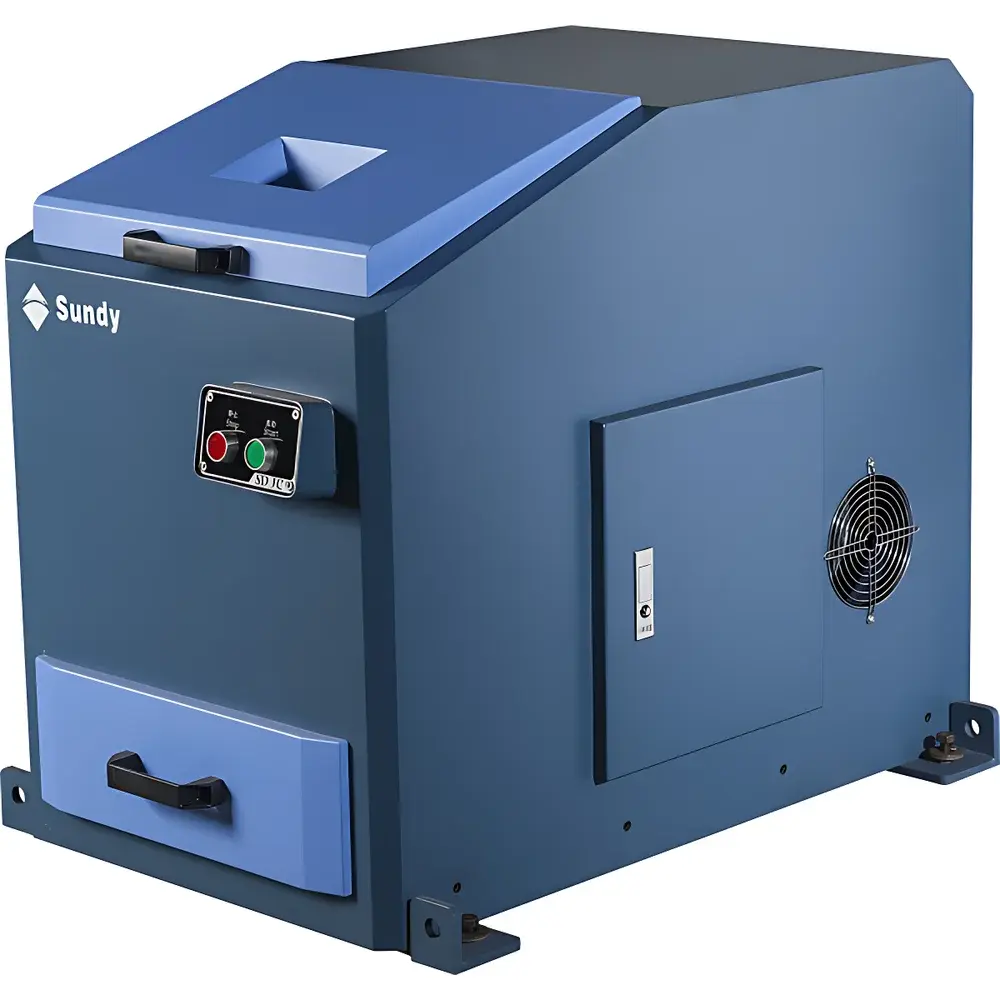
Sundy SDJC Jaw Crusher
| Brand | Sundy |
|---|---|
| Model | SDJC |
| Origin | Hunan, China |
| Jaw Crusher Type | Laboratory Benchtop Primary Crusher |
| Compliance | GB/T 474–2008 “Methods for Preparation of Coal Samples” |
| Input Size | ≤50 mm (SDJC100×60a) / ≤100 mm (SDJC150×125a) |
| Output Size | Adjustable 6–13 mm (SDJC100×60a) / 6–38 mm (SDJC150×125a) |
| Max. Moisture Content (as-received) | ≤12% |
| Eccentric Shaft Speed | 466 rpm |
| Throughput | 45–550 kg/h (SDJC100×60a) / 500–1000 kg/h (SDJC150×125a) |
| Power Rating | 1.5 kW (SDJC100×60a) / 4 kW (SDJC150×125a) |
| Voltage | AC 380 V ±10%, 50 Hz ±1 Hz |
| Dimensions (L×W×H) | 940×640×730 mm (SDJC100×60a) / 1245×700×1010 mm (SDJC150×125a) |
| Weight | 200 kg (SDJC100×60a) / 420 kg (SDJC150×125a) |
| Dust Extraction Port | Standard 100 mm flanged interface |
Overview
The Sundy SDJC Jaw Crusher is a precision-engineered primary crushing system designed specifically for laboratory-scale sample preparation in coal, mineral, and industrial raw material analysis. Operating on the principle of compressive crushing between two hardened jaw plates—one fixed and one reciprocating—the SDJC series delivers consistent, reproducible particle size reduction under controlled mechanical loading. Its design adheres strictly to GB/T 474–2008, the national standard governing coal sample preparation in China, ensuring compliance with statutory requirements for homogeneity, mass retention, and representative sub-sampling downstream. Unlike general-purpose industrial crushers, the SDJC integrates metrological traceability into its mechanical architecture: real-time jaw gap adjustment—while the unit is operational—enables direct correlation between mechanical setting and output particle size distribution, eliminating reliance on post-crushing sieve validation for routine calibration.
Key Features
- Dynamic jaw gap adjustment mechanism with calibrated scale indicator, enabling continuous in-process optimization of discharge particle size without halting operation or disassembly.
- Interchangeable jaw plates fabricated from high-chromium cast steel or manganese steel (HB ≥500), providing exceptional wear resistance, minimal plastic deformation under cyclic load, and extended service life across abrasive feedstocks including bituminous coal, lignite, shale, and low-grade iron ore.
- Self-leveling heavy-duty base frame with vibration-damping rubber mounts; requires no anchoring or reinforced concrete foundation—only a level, load-bearing floor surface (≥5 kN/m²) is necessary for stable operation.
- Integrated 100 mm diameter dust extraction port (ISO 5167-compliant flange), compatible with centralized lab ventilation systems or portable industrial vacuum units meeting ATEX Zone 20/21 requirements for combustible dust environments.
- Dual safety interlocks: main chamber door sensor disables drive motor when open; overload thermal protection circuit interrupts power supply if eccentric shaft torque exceeds rated threshold for >3 s.
Sample Compatibility & Compliance
The SDJC Jaw Crusher accommodates heterogeneous feed materials with maximum particle dimensions up to 100 mm and total moisture content ≤12% (as-received basis), covering the full scope of coal rank classifications defined in ISO 11760 and ASTM D388. It is routinely deployed in accredited laboratories performing proximate analysis (ASTM D3172), ultimate analysis (ASTM D3176), calorific value determination (ASTM D5865), and ash fusion temperature testing (ASTM D1857). All structural welds conform to ISO 5817-B quality class; electrical components meet IEC 60204-1 for industrial machinery safety. Documentation includes factory calibration certificate (jaw gap vs. vernier reading), material test reports for jaw plate alloys, and conformity statement to GB/T 474–2008 Annex B (crushing efficiency verification protocol).
Software & Data Management
The SDJC operates as a standalone electromechanical instrument without embedded firmware or digital control interface. However, it supports GLP-compliant workflow integration via external logging: jaw gap settings, operating duration, feed mass, and ambient temperature/humidity can be recorded manually in laboratory notebooks or imported into LIMS platforms (e.g., LabWare LIMS, Thermo Fisher SampleManager) using standardized CSV templates. Optional third-party load cells (0.1% FS accuracy) and time-stamped video monitoring (25 fps, H.264 encoding) are available for audit-ready process documentation aligned with ISO/IEC 17025:2017 clause 7.7 (measurement uncertainty evaluation).
Applications
- Routine coal sample reduction prior to pulverization in ring-and-puck mills (e.g., for ASTM D3174 ash analysis).
- Preparation of geological core samples for XRF fusion bead preparation (ISO 12846) and ICP-MS digestion.
- Size reduction of cement clinker, limestone, and blast furnace slag in construction materials QA/QC labs.
- Primary comminution step in multi-stage sample division protocols per ISO 13909-3 for bulk solids heterogeneity assessment.
- Crushing of biomass pellets and waste-derived fuels (RDF/SRF) in renewable energy research facilities.
FAQ
Is the SDJC Jaw Crusher suitable for wet or sticky feed materials?
No. Feed moisture must not exceed 12% (as-received) to prevent material adhesion to jaw surfaces and clogging of the discharge zone. Pre-drying at <40 °C is recommended for high-moisture coals.
Can jaw plate wear be quantified during operation?
Yes. Each jaw plate is engraved with a reference groove pattern. Wear depth is measured periodically using a depth micrometer (±1 µm resolution); replacement is advised when groove erosion exceeds 2.5 mm.
What maintenance intervals are recommended for the eccentric shaft bearing assembly?
Grease replenishment every 500 operating hours using NLGI #2 lithium complex grease (ISO-L-XBCGB 2); full bearing inspection and replacement every 5,000 hours or upon vibration amplitude exceeding 4.5 mm/s RMS (per ISO 10816-3).
Does the SDJC comply with FDA 21 CFR Part 11 requirements?
As a non-computerized, non-data-generating device, the SDJC falls outside the regulatory scope of 21 CFR Part 11. However, its mechanical traceability supports ALCOA+ principles when integrated into validated sample prep SOPs.
Are CE or UL certifications available for export models?
CE marking is available upon request for EU-bound units, subject to additional EMC testing (EN 61000-6-4) and Low Voltage Directive assessment (2014/35/EU). UL 508A listing requires custom enclosure redesign and is offered as an engineering option.



