
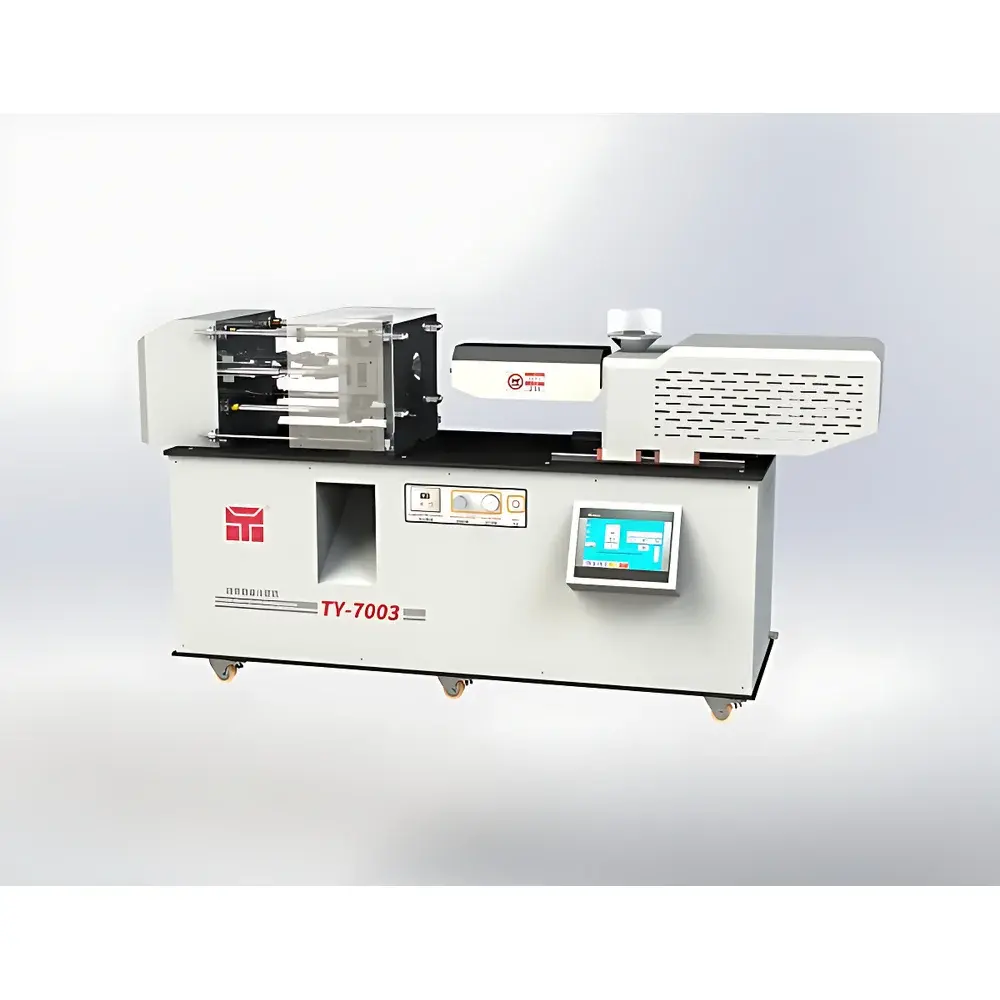
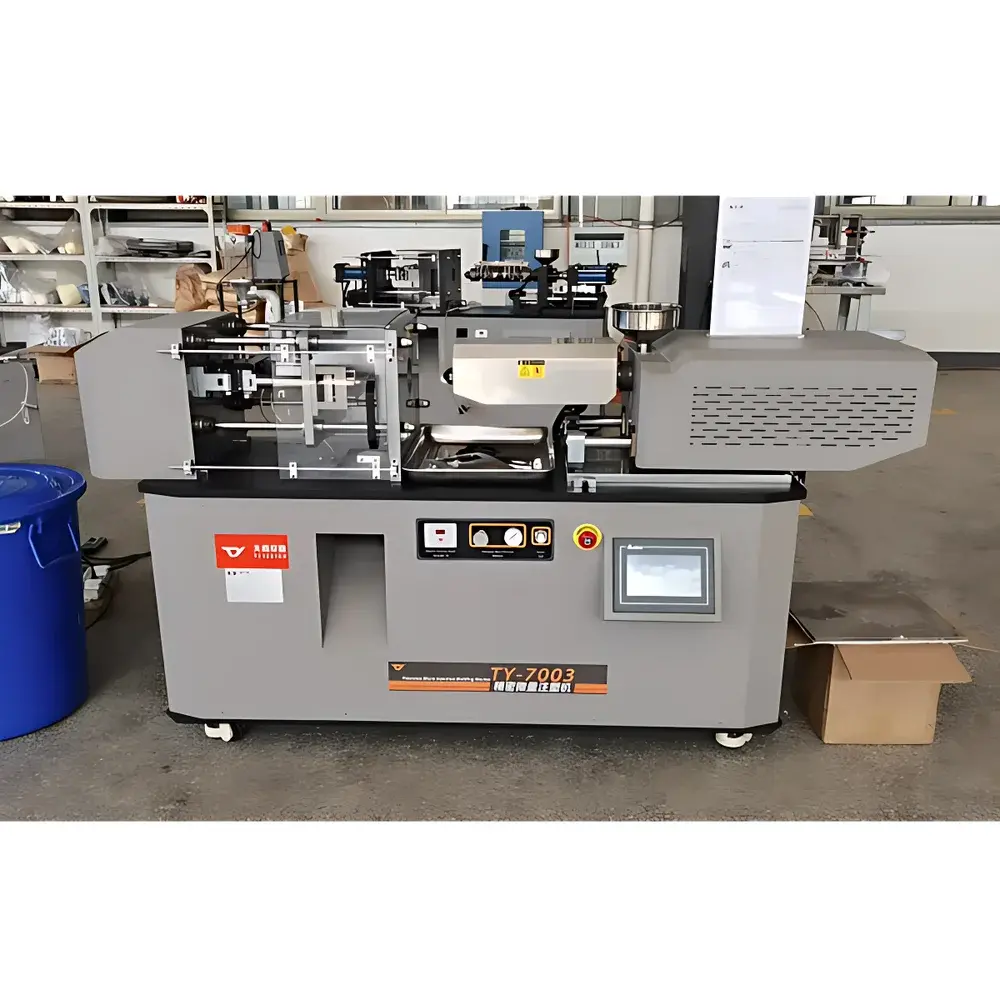
TianYuan TY-7003 Compact Screw-Type Injection Molding Machine for Material Testing and R&D
| Brand | TianYuan |
|---|---|
| Origin | Jiangsu, China |
| Manufacturer Type | Direct Manufacturer |
| Region Category | Domestic (China) |
| Model | TY-7003 |
| Price Range | USD 7,000 – 14,000 (FOB) |
| Screw Diameter | 20 mm |
| Overall Dimensions | 1700 × 500 × 950 mm |
| L/D Ratio | 20:1 |
| Clamping Force | 5 metric tons |
| Maximum Shot Volume | 25 cm³ |
| Injection Stroke Range | 0–80 mm |
| Injection Resolution | 0.1 mm |
| Plasticizing Speed | 0.1–60 rpm |
| Torque | 105 N·m (servo motor + planetary gearbox) |
| Mold Opening Stroke | ~70 mm (excluding mold) |
| Injection Force | ~1.8 t (up to 3.6 t with force-multiplying system) |
| Zone Temperature Range | Up to 360 °C (3-zone heating) |
| Temperature Control Accuracy | ±0.5 °C (steady-state) |
| Power Supply | Single-phase AC 220 V ±10%, 50 Hz, 2200 W, 10 A |
| Air Pressure Requirement | ≥0.8 MPa |
| Mold Cavity Dimensions (standard) | 360 × 90 × 72 mm (L×W×H) |
| Tie-Bar Spacing | 280 × 186 mm (center-to-center) |
| Fixed Platen Ring OD | 50 mm |
| Net/Gross Weight | 380 / 420 kg |
| Core Components | Delta PLC (Taiwan), Omron SSR (Japan), Sonko Planetary Gearbox (Taiwan) |
| Compatible Materials | PP, PE, PA, PVC, ABS, TPU, PLA, and other engineering thermoplastics |
Overview
The TianYuan TY-7003 is a compact, benchtop-scale screw-type injection molding machine engineered specifically for laboratory-scale material evaluation, academic instruction, and pre-production prototyping in polymer science and plastics engineering. Unlike full-scale industrial machines, the TY-7003 integrates precision process control within a footprint suitable for university labs, QC testing rooms, and R&D centers with limited floor space. Its core architecture follows classical reciprocating-screw injection principles—melting polymer granules via shear and conductive heating in a 20 mm diameter barrel (L/D = 20:1), followed by controlled forward displacement of molten material into a cavity under programmable pressure and velocity profiles. The system operates on standard single-phase 220 V AC power, eliminating dependency on three-phase industrial supply—a critical advantage for educational institutions and small laboratories. All thermal zones (three independent heating bands) maintain ±0.5 °C stability during dwell, enabling reproducible melt conditioning essential for comparative rheological and mechanical property studies.
Key Features
- Compact footprint (1700 × 500 × 950 mm) with casters for repositioning—designed for integration into shared lab environments.
- Hybrid actuation architecture: servo-driven plasticization combined with pneumatic clamping and injection—oil-free, low-maintenance, and compliant with ISO 8573-1 Class 1 air purity requirements when paired with appropriate filtration.
- Delta PLC-based control system with color touchscreen HMI; supports one-touch cycle initiation, parameter recall, and real-time monitoring of temperature, pressure, position, and torque.
- Dual safety architecture: mechanical limit switches on mold movement paths plus electronic interlocks tied to door position, hydraulic/pneumatic pressure thresholds, and overtemperature cutouts.
- Modular mold interface supporting rapid manual changeover (<3 seconds for standard templates) or semi-automated tooling for high-throughput sample batches.
- Integrated planetary gear reducer (Sonko, Taiwan) delivering 105 N·m peak torque at low-speed plasticization—optimized for consistent melt homogeneity across low-viscosity and high-melt-strength resins.
Sample Compatibility & Compliance
The TY-7003 accommodates a broad spectrum of thermoplastic polymers—including polypropylene (PP), polyethylene (PE), polyamide (PA6/66), polyvinyl chloride (PVC), acrylonitrile butadiene styrene (ABS), thermoplastic polyurethane (TPU), and polylactic acid (PLA)—enabling ASTM D638, ISO 527, ASTM D790, and ISO 178 specimen preparation under controlled thermal histories. Standard mold dimensions (360 × 90 × 72 mm) comply with common tensile bar, flexural bar, and impact test specimen geometries. Optional water-cooling add-ons permit extended cycle stability for heat-sensitive biopolymers. While not certified to UL 508A or CE Machinery Directive Annex I out-of-the-box, the machine’s electrical architecture (Omron solid-state relays, IP65-rated terminal enclosures) supports third-party conformity assessment for regional regulatory deployment. Documentation includes full electrical schematics, CE-compliant risk assessment summaries, and traceable component certifications per RoHS 2011/65/EU.
Software & Data Management
The embedded Delta DOP-107EV HMI provides local data logging of up to 10,000 cycles, storing timestamps, zone temperatures, injection speed profiles, clamp force curves, and plasticizing torque trends in CSV format via USB export. No proprietary software license is required. For integration into GLP/GMP environments, optional Ethernet/IP or Modbus TCP modules enable connection to centralized LIMS or MES platforms. Audit trail functionality—including user login logs, parameter modification history, and cycle start/stop records—meets FDA 21 CFR Part 11 requirements when deployed with validated Windows-based supervisory software (e.g., Ignition SCADA or Siemens Desigo CC). Raw process data exports are fully compatible with MATLAB, Python (pandas), and JMP for statistical process analysis and DOE correlation modeling.
Applications
- Academic instruction: Demonstrating injection molding fundamentals—melting kinetics, gate freeze-off behavior, weld line formation, and shrinkage anisotropy—in undergraduate polymer processing labs.
- Material qualification: Generating standardized test specimens for mechanical, thermal, and flammability testing per ASTM, ISO, and UL standards prior to pilot-line trials.
- Formulation screening: Evaluating dispersion quality of fillers (e.g., glass fiber, carbon black, nanocellulose) and additive compatibility (lubricants, flame retardants) through visual inspection and post-mold dimensional metrology.
- Process window mapping: Determining optimal melt temperature, injection speed, pack pressure, and cooling time combinations for new resin grades using Design of Experiments (DoE) methodology.
- Tooling validation: Verifying mold cavity fidelity, venting adequacy, and ejection reliability before committing to large-scale steel tool fabrication.
FAQ
Does the TY-7003 support multi-cavity or family molds?
Yes—standard mold mounting conforms to ISO 2041-1 platen interface specifications. Custom mold bases can be designed for up to four cavities depending on part geometry and total projected area (must remain ≤ 250 cm² to stay within 5 t clamping capacity).
Can the machine process high-temperature engineering resins such as PEEK or PEI?
With upgraded barrel liners and thermocouples rated to 400 °C, the system supports short-run processing of semi-crystalline high-temp polymers. Standard configuration limits continuous operation to 360 °C; sustained exposure above this requires optional ceramic insulation and PID tuning.
Is remote monitoring or predictive maintenance supported?
Basic remote status polling is available via Modbus TCP. Full predictive diagnostics (e.g., screw wear estimation, heater degradation trending) require integration with third-party IIoT edge gateways and cloud analytics platforms—not included in base configuration.
What documentation is provided for IQ/OQ validation?
Factory acceptance test (FAT) reports, calibration certificates for all RTDs and pressure transducers, electrical safety test records, and a URS-aligned validation protocol template are supplied. Site-specific OQ execution remains customer-responsible per ISO 13485 or GMP Annex 15 guidelines.
Are spare parts and technical support available internationally?
TianYuan maintains authorized service partners in Germany, USA, and Singapore. Critical spares—including screw/barrel assemblies, HMI modules, and SSRs—are stocked regionally with typical lead times under 14 days. Firmware updates and troubleshooting guides are accessible via secure customer portal.




