
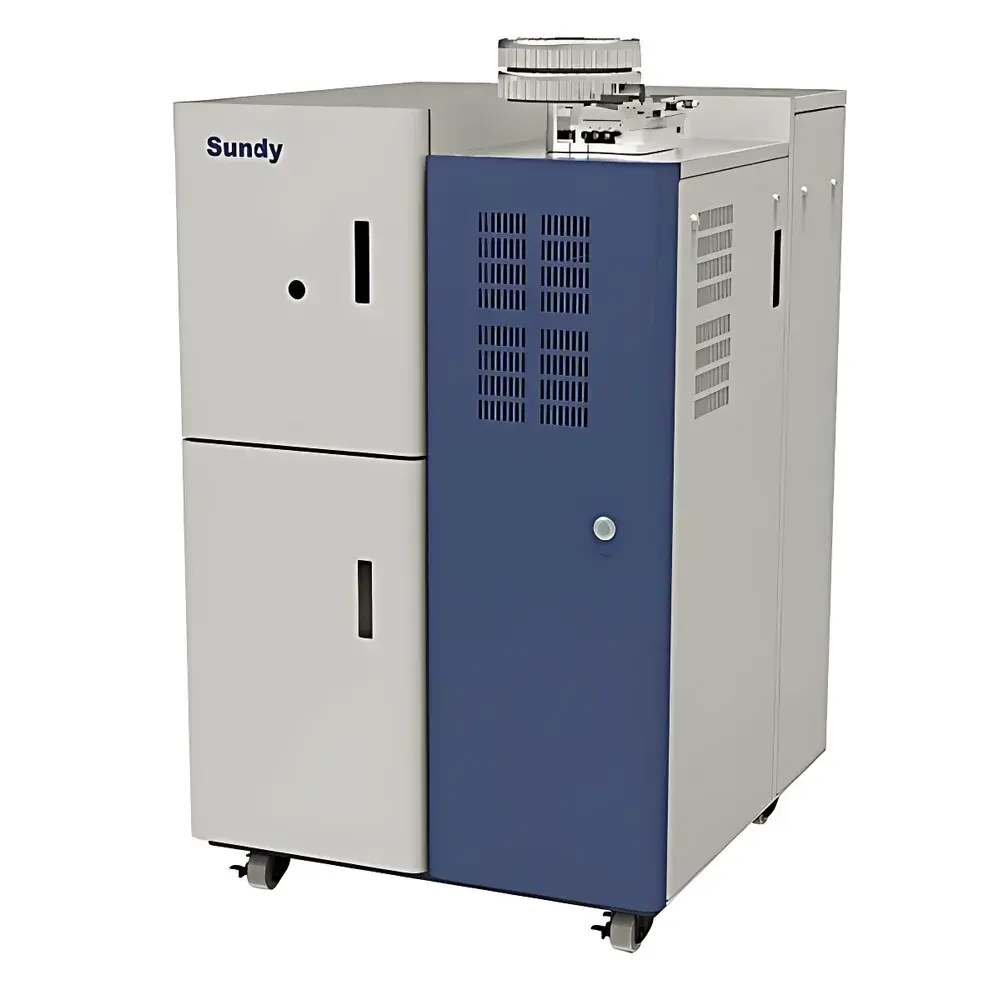
Sundhy SDCHN636 Carbon-Hydrogen-Nitrogen Elemental Analyzer
| Brand | Sundhy |
|---|---|
| Model | SDCHN636 |
| Origin | Hunan, China |
| Measurement Principle | Infrared Absorption (for C/H) & Thermal Conductivity Detection (for N) |
| Sample Capacity | 36 positions (single tray) / 72 positions (dual tray) |
| Carbon Range | 0.005–100 wt% |
| Hydrogen Range | 0.01–50 wt% |
| Nitrogen Range | 0.01–50 wt% |
| Sample Mass | 75–105 mg (recommended: 100 mg) |
| Repeatability | Compliant with GB/T 30733-2014 and ASTM D5373-08 |
| Analysis Time per Sample | 6–8 min |
| Power Consumption | ≤4.5 kW |
| Supply Voltage | AC 220 V ±10%, 50 Hz ±1 Hz |
| Gas Requirements | O₂ (≥99.99%, ≥1 MPa) |
| Dimensions (L×W×H) | 710 × 660 × 1045 mm |
| Weight | ~140 kg |
Overview
The Sundhy SDCHN636 Carbon-Hydrogen-Nitrogen Elemental Analyzer is a fully automated, high-throughput combustion-based elemental analyzer engineered for precise quantification of carbon, hydrogen, and nitrogen in solid and liquid samples—including coal, coke, biomass, petrochemical feedstocks, urea solutions (AUS 32), cement raw materials, geological specimens, and hazardous waste matrices. It operates on the principle of high-temperature catalytic combustion followed by selective detection: carbon and hydrogen are determined via dual-channel non-dispersive infrared (NDIR) absorption spectroscopy, while nitrogen is quantified using a high-stability, low-drift thermal conductivity detector (TCD) with independent temperature-controlled measurement cells. The instrument complies with internationally recognized standard methods including GB/T 30733-2014, ASTM D5373-08, and GB 29518-2013, ensuring data integrity for regulatory reporting, quality control, and research applications across coal-fired power generation, metallurgy, cement manufacturing, environmental monitoring, and R&D laboratories.
Key Features
- High-capacity dual-tray autosampler supporting up to 72 samples per unattended run—with dynamic sample loading capability during analysis, enabling continuous throughput without interruption.
- Integrated gas-wall protected sample introduction system that isolates ambient air ingress during drop-in sampling, combined with laminar flow distribution to ensure complete and reproducible combustion—minimizing splattering and oxidation variability.
- Dual NDIR modules with real-time combustion endpoint recognition, significantly reducing analysis time and improving precision for carbon and hydrogen measurements.
- Diffusion-type TCD optimized for nitrogen detection, featuring ultra-low thermal drift and active thermal stabilization to maintain baseline stability over extended operation cycles.
- Modular, low-dead-volume gas manifold with integrated mass flow control—reducing residual moisture carryover and enhancing long-term repeatability of gas-phase detection.
- Ergonomic vertical architecture with industrial-grade casters and locking mechanisms; top-access crucible replacement and tool-free furnace disassembly simplify routine maintenance and reagent replenishment.
- Helium conservation strategy: full-flow helium (0.7 L/min) activated only during sample injection and combustion phases; standby flow reduced to 0.05 L/min—lowering operational cost without compromising detection sensitivity or baseline fidelity.
Sample Compatibility & Compliance
The SDCHN636 accommodates a broad spectrum of sample types, including pulverized coal, char, fly ash, petroleum coke, lignite, bituminous and anthracite coals, urea-water solutions (AUS 32), polymers, soils, sludges, and certified reference materials (CRMs). Its analytical performance meets the repeatability and accuracy requirements defined in GB/T 30733-2014 and ASTM D5373-08 for coal analysis, as well as the purity verification criteria specified in GB 29518-2013 for diesel exhaust fluid. The system supports GLP-compliant workflows through configurable audit trails, user access levels, and electronic signature-ready reporting—facilitating alignment with ISO/IEC 17025, USP , and FDA 21 CFR Part 11 requirements when integrated with validated LIMS or ELN platforms.
Software & Data Management
The embedded Windows-based control software provides intuitive method setup, real-time gas chromatogram visualization, automatic peak integration, and customizable calibration curve management (linear, quadratic, or multi-point). All raw detector signals, gas flow logs, temperature profiles, and error flags are timestamped and stored in a structured SQLite database. Export options include CSV, PDF, and XML formats compatible with laboratory information management systems (LIMS). Audit trail functionality records operator actions, parameter modifications, and calibration events with immutable timestamps—ensuring traceability for internal QA reviews or external regulatory inspections.
Applications
- Coal quality assessment in thermal power plants and coking facilities per ISO 19579 and ASTM D3176.
- Verification of AUS 32 urea concentration and impurity profiling in SCR aftertreatment systems.
- Elemental balance calculations in waste-to-energy and cement kiln co-processing operations.
- Research-grade CHN characterization of novel carbonaceous materials, biochars, and catalysts.
- Environmental compliance testing of solid recovered fuels (SRF), municipal solid waste (MSW), and industrial slags under EN 15403 and EPA Method 5E.
- QC/QA support for ISO 5725-2 validation studies and interlaboratory comparison programs.
FAQ
What sample forms are supported?
Solid powders (e.g., coal, coke, soil), pressed pellets, and homogeneous liquids (e.g., AUS 32, organic solvents) can be analyzed directly—no derivatization required.
Is helium the only acceptable carrier gas?
Yes; high-purity helium (≥99.999%) is mandatory for optimal TCD performance and NDIR signal-to-noise ratio. Nitrogen or argon are not suitable substitutes.
Can the instrument be integrated into an existing LIMS?
Yes—via configurable ODBC drivers and ASCII-based data export protocols. Custom API integration is available upon request for enterprise-scale deployment.
How often does the combustion catalyst require replacement?
Under typical coal analysis conditions (≤500 samples/month), the platinum-coated ceramic catalyst retains activity for ≥12 months; replacement intervals are tracked automatically within the software.
Does the system support multi-point calibration with CRMs?
Yes—calibration curves may be built using up to 12 certified reference materials, with automatic outlier rejection and uncertainty propagation per ISO/IEC Guide 98-3.






