
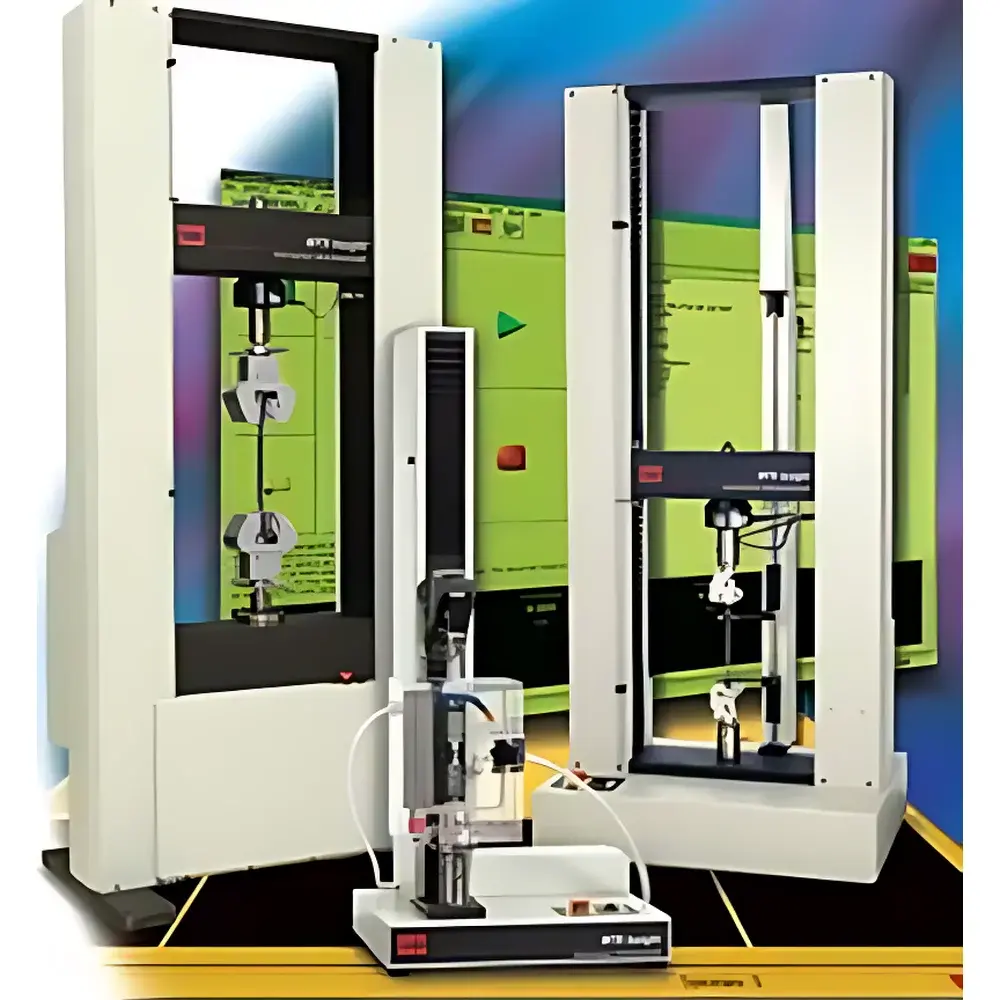
MTS Insight Series Electromechanical Universal Testing Machine
| Brand | MTS |
|---|---|
| Origin | USA |
| Model | Insight Series |
| Type | Electromechanical Universal Testing Machine |
| Load Capacity Options | 1–2 kN, 5–50 kN, 100–300 kN |
| Configurations | Standard, High-Stroke, High-Speed, Wide-Frame |
| Test Modes | Tensile, Compression, Flexure, Peel, Tear, Creep, Stress Relaxation, Cyclic Loading |
| Compliance Standards | ASTM E4, ASTM E8/E21, ASTM D638/D790/D3039, ISO 6892-1, ISO 178, ISO 1133, USP <1041>, FDA 21 CFR Part 11 (via software audit trail) |
Overview
The MTS Insight Series Electromechanical Universal Testing Machine is a precision-engineered static mechanical testing platform designed for high-fidelity force and displacement measurement across research, quality control, and regulatory compliance environments. Built upon a dual-column, servo-controlled electromechanical architecture, the system operates on closed-loop PID control with real-time load cell feedback and high-resolution encoder-based crosshead positioning. Its modular design supports standardized test methods defined by ASTM, ISO, and USP for mechanical property characterization—including Young’s modulus, yield strength, ultimate tensile strength, elongation at break, flexural modulus, peel adhesion energy, and time-dependent viscoelastic behavior (creep and stress relaxation). The Insight platform is purpose-built for laboratories requiring traceable, repeatable, and auditable mechanical test data under GLP, GMP, or ISO/IEC 17025 frameworks.
Key Features
- High-stiffness dual-column frame with preloaded ball screws and precision-ground linear guides for minimal deflection and axial alignment stability
- Load cells calibrated to ISO 376 Class 0.5 or better, with capacities spanning 1 N to 300 kN across scalable models
- Integrated digital controller supporting sampling rates up to 10 kHz and sub-micron displacement resolution (≤0.1 µm)
- Modular test space configuration—standard, high-stroke (up to 1,500 mm), wide-frame (for large composites or automotive components), and high-speed (≥2 m/s crosshead velocity)
- Thermally stable base and column design minimizing thermal drift during long-duration creep or relaxation tests
- Interchangeable grip systems including pneumatic, hydraulic, wedge, and custom fixtures—compatible with ASTM E8, ISO 6892-1, and ISO 178 specimen geometries
Sample Compatibility & Compliance
The Insight Series accommodates a broad spectrum of specimen types and material classes without hardware modification: ductile and brittle metals, thermoplastics and thermosets, fiber-reinforced composites, elastomers, hydrogels, woven textiles, paperboard, adhesives, foams, and biological tissues (e.g., tendons, vascular grafts, dental biomaterials). All standard test configurations comply with internationally recognized method standards—including ASTM D638 (tensile plastics), ASTM D790 (flexural properties), ASTM D3039 (composite tensile), ISO 6892-1 (metallic materials), ISO 178 (flexure), and ISO 1133 (melt flow index correlation). Optional environmental chambers (−70 °C to +300 °C) and extensometers (contact and non-contact) extend compliance to elevated-temperature tensile, low-temperature impact simulation, and strain-controlled fatigue protocols. System validation documentation meets IQ/OQ requirements per ASTM E74 and ISO/IEC 17025 Annex A.2.
Software & Data Management
TestWorks™ software provides a validated, role-based interface for test method definition, execution, real-time monitoring, and automated report generation. It supports multi-step test profiles (e.g., ramp-hold-ramp sequences for stress relaxation), dynamic parameter adjustment during active tests, and synchronized acquisition from auxiliary sensors (extensometers, environmental chambers, video extensometry). Audit trails record user actions, method changes, calibration events, and data exports in accordance with FDA 21 CFR Part 11 requirements—including electronic signatures, immutable logs, and password-protected access levels. Raw data is exported in ASCII (.txt), CSV, and universal .tdms formats; reports are generated in PDF/XLSX with embedded metadata (test ID, operator, timestamp, instrument ID, calibration due date). Software validation packages (IQ/OQ/PQ) and 21 CFR Part 11 configuration files are supplied with each system.
Applications
- Biomedical R&D: Mechanical characterization of scaffolds, suture materials, stents, orthopedic implants, and soft tissue analogs under physiological loading conditions
- Automotive & Aerospace: Validation of structural joints, composite laminates, seatbelt webbing, airbag fabrics, and high-temperature alloys per SAE J211, AMS 2750, and Boeing BMS specifications
- Consumer Goods QA: Batch release testing of packaging films (peel strength), smartphone casings (impact resistance), textile elasticity, and adhesive bond durability
- Academic Materials Science: Teaching and research labs performing fundamental structure–property relationships in polymers, nanocomposites, and shape-memory alloys
- Regulatory Submissions: Generation of GLP-compliant datasets for ISO 10993 biocompatibility assessments, FDA 510(k) submissions, and CE marking technical files
FAQ
What load capacity ranges does the Insight Series support?
The series spans three primary capacity tiers: low-force (1–2 kN), mid-range (5–50 kN), and high-load (100–300 kN), each configurable with optional high-stroke, high-speed, or wide-frame variants.
Is TestWorks software compliant with FDA 21 CFR Part 11?
Yes—when deployed with enabled audit trail, electronic signature, and role-based access controls, TestWorks meets all technical and procedural requirements for Part 11 compliance.
Can the system perform creep and stress relaxation tests?
Yes—closed-loop load or displacement control, combined with extended data logging (up to 30 days), enables full ISO 899-1/ISO 899-2 compliant creep and stress relaxation testing.
Are environmental chambers and extensometers available as accessories?
Yes—MTS-certified temperature chambers (−70 °C to +300 °C), video extensometers (0.5% strain accuracy), and clip-on axial/torsional extensometers are fully integrated and validated.
Does the system support ASTM and ISO standard test methods out-of-the-box?
Yes—preconfigured test methods for ASTM D638, D790, D3039, E8, and ISO 6892-1, 178, and 1133 are included; additional methods can be created using the built-in scripting engine.



