
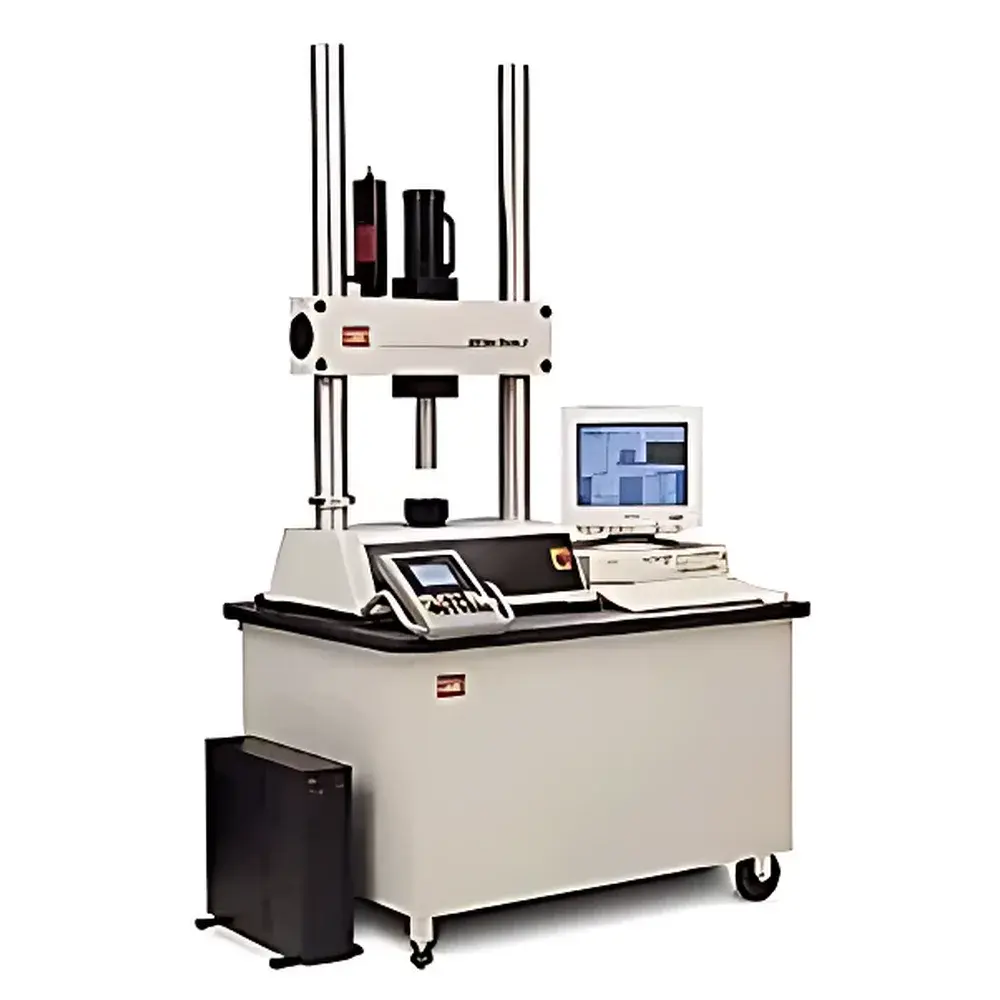
MTS 858 Desktop Electro-Hydraulic Servo Universal Testing Machine
| Origin | USA |
|---|---|
| Manufacturer Type | Authorized Distributor |
| Origin Category | Imported |
| Model | MTS 858 |
| Instrument Type | Electro-Hydraulic Servo Testing System |
| Load Capacity Options | Configurable (Standard Range: 5 kN to 100 kN) |
| Control Architecture | Closed-Loop Digital Servo Controller with High-Bandwidth Hydraulic Actuation |
| Axial-Torsional Capability | Optional Integrated Axial-Torsion Module |
| Calibration | Factory Laser-Aligned for Sub-0.1° Angular Misalignment Tolerance |
| Compliance | ASTM E4, ASTM E8/E8M, ASTM E21, ISO 6892-1, ISO 15630-1, EN 10002-1, USP <1041>, FDA 21 CFR Part 11 Ready (with optional audit trail & electronic signature package) |
Overview
The MTS 858 Desktop Electro-Hydraulic Servo Universal Testing Machine is a compact, high-fidelity materials testing platform engineered for precision static and dynamic mechanical characterization in constrained laboratory environments. Leveraging electro-hydraulic servo actuation, the system delivers high-force density within a minimal footprint—designed for benchtop integration without compromising structural rigidity or control fidelity. Its core measurement principle relies on closed-loop force, displacement, and strain feedback synchronized via digital hydraulic servo control, enabling compliant testing per ASTM E4 (standard practices for force verification), ASTM E8/E8M (tensile testing of metallic materials), and ISO 6892-1 (metallic materials — tensile testing at ambient temperature). The system supports both uniaxial and axial-torsional loading configurations, making it suitable for evaluating fundamental mechanical properties—including modulus, yield strength, ultimate tensile strength, elongation, fatigue life, and cyclic torsional stiffness—across metals, polymers, composites, biomedical implants, and engineered components.
Key Features
- Compact benchtop architecture with ≤0.7 m² floor space requirement, eliminating need for reinforced flooring or dedicated test rooms.
- Laser-aligned load train ensures ≤0.1° angular misalignment tolerance at maximum crosshead height, minimizing parasitic bending moments during high-precision tensile or compression tests.
- Modular hydraulic subsystem: user-configurable actuator bore size, servo valve bandwidth (up to 100 Hz), and manifold-based pressure distribution for optimized response in quasi-static to high-cycle fatigue regimes.
- Integrated crosshead elevation and hydraulic locking mechanism enables rapid, repeatable specimen setup with sub-50 µm positioning repeatability.
- Optional axial-torsion module provides simultaneous controlled axial force and rotational torque application, supporting ISO 7886-1 (syringe performance) and ASTM F543 (orthopedic screw testing) protocols.
- Robust cast-iron frame with preloaded linear guideways and hardened steel load train components ensures long-term dimensional stability under sustained 10⁷-cycle fatigue loads without scheduled maintenance.
Sample Compatibility & Compliance
The MTS 858 accommodates specimens ranging from miniature biomaterial coupons (e.g., 2 mm diameter bone screws) to structural metal coupons (up to 25 mm thick, 50 mm wide) using interchangeable grip systems—including wedge-action, pneumatic, and hydraulic self-tightening configurations. Environmental compatibility extends to optional thermal chambers (−70 °C to +300 °C) and corrosion-resistant fixtures for ASTM G151/G154 accelerated weathering integration. All hardware and firmware comply with electromagnetic compatibility (EMC) standards IEC 61326-1 and safety standard IEC 61000-6-2. When equipped with MTS TestSuite™ software and validated configuration, the system meets GLP and GMP requirements for regulated environments—including full 21 CFR Part 11 compliance with role-based access control, electronic signatures, and immutable audit trails.
Software & Data Management
Control and analysis are executed through MTS TestSuite™, a Windows-based, ISO/IEC 17025-aligned software platform supporting real-time data acquisition at up to 10 kHz sampling rate. The interface provides programmable test profiles (ramp, hold, sine, triangle, random waveform), automatic parameter calculation (modulus, offset yield, reduction of area), and export to ASTM E29, ISO 80000-1, and NIST-traceable formats (CSV, XML, PDF). Data integrity is enforced via cryptographic hashing of raw datasets and time-stamped metadata logging. Integration with LIMS (e.g., LabVantage, Thermo Fisher SampleManager) is supported via OPC UA and RESTful API endpoints. Software validation packages—including IQ/OQ documentation and traceability matrices—are available upon request for regulated QA/QC laboratories.
Applications
- Mechanical validation of ASTM F136 titanium alloy orthopedic implants under combined axial-torsional loading.
- Fatigue life assessment of automotive fasteners per SAE J1199 and ISO 148-1.
- Tensile property mapping of additively manufactured Inconel 718 specimens across build orientations (ASTM E8M).
- Compression testing of pharmaceutical tablet compacts per USP mechanical strength guidelines.
- Quasi-static shear testing of elastomeric seismic isolation bearings (AASHTO LRFD Bridge Design Specifications).
- Dynamic characterization of polymer matrix composites under variable amplitude loading (ASTM D3479).
FAQ
What load capacity options are available for the MTS 858 system?
Standard configurations support 5 kN, 25 kN, 50 kN, and 100 kN load cells; custom calibrations extend to ±0.5% of reading accuracy per ASTM E4 Annex A4.
Is the system compatible with third-party extensometers and environmental chambers?
Yes—MTS 858 features analog and digital input channels compliant with ASTM E83 Class B-1 and ISO 9513 resolution requirements; chamber interfaces follow MTS-defined thermal control protocol (RS-485/Modbus RTU).
Can the system perform fully automated multi-step tests with conditional branching?
Yes—TestSuite™ supports IF/THEN logic, real-time pass/fail decision trees, and adaptive ramp rate adjustment based on live strain rate feedback.
What documentation is provided for regulatory audits?
Factory calibration certificates (NIST-traceable), system IQ/OQ protocols, software validation reports, and 21 CFR Part 11 implementation guides are included in the Validation Support Package.
How is mechanical alignment verified after installation?
An on-site laser alignment verification service is offered; users may also perform routine checks using MTS-supplied alignment gauges and digital inclinometers per ASTM E1012.



