
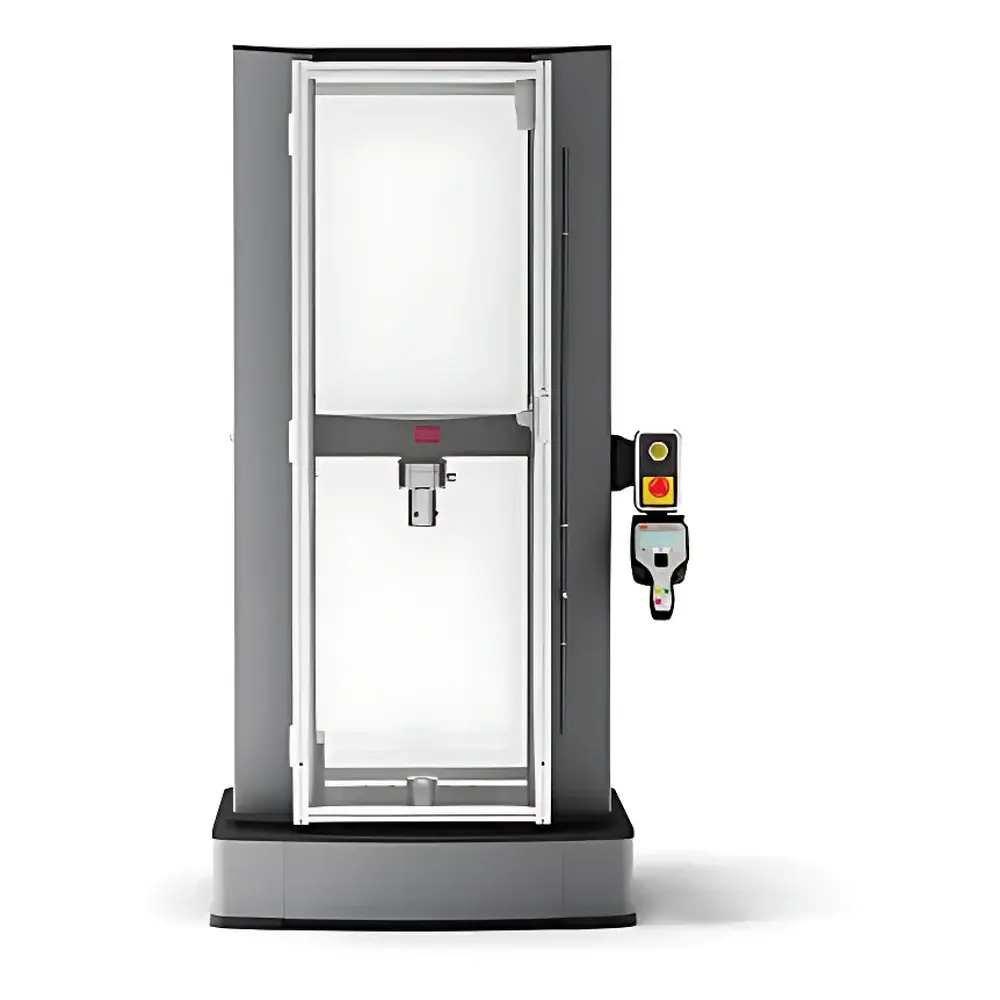
MTS Criterion C43 Electromechanical Universal Testing Machine (100 N – 50 kN)
| Brand | MTS |
|---|---|
| Origin | USA |
| Model | MTS Criterion C43 |
| Type | Electromechanical Universal Testing Machine |
| Load Capacity | 100 N, 250 N, 500 N, 1 kN, 2.5 kN, 5 kN, 10 kN, 20 kN, 30 kN, 50 kN |
| Frame Type | Dual-column, Bench-top |
| Test Space | Single |
| Max Speed | 2000 mm/min |
| Min Speed | 0.005 mm/min |
| Displacement Resolution | 0.00005 mm |
| Force Accuracy | ISO 7500-1 Class 1 or ASTM E4 |
| Data Acquisition Rate | 1000 Hz |
| Control Loop Frequency | 1000 Hz |
| Compliance | Machinery Directive 2006/42/EC, Low Voltage Directive 2006/95/EC, EMC Directive 2004/108/EC, GOST-R |
Overview
The MTS Criterion C43 Electromechanical Universal Testing Machine is a precision-engineered bench-top materials testing system designed for high-reproducibility mechanical characterization across a broad force range—from 100 N to 50 kN. Utilizing a dual-column, electromechanical architecture with preloaded ball screws and a high-speed, low-vibration AC servo motor drive, the C43 delivers exceptional stiffness, linearity, and dynamic response. Its integrated digital closed-loop controller operates at 1000 Hz, enabling simultaneous high-fidelity control of force, displacement, and strain—critical for quasi-static tensile, compression, flexure, peel, shear, and cyclic testing per ASTM, ISO, EN, DIN, and BS standards. The system conforms to ISO 7500-1 Class 1 (or ISO 7500-1 Class 0.5 upon request) and ASTM E4 calibration requirements, ensuring traceable metrological integrity for QA/QC, R&D, and regulatory submissions.
Key Features
- Dual-column, bench-top frame with 425 mm column spacing and 1000 mm standard vertical travel—optimized for stability and accessibility in constrained lab environments.
- High-stiffness preloaded recirculating ball screw actuation with linear guidance—eliminates backlash and ensures sub-micron positional fidelity over full stroke.
- Non-clutch-driven servo system capable of delivering full rated load at maximum speed (up to 2000 mm/min), enabling efficient high-throughput testing without mechanical compromise.
- Integrated 1000 Hz digital controller housed within the frame—reducing signal latency and electromagnetic interference while supporting real-time PID tuning and multi-channel synchronization.
- TEDS-enabled MTS load cells with automatic sensor recognition—minimizing setup errors and accelerating calibration verification per ISO 376.
- Comprehensive safety architecture: programmable force overload protection (±10% of full scale), hardware-based displacement limits, thermal and voltage fault monitoring, and optional CE-compliant integrated safety enclosure per Machinery Directive 2006/42/EC.
- Modular expansion readiness—including support for extensometers (contact and non-contact), environmental chambers (-70 °C to +350 °C), pneumatic/hydraulic grips, and multi-axis fixtures.
Sample Compatibility & Compliance
The C43 accommodates diverse specimen geometries and material classes—including thin films, fibers, adhesives, foams, elastomers, biomedical polymers, paperboard, wood composites, metallic wires (up to 8 mm diameter), fasteners, and CFRP laminates. Its single-space configuration supports standardized test methods under ASTM D638, D790, D3039, D1876, ISO 527, ISO 178, ISO 6892-1, ISO 1133, and USP . System validation documentation supports GLP and GMP environments; audit trails, electronic signatures, and 21 CFR Part 11–compliant software options are available via TestWork Suite. All electrical and mechanical subsystems comply with EU Directives 2006/42/EC (Machinery), 2006/95/EC (Low Voltage), and 2004/108/EC (EMC), as well as Russian GOST-R certification requirements.
Software & Data Management
TestWork software provides intuitive test method authoring, real-time curve overlay, automated pass/fail evaluation, and export to CSV, XML, and PDF formats. Its built-in standards library includes over 200 preconfigured methods aligned with ASTM, ISO, DIN, EN, and JIS specifications—with quarterly updates delivered via secure MTS portal. Raw data streams at 1000 Hz are time-stamped and stored with full metadata (operator ID, sample ID, environmental conditions, calibration history). Optional modules enable advanced analysis: hysteresis loop quantification, modulus mapping, creep/recovery modeling, and fracture energy integration. All software versions undergo rigorous regression testing and maintain backward compatibility with legacy test files and hardware interfaces.
Applications
The C43 serves as a primary mechanical testing platform in polymer laboratories evaluating tensile strength and elongation at break in thermoplastics per ISO 527-2; in medical device R&D validating suture tensile performance per ISO 10993-12; in packaging labs measuring peel strength of laminated films per ASTM F904; in aerospace QA verifying bond integrity of adhesive joints per ASTM D1002; and in academic research characterizing viscoelastic behavior of hydrogels using controlled-strain ramp-hold protocols. Its wide dynamic range and sub-0.005 mm/min minimum speed make it equally suitable for slow-rate creep studies in bituminous binders (ASTM D6927) and high-speed impact simulation of composite panels.
FAQ
What load cell accuracy classes are supported on the C43?
The system ships calibrated to ISO 7500-1 Class 1; Class 0.5 calibration is available as an optional factory service with documented uncertainty budgets.
Can the C43 be upgraded to dual-test-space configuration?
No—the C43 is a single-space model. Dual-space capability is exclusive to the C44 and C45 frame variants.
Is TestWork software validated for FDA-regulated environments?
Yes—when deployed with the 21 CFR Part 11 Compliance Pack, TestWork provides audit trail logging, role-based access control, electronic signatures, and data integrity safeguards required for pharmaceutical and biotech applications.
What is the maximum specimen height accommodated with standard crosshead travel?
With the standard 1000 mm vertical stroke and 425 mm column spacing, specimens up to 39.4 inches (1000 mm) in height can be tested without extension kits.
Does the system support extensometry for modulus determination?
Yes—both clip-on axial extensometers (ASTM E83 Class B-1) and video-based non-contact systems integrate seamlessly via dedicated analog and digital input channels, with automatic gauge length registration and real-time strain feedback.



