
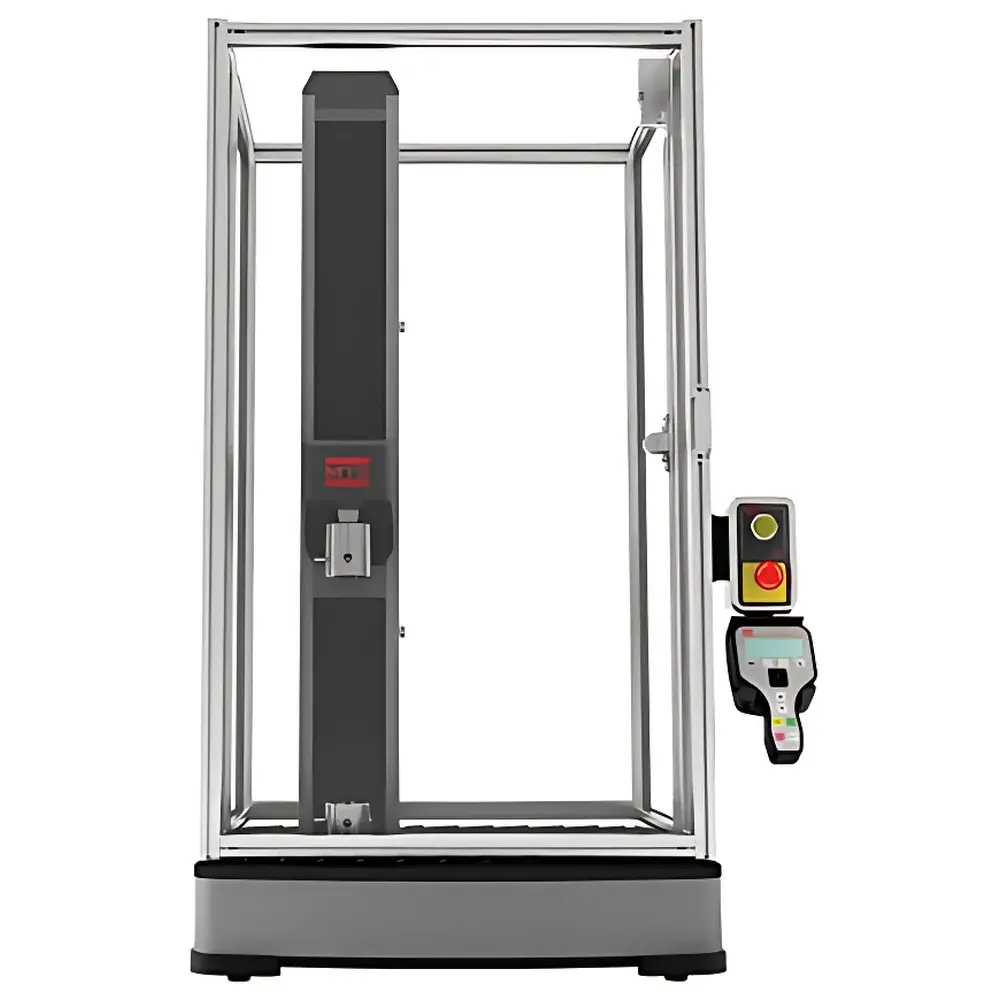
MTS Criterion C42 Desktop Electromechanical Universal Testing Machine
| Brand | MTS |
|---|---|
| Origin | USA |
| Model | MTS Criterion C42 |
| Load Capacity | 1–5 kN |
| Load Accuracy | ±0.5% |
| Frame Type | Single-Column, Benchtop |
| Test Space | Single |
| Max Test Speed | 2000 mm/min |
| Min Test Speed | 0.005 mm/min |
| Displacement Resolution | 0.00005 mm |
| Crosshead Travel (Standard) | 650 mm |
| Power Supply | 200–230 V AC, 5 A, 50/60 Hz, 1000 W |
| Data Acquisition Rate | 1000 Hz |
| Control Loop Frequency | 1000 Hz |
| Calibration Standard | ISO 7500-1 Class 0.5 / ASTM E4 Class I |
| Strain Accuracy Compliance | ASTM E83 / ISO 8513 |
Overview
The MTS Criterion C42 Desktop Electromechanical Universal Testing Machine is a precision-engineered, single-column benchtop system designed for high-fidelity mechanical characterization of materials under tension, compression, flexure, and peel loading conditions. Built upon MTS’s proven Criterion 40-series architecture, the C42 employs a fully integrated digital closed-loop control system with 1000 Hz data acquisition and real-time control loop frequency—enabling accurate force, displacement, and strain regulation across its 1 N to 5 kN load range. Its core measurement principle relies on direct-load sensing via TEDS-enabled, traceable load cells calibrated per ISO 7500-1 Class 0.5 or ASTM E4 Class I standards, coupled with high-resolution optical encoder-based crosshead positioning (0.00005 mm resolution) and preloaded ball-screw actuation. The system is optimized for laboratories requiring repeatable, GLP-compliant mechanical testing at low-to-moderate force levels—particularly where footprint efficiency, operational simplicity, and regulatory traceability are critical.
Key Features
- Single-column, compact benchtop frame with rigid linear guidance and anti-rotation alignment—ensuring high axial fidelity and minimal lateral deflection during testing.
- High-speed, low-vibration AC servo motor drive with maintenance-free operation and full-speed capability at maximum rated load (5 kN).
- Integrated digital controller housed within the load frame—eliminating external rack-mounted electronics and reducing signal noise and latency.
- TEDS (Transducer Electronic Data Sheet)-enabled load cells for automatic sensor recognition, calibration parameter recall, and audit-ready traceability.
- Preloaded precision ball screw with zero-backlash transmission—delivering consistent velocity profiles and eliminating clutch-based speed transitions.
- Dual analog input channels (e.g., for resistance-type extensometers) and one digital channel (e.g., for large-deformation encoders or orthogonal position feedback) for multi-parameter synchronization.
- Comprehensive hardware safety suite: force overload protection (10% over capacity), crosshead travel limits, thermal cutoffs, voltage surge suppression, and optional EU-compliant integrated safety enclosure per Machinery Directive 2006/42/EC.
- Standard compliance with electromagnetic compatibility (EMC Directive 2004/108/EC) and low-voltage safety (2006/95/EC), plus GOST-R certification for CIS markets.
Sample Compatibility & Compliance
The C42 accommodates a broad spectrum of specimen geometries and mechanical behaviors—including thin films (≥10 µm), polymer fibers (<0.5 mm diameter), metallic wires (up to 3 mm), adhesive bonds, biomedical hydrogels, paperboard laminates, and elastomeric foams. Its 100 mm column-to-guard distance and 650 mm standard vertical travel support both short-gauge tensile specimens and extended-compression configurations. All test protocols align with internationally recognized standards including ASTM D638, D790, D3039, ISO 527-1, ISO 178, ISO 1133, EN 1311-1, and BS EN 14410. The system supports full 21 CFR Part 11-compliant electronic records when paired with validated TestWork software configurations, enabling FDA-regulated environments to maintain audit trails for user actions, method changes, and raw data integrity.
Software & Data Management
TestWork software serves as the unified interface for test definition, execution, analysis, and reporting. It includes an expandable library of preconfigured test methods aligned with ASTM, ISO, DIN, EN, and BS standards—with built-in pass/fail logic, automatic calculation of modulus, yield strength, elongation at break, and secant stiffness. Real-time plotting, multi-curve overlay, and customizable report templates (PDF, Excel, XML) facilitate rapid QA/QC review. Data export supports third-party statistical process control (SPC) platforms and LIMS integration via ODBC and CSV. Audit trail functionality logs all operator interventions—including login events, method edits, calibration updates, and result approvals—with immutable timestamps and user IDs. Optional IQ/OQ/PQ documentation packages are available for regulated pharmaceutical and medical device laboratories.
Applications
The MTS Criterion C42 is routinely deployed in quality assurance labs for incoming material verification (e.g., polymer film tensile strength, wire ductility, adhesive lap-shear performance), R&D departments evaluating novel composites or bioresorbable scaffolds, and packaging validation labs assessing seal integrity and puncture resistance. Its high-speed capability (up to 2000 mm/min) enables dynamic rate-dependent studies such as strain-rate sensitivity mapping in thermoplastics, while sub-micron displacement resolution supports precise creep and stress-relaxation profiling. Common use cases include ASTM D882 film testing, ISO 1184 fiber tensile analysis, ASTM D1876 T-peel adhesion evaluation, and ISO 1924-2 paper tensile testing—all executed with metrological confidence and procedural repeatability.
FAQ
What load cell options are supported on the C42?
The system accepts MTS TEDS-enabled load cells ranging from 1 N to 5 kN, with automatic identification and calibration parameter loading upon connection.
Can the C42 perform strain-controlled tests?
Yes—when equipped with a compatible extensometer (e.g., MTS 634 series) connected via the dual analog input channel, the system executes closed-loop strain control per ASTM E83 Class B or ISO 8513 requirements.
Is TestWork software validated for GxP environments?
Validated TestWork configurations—including electronic signature support, role-based access control, and 21 CFR Part 11 audit trail generation—are available under formal IQ/OQ/PQ protocols.
What is the minimum measurable displacement increment?
The system achieves 0.00005 mm displacement resolution across its full 650 mm travel range, verified per ISO 6892-1 Annex C.
Does the C42 meet ISO/IEC 17025 requirements for accredited testing labs?
When operated with certified load cells, documented calibration procedures, and controlled environmental monitoring (23 ± 2 °C, 50 ± 10% RH), the C42 satisfies mechanical testing scope requirements under ISO/IEC 17025:2017 Clause 6.4.



