
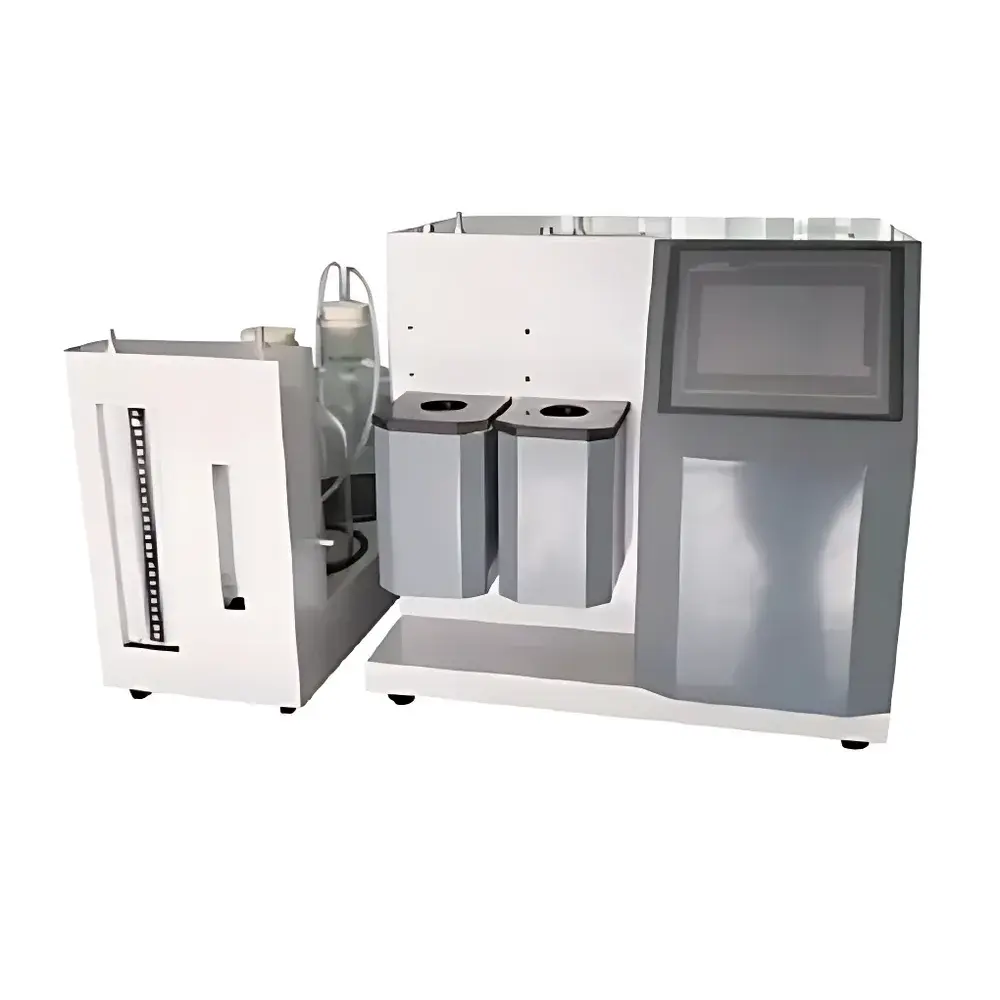
Qigao HSY-0248D Automatic Cold Filter Plugging Point (CFPP) Tester
| Brand | Qigao |
|---|---|
| Origin | Shanghai, China |
| Manufacturer Type | Direct Manufacturer |
| Country of Origin | China |
| Model | HSY-0248D |
| Standard Compliance | SH/T 0248 |
| Test Channels | Dual-position |
| Detection Method | Infrared Fiber-Optic Sensor |
| Cooling System | Compressor-Based Refrigeration |
| Bath Temperature Range | –70 °C to +80 °C |
| Display & Control | 7-inch Industrial Touchscreen + PLC Controller |
| Sample Tube | CFPP-Specific ASTM/SH-Compliant Tube |
| Filtration System | Vacuum-Assisted Suction per SH/T 0248 |
| Power Supply | AC 220 V, 50 Hz |
| Rated Power | 1500 W |
| Operating Ambient | 10–30 °C, ≤85% RH |
| Data Export | USB Flash Drive |
| Temperature Sensor Accuracy | ±0.1 °C (typical for industrial Pt100 RTD) |
Overview
The Qigao HSY-0248D Automatic Cold Filter Plugging Point (CFPP) Tester is a precision-engineered instrument designed specifically for the automated determination of the cold filter plugging point of distillate fuels—including diesel, biodiesel blends, and kerosene—according to the Chinese national standard SH/T 0248. CFPP is a critical low-temperature performance parameter that indicates the lowest temperature at which a fuel can pass through a standardized wire mesh filter under specified vacuum conditions within 60 seconds. This measurement directly correlates with operability in cold climates and serves as a key specification for fuel quality assurance in refining, distribution, and end-user logistics. The HSY-0248D implements a controlled cooling protocol followed by dynamic vacuum filtration and real-time optical detection of flow cessation, delivering repeatable, operator-independent results aligned with standardized test methodology.
Key Features
- Dual-channel parallel testing architecture enables simultaneous evaluation of two independent fuel samples—improving laboratory throughput without compromising measurement integrity.
- High-stability compressor-based refrigeration system delivers rapid, uniform bath cooling across the full operating range (–70 °C to +80 °C), with precise digital PID control ensuring thermal stability within ±0.3 °C during filtration cycles.
- Infrared fiber-optic sensing technology monitors filtrate flow through the standardized 45-μm stainless steel mesh at the suction tube outlet—eliminating mechanical contact, reducing drift, and enhancing long-term detection reliability.
- Integrated 7-inch industrial-grade touchscreen interface powered by an embedded PLC controller manages all operational sequences: pre-cooling ramp, stabilization hold, vacuum initiation, flow monitoring, endpoint detection, and automatic data logging.
- CFPP-specific sample tubes conform to dimensional and material requirements defined in SH/T 0248, ensuring geometric consistency and minimizing wall effects during wax crystal formation and filter clogging dynamics.
- Automated vacuum suction system maintains calibrated differential pressure (200 mmH₂O vacuum) throughout the filtration phase, complying strictly with the standard’s timing and pressure specifications.
- Onboard temperature sensing uses calibrated Pt100 RTD probes immersed directly in the cold bath and sample tube jacket—providing traceable, high-resolution thermal feedback for both control and reporting.
Sample Compatibility & Compliance
The HSY-0248D is validated for use with middle distillates meeting ASTM D6371, ISO 3015, and EN 116 methodologies—though its primary compliance anchor remains SH/T 0248. It accommodates standard 30-mL fuel specimens in certified glass tubes and supports common additives (e.g., cold flow improvers) without interference. All hardware components contacting fuel or vapor are chemically inert (borosilicate glass, stainless steel 316, PTFE seals), preventing catalytic degradation or contamination. The instrument design adheres to IEC 61010-1 safety standards for laboratory electrical equipment and incorporates over-temperature cutoff, refrigerant leak detection, and emergency power-off circuitry. Routine calibration verification follows internal SOPs traceable to NIM (National Institute of Metrology, China) reference standards.
Software & Data Management
The embedded control firmware supports GLP-compliant data handling: each test record includes timestamp, operator ID (optional login), ambient conditions, bath temperature profile, filtration start/end times, detected CFPP value, and raw sensor output traces. Data are stored internally (≥10,000 records) and exportable via USB 2.0 to CSV or PDF formats—retaining full metadata for audit readiness. Audit trail functionality logs all user actions (method changes, calibration entries, result edits) with timestamps and identifiers. While not FDA 21 CFR Part 11–certified out-of-the-box, the system architecture supports integration into validated LIMS environments via RS-232 or optional Ethernet module (firmware v2.3+), enabling electronic signature workflows and centralized data governance.
Applications
- Refinery QC laboratories performing batch release testing of diesel and heating oil against contractual CFPP limits.
- Fuel additive development labs evaluating cold flow improver (CFI) efficacy under controlled thermal gradients.
- Third-party inspection agencies conducting conformity assessments for domestic and export fuel shipments.
- Research institutions studying wax crystallization kinetics and filter clogging mechanisms in biofuel blends (e.g., FAME, HVO).
- Aviation ground support units verifying Jet A-1 cold weather readiness prior to winter deployment.
FAQ
What standards does the HSY-0248D fully comply with?
It is engineered and verified for SH/T 0248; its mechanical and thermal specifications also permit adaptation to ISO 3015 and ASTM D6371 with minor procedural adjustments.
Can the instrument store and recall user-defined test methods?
Yes—up to 20 custom protocols may be saved, including ramp rates, stabilization durations, and vacuum setpoints, subject to SH/T 0248 boundary constraints.
Is external calibration required, and how often?
Annual verification using NIST-traceable temperature standards and certified reference fuels is recommended; internal diagnostics run automatically at startup.
Does the system support remote monitoring or network connectivity?
Standard configuration includes RS-232; optional Ethernet/Wi-Fi modules enable SCADA integration and remote status polling via Modbus TCP.
What maintenance intervals are specified for the compressor and filtration components?
Compressor service is recommended every 24 months under continuous operation; suction filters and O-rings should be inspected quarterly and replaced per usage log.




