
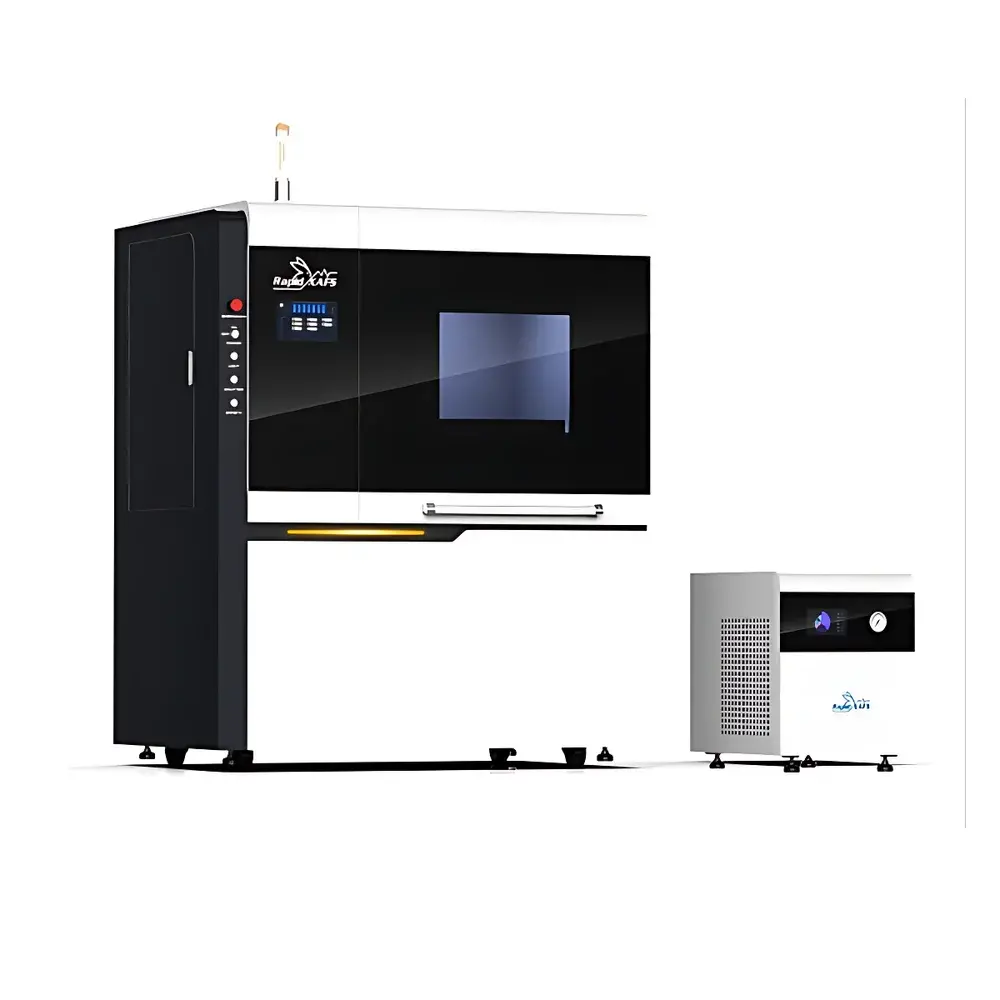
RapidXAFS 2M Desktop X-ray Absorption Fine Structure (XAFS) Spectrometer
| Brand | RapidXAFS |
|---|---|
| Origin | Anhui, China |
| Manufacturer Type | Authorized Distributor |
| Country of Origin | China |
| Model | RapidXAFS 2M |
| Price Range | USD 700,000 – 1,400,000 |
| X-ray Source Power | 1.6 kW & 3.0 kW |
| Monochromatic X-ray Photon Flux | > 2,000,000 photons/s/eV at 8 keV |
| Minimum Detectable Elemental Concentration | 0.5 wt% (on CN-supported matrix) |
| Tunable X-ray Absorption Energy Range | 4.5 keV – 20 keV |
Overview
The RapidXAFS 2M is a benchtop X-ray Absorption Fine Structure (XAFS) spectrometer engineered for laboratory-scale, non-synchrotron XAFS and X-ray Emission Spectroscopy (XES) measurements. It employs a Rowland-circle geometry with high-order crystal optics to deliver high-resolution monochromatic X-ray beams, enabling precise measurement of both X-ray Absorption Near-Edge Structure (XANES) and Extended X-ray Absorption Fine Structure (EXAFS). Unlike diffraction-based techniques, XAFS is element-specific and does not require long-range crystalline order—making it uniquely suited for probing local atomic coordination, oxidation states, and dynamic structural evolution in amorphous, nanoscale, liquid, gaseous, or heterogeneous systems. The instrument operates across an energy range of 4.5–20 keV, covering K-edges of elements from P (phosphorus) through Zn (zinc), L-edges of 4d/5d transition metals (e.g., Ru, Pd, Ag, Pt), and M-edges of lanthanides—enabling broad applicability in catalysis, energy materials, environmental science, and bioinorganic chemistry.
Key Features
- Self-contained benchtop design: No synchrotron beamtime dependency; installed directly in standard laboratory environments (no radiation shielding vault required beyond local regulatory compliance).
- High-flux microfocus X-ray source: Dual-power configuration (1.6 kW and 3.0 kW) optimized for signal-to-noise ratio and acquisition speed—enabling full XAFS scans on 1 wt% samples in under 60 minutes.
- Rowland-circle monochromator with high-index crystal optics (e.g., Si(311), Ge(422)): Delivers energy resolution ΔE/E 2×10⁶ photons/s/eV at 8 keV.
- In situ and operando capability: Compatible with custom-designed sample cells for variable-temperature (80–1000 K), variable-pressure (10⁻³ mbar to 100 bar), and controlled-atmosphere (inert, oxidizing, reducing, humidified) experiments.
- Non-destructive, bulk- and surface-sensitive measurement: Applicable to solids (crystalline/powdered), liquids (solutions, melts), gases, and thin films without sample degradation.
- High structural precision: Yields quantitative coordination numbers, interatomic distances (±0.01 Å accuracy), and disorder parameters (Debye–Waller factors) via EXAFS fitting using standard protocols (e.g., FEFF, Artemis, Demeter).
Sample Compatibility & Compliance
The RapidXAFS 2M accommodates diverse sample forms—including pressed pellets, capillary-mounted solutions, gas-phase flow cells, and electrochemical liquid cells—without matrix-induced artifacts. Its element-specific detection enables selective analysis of target atoms even in multi-element matrices, eliminating interference from neighboring elements. All hardware and software modules comply with international safety standards for X-ray generating equipment (IEC 61010-1, IEC 62471). Data acquisition and processing workflows support audit-trail generation and electronic signature functionality in accordance with FDA 21 CFR Part 11 and GLP/GMP documentation requirements. Instrument calibration is traceable to NIST SRM standards for energy and intensity response.
Software & Data Management
The integrated RapidXAFS Control Suite provides real-time data acquisition, energy calibration, fluorescence/transmission normalization, and automated background subtraction. Raw spectra are exported in standard formats (e.g., .dat, .chi, .prj) compatible with open-source XAFS analysis toolchains (Demeter, Larch, Athena). Advanced features include batch processing, time-resolved averaging, and correlation with simultaneous auxiliary signals (e.g., temperature, pressure, current, potential). All metadata—including beamline parameters, sample environment logs, and operator annotations—are embedded in HDF5-formatted archives for FAIR (Findable, Accessible, Interoperable, Reusable) data management. Remote monitoring and secure cloud backup options are available via optional enterprise deployment packages.
Applications
- Catalysis: Tracking dynamic changes in coordination geometry and oxidation state of single-atom catalysts (SACs) and nanoparticle surfaces during reaction cycles—under realistic gas-phase or electrochemical conditions.
- Energy Materials: Probing local structure evolution of Ni/Co/Mn in layered cathodes during Li-ion battery cycling; identifying active sites in Fe/N/C ORR catalysts; characterizing hydride formation in Mg-based hydrogen storage alloys.
- Environmental Science: Speciation of Cr(VI)/Cr(III), As(III)/As(V), and Se(IV)/Se(VI) in soils, sediments, and biological tissues; quantifying redox transformations in contaminated groundwater systems.
- Materials Science: Structural fingerprinting of disordered oxides, metal–organic frameworks (MOFs), and glassy chalcogenides; studying radiation-induced defect clustering in nuclear waste forms.
- Biological Inorganic Chemistry: Determining metal–ligand bond lengths and coordination symmetry in metalloproteins (e.g., nitrogenase, cytochrome c oxidase, superoxide dismutase) without crystallization.
FAQ
Does the RapidXAFS 2M require synchrotron radiation?
No. It uses a high-brightness microfocus sealed-tube X-ray source with advanced monochromation—eliminating dependence on large-scale facilities.
Can it measure both XANES and EXAFS?
Yes. Full spectral coverage from pre-edge (−10 eV) through EXAFS region (up to +1000 eV beyond absorption edge) is supported across its 4.5–20 keV operating range.
Is in situ/operando testing supported?
Yes. Standard interfaces accommodate third-party environmental cells; custom cell integration is available through RapidXAFS engineering services.
What sample preparation is required?
Minimal: Solid samples are typically diluted in boron nitride or cellulose matrix; liquid samples are loaded into quartz capillaries; gas-phase studies use flow-through cells with differential pumping.
How is data quality validated?
Each system ships with NIST-traceable reference foils (e.g., Cu, Ni, Co) for energy calibration and reproducibility verification; annual performance validation reports are provided per ISO/IEC 17025 guidelines.





