
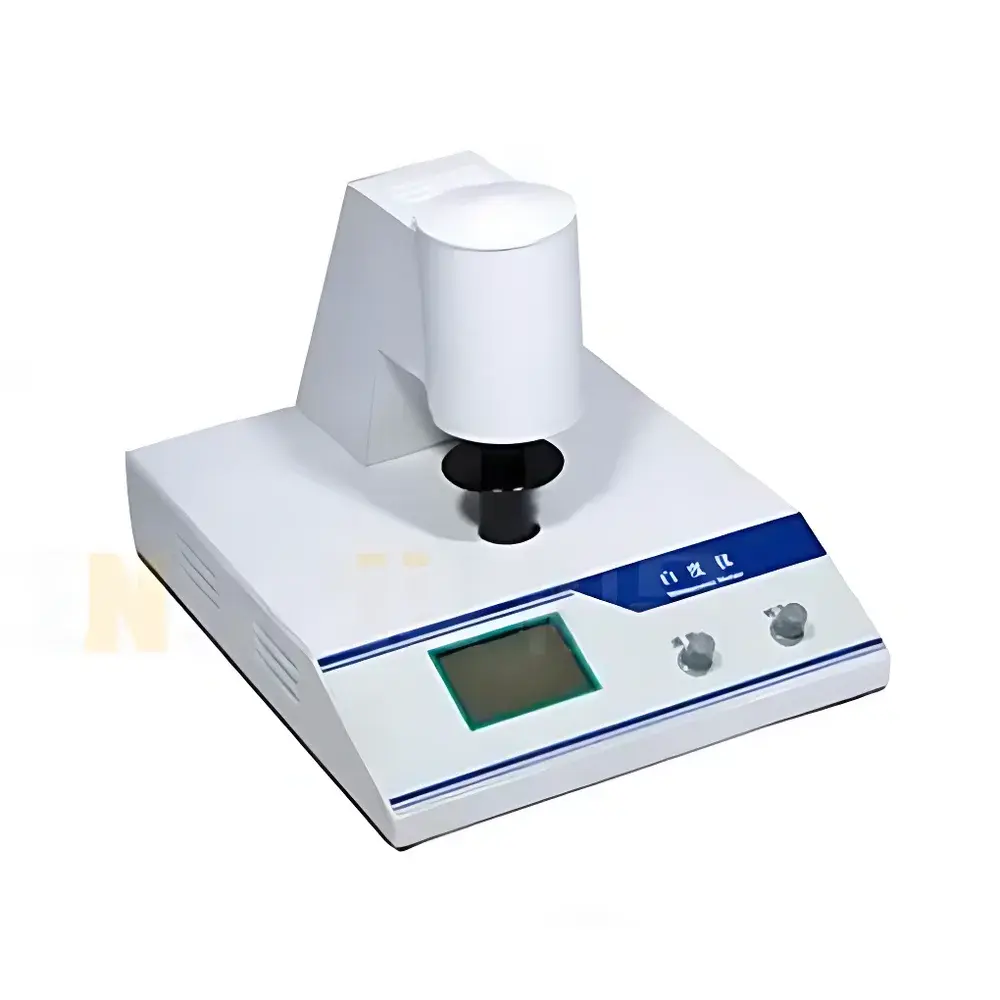
Jihengpin HP-WSB-2Y Fluorescence Whiteness Meter
| Brand | Jihengpin |
|---|---|
| Origin | Shandong, China |
| Manufacturer Type | Direct Manufacturer |
| Country of Origin | China |
| Model | HP-WSB-2Y |
| Price | Upon Request |
| Measurement Range | 0–199 |
| Measured Parameters | Blue Light Whiteness (r₄₅₇), Fluorescent Whitening Value (F) |
| Light Source | LED |
| Illumination/Viewing Geometry | 45/0 (compliant with GB/T 3978) |
| Display | LCD |
| Minimum Resolution | 0.1 |
| Repeatability | ≤0.2 |
| Accuracy | ±1.0 |
| Operating Temperature | 5–35 °C |
| Operating Humidity | ≤85% RH |
| Storage/Transport Conditions | –20–50 °C, ≤90% RH |
Overview
The Jihengpin HP-WSB-2Y Fluorescence Whiteness Meter is a dedicated optical measurement instrument engineered for quantitative evaluation of whiteness in materials where both inherent reflectance and fluorescent enhancement contribute to perceived brightness. It operates on the principle of spectrally resolved diffuse reflectance measurement at the standardized blue light wavelength of 457 nm—defined in ISO 2470-1, GB/T 3978, and CIE Publication No. 15—as the primary metric for “blue light whiteness” (r457). In addition, the instrument incorporates a calibrated fluorescence excitation-detection pathway to quantify the contribution of optical brightening agents (OBAs), delivering a separate, traceable value designated as fluorescent whiteness (F). This dual-mode capability distinguishes it from conventional non-fluorescent whiteness meters and supports compliance-driven quality control in regulated manufacturing environments.
Key Features
- LED-based stable illumination system with narrow-band spectral output centered at 457 nm, ensuring long-term photometric consistency and eliminating lamp aging drift.
- 45/0 illumination/viewing geometry conforming to GB/T 3978 and aligned with ISO/CIE standard practice for minimizing directional bias in diffuse reflectance measurement.
- Dual-channel optical path design: one optimized for r457 determination under UV-filtered conditions; the other enabling controlled UV excitation (typically 365 nm) and F-value calculation via integrated fluorescence correction algorithms.
- High-resolution LCD display with 0.1-unit resolution and real-time numeric readout for both r457 and F values, supporting immediate pass/fail assessment against internal or user-defined thresholds.
- Robust mechanical architecture with temperature-compensated sensor electronics, validated for repeatability ≤0.2 units across ≥10 consecutive measurements under stable ambient conditions (5–35 °C, ≤85% RH).
- Calibration traceability supported via factory-certified reference standards; optional NIST-traceable calibration kits available for in-house verification.
Sample Compatibility & Compliance
The HP-WSB-2Y accommodates flat, opaque, or semi-opaque solid samples up to 100 mm × 100 mm, including paper sheets, ceramic tiles, plastic plaques, textile swatches, powdered solids (e.g., starch, talc, TiO2 pigments), and granular commodities such as salt or flour—provided surface uniformity and minimal texture variation are maintained. For paper applications, the instrument supports indirect estimation of opacity through comparative r457 readings on single- and double-sheet configurations per ISO 2471 methodology. Regulatory alignment includes conformance with Chinese national standard GB/T 3978 (general requirements for colorimetric instruments), GB/T 2288 (paper and board whiteness), and GB/T 5950 (building materials whiteness). While not FDA 21 CFR Part 11–certified out-of-the-box, its deterministic measurement logic and audit-ready manual logging support GLP/GMP-aligned documentation workflows when paired with controlled SOPs.
Software & Data Management
The HP-WSB-2Y operates as a standalone benchtop unit with no embedded firmware-based data export. All measurement records—including date/time stamp, sample ID (manually entered), r457, F, and operator notes—are retained in volatile memory for up to 99 entries and may be manually transcribed. For integration into automated QA systems, optional RS-232 or USB-to-serial interface modules enable ASCII-formatted data streaming to external PCs running custom or third-party LIMS-compatible acquisition software. Raw output adheres to fixed-field ASCII protocol (e.g., “R457=87.3|F=12.6|T=202405121422|ID=LOT-A7X”), facilitating structured parsing and traceability. No proprietary software installation is required, and no cloud connectivity or remote access functionality is implemented—ensuring full data sovereignty and compatibility with air-gapped laboratory networks.
Applications
- Quality assurance of paper and board grades: monitoring r457 consistency across production batches and detecting OBA concentration shifts affecting aging performance.
- Formulation validation in paint, coating, and pigment manufacturing: correlating F-values with titanium dioxide loading and organic brightener dosage.
- Raw material screening for ceramics and refractories: quantifying whiteness loss due to iron contamination in kaolin or feldspar feedstocks.
- Food-grade additive certification: verifying whiteness compliance of starch, flour, and sodium chloride per GB 1355 and GB 5461 specifications.
- Regulatory testing for detergent and cosmetic products: documenting fluorescent whitening agent content in accordance with GB/T 13173 (detergent testing methods) and GB/T 27578 (cosmetic pigment limits).
FAQ
Does the HP-WSB-2Y comply with international standards such as ISO 2470 or CIE 15?
It conforms to the geometric and spectral requirements of GB/T 3978, which is technically equivalent to ISO/CIE 45/0 geometry and references the same 457 nm evaluation wavelength specified in ISO 2470-1. Full ISO 2470 certification requires third-party validation; users should verify alignment with their specific accreditation body.
Can the instrument measure opacity directly?
No—it does not include a transmission port or dual-beam configuration. However, opacity can be estimated indirectly using the r457 ratio method (single- vs. double-sheet measurement) per ISO 2471 guidelines.
Is UV source intensity adjustable or user-calibratable?
The UV LED excitation source is factory-set and non-adjustable to maintain metrological stability. Calibration of fluorescence response is performed using certified fluorescent reference tiles during initial setup or periodic verification.
What maintenance is required beyond routine cleaning?
Annual verification with traceable standards is recommended. Optical surfaces should be cleaned with lint-free, alcohol-moistened swabs; no lubrication or internal servicing is intended for end users.




