
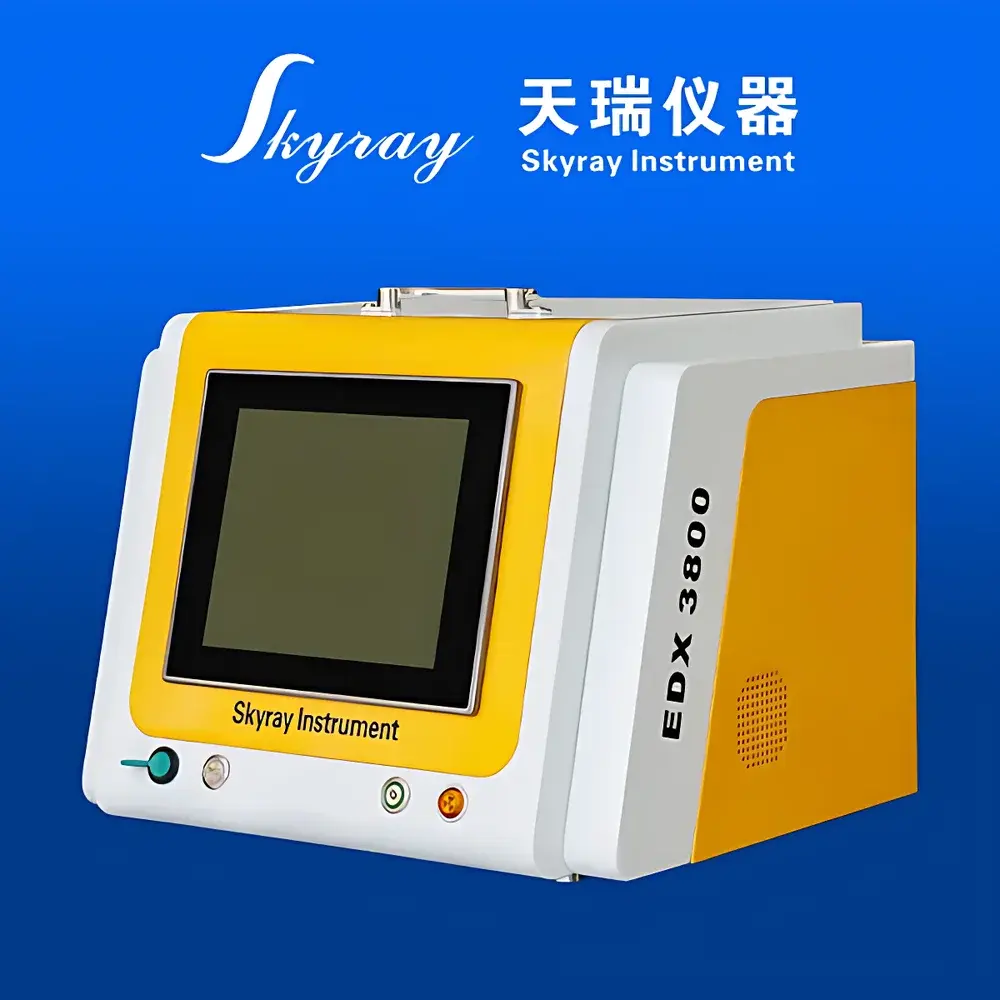
SkyRay Instrument EDX3800 Energy Dispersive X-Ray Fluorescence Spectrometer
| Brand | SkyRay Instrument |
|---|---|
| Origin | Jiangsu, China |
| Manufacturer Type | Manufacturer |
| Origin Category | Domestic |
| Model | EDX 3800 |
| Configuration | Benchtop/Floor-standing |
| Application Type | General-purpose |
| Energy Resolution | 125 eV |
| Detector | FAST-SDD |
Overview
The SkyRay Instrument EDX3800 is a high-performance energy dispersive X-ray fluorescence (EDXRF) spectrometer engineered for precise, non-destructive elemental analysis across solid, powder, and liquid samples. Based on over 10,000 installed EDXRF systems globally, the EDX3800 integrates advanced excitation optics, low-noise detection architecture, and intelligent automation to deliver enhanced sensitivity—particularly for heavy elements—while maintaining strict compliance with international radiation safety and analytical validation standards. Its measurement principle relies on primary X-ray excitation of sample atoms, followed by detection of characteristic fluorescent X-rays dispersed by energy (not wavelength), enabling simultaneous multi-element quantification from Na (11) to U (92) without vacuum or helium purge in most routine applications.
Key Features
- FAST-SDD (Silicon Drift Detector) with Peltier cooling: Delivers 125 eV Mn Kα energy resolution at 100,000 cps count rate, optimized for high peak-to-background ratio and low detection limits.
- High-power microfocus X-ray tube: Adjustable voltage up to 50 kV and current up to 1 mA, coupled with a short-path, low-absorption optical path to maximize photon throughput and minimize spectral degradation.
- Dual thermal management architecture: Independent air-cooling channels for detector, X-ray tube, and electronics ensure stable gain calibration and long-term intensity reproducibility—even during extended batch runs.
- Integrated touch-enabled industrial PC: Pre-installed with SkyRay’s proprietary EDXRF software featuring one-click analysis, auto-peak identification, matrix-matched standardless quantification, and user-defined method templates.
- Modular mechanical design: Supports both manual sample placement and optional 85-position automated sample handling via a four-axis collaborative robotic arm with collision-sensing safety logic—certified for unguarded human–machine interaction per ISO/TS 15066 guidelines.
- Multi-layer radiation safety system: Includes hardware interlocks (door sensors, beam shutter feedback), software-enforced operational constraints, real-time dose monitoring, and labyrinth-style shielding compliant with IEC 61010-1 and GBZ 117–2015.
Sample Compatibility & Compliance
The EDX3800 accommodates flat solids (up to Ø100 mm × 40 mm height), pressed pellets, loose powders in cups, and homogeneous liquids in sealed cells. It meets ASTM E1621–22 for RoHS screening, ISO 3497 for metallic coating thickness measurement (Ni/Cr/Cu/Zn on steel, Au/Ni/Cu on PCBs), and USP / for elemental impurities in pharmaceutical excipients. All firmware and software modules support audit trail logging, electronic signatures, and 21 CFR Part 11–compliant data integrity controls when configured for GLP/GMP environments.
Software & Data Management
SkyRay’s EDX-Analyzer v5.2 provides full traceability from raw spectrum acquisition to certified report generation. Key capabilities include: background subtraction using iterative SNIP algorithms; fundamental parameter (FP) and empirical calibration modes; statistical process control (SPC) charting; customizable PDF/Excel export with embedded metadata (operator ID, timestamp, instrument serial, calibration history); and secure network deployment via TLS 1.2–encrypted client-server architecture. Raw spectral data (.spe/.csv) and processed results are stored in ACID-compliant SQLite databases with automatic daily backup and role-based access control.
Applications
- RoHS/WEEE compliance testing: Quantitative determination of Pb, Cd, Hg, Cr(VI), Br (as PBB/PBDE), and Cl (as SCCPs) in plastics, PCBs, and molded components.
- Metal alloy verification: Rapid grade identification and composition verification of stainless steels, aluminum alloys, brass, and copper-based materials per ASTM E1086 and ISO 11577.
- Electroplating process control: Thickness measurement of single/multi-layer coatings (e.g., Ni–Au, Cu–Sn, Zn–Ni) and bath concentration monitoring via standard addition methodology.
- Precious metal assay: Accurate fineness determination of Au, Ag, Pt, and Pd in jewelry, scrap, and bullion—validated against fire assay reference methods per ISO 11426.
- Geological & environmental screening: Semi-quantitative analysis of soil, sediment, and ore samples for exploration-grade element mapping (Fe, Mn, Zn, Cu, As, Sb).
FAQ
Does the EDX3800 require vacuum or helium purging for light element analysis?
No. The FAST-SDD detector and optimized beam path enable reliable detection down to sodium (Na) in air mode. For enhanced light-element sensitivity (e.g., Mg, Al, Si), optional He flush or vacuum chamber accessories are available.
Is the robotic autosampler compatible with irregularly shaped or fragile samples?
Yes—the 4-axis collaborative arm supports custom end-effector tooling and programmable force-limiting motion profiles, allowing safe handling of coins, watch components, and ceramic tiles without surface damage.
How is calibration maintained across instrument lifetime?
The system includes built-in drift correction using internal reference sources and automatic recalibration triggers based on tube aging models, ambient temperature shifts, and detector gain variance—documented in every analysis report.
Can the EDX3800 be integrated into a laboratory information management system (LIMS)?
Yes. It supports ASTM E1384-compliant HL7 and ASTM E2500–22 XML data exchange protocols, as well as direct ODBC connectivity for bidirectional result transfer and workflow synchronization.



