
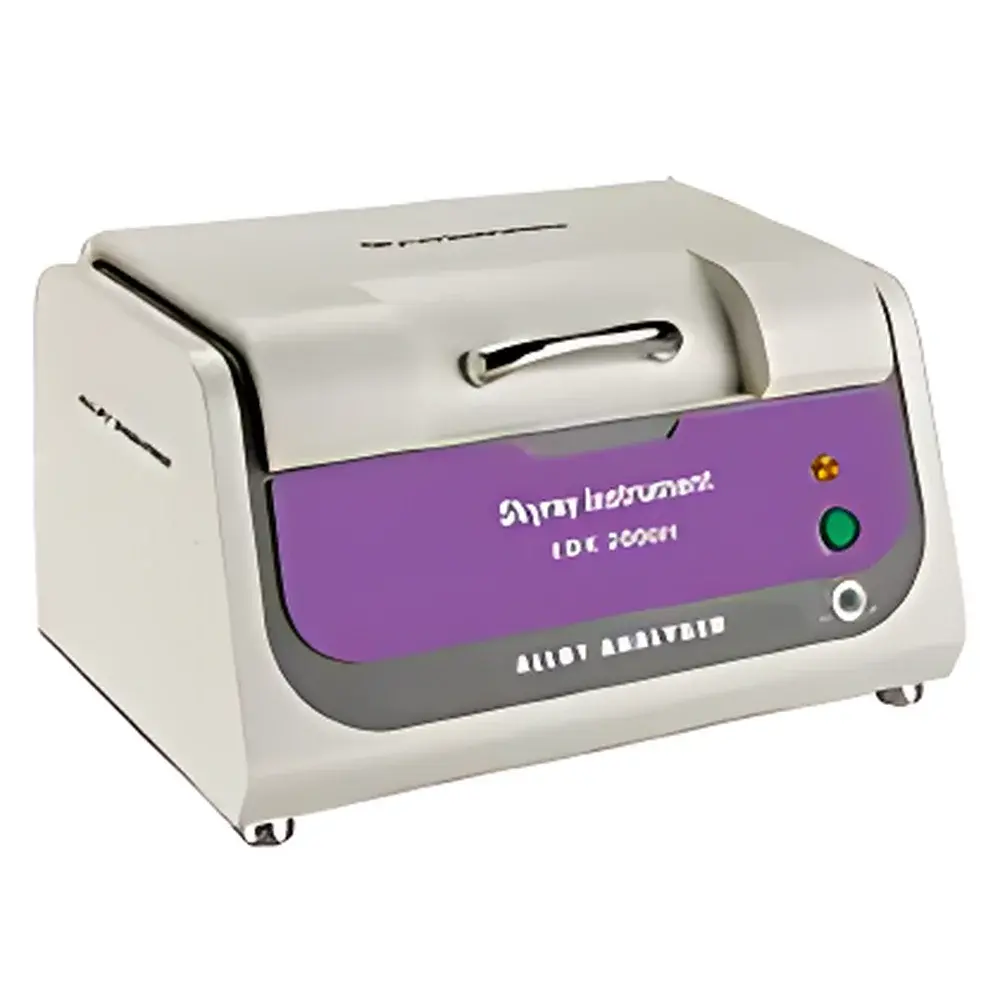
SkyRay EDX2000H Energy Dispersive X-Ray Fluorescence Spectrometer
| Brand | SkyRay Instrument |
|---|---|
| Origin | Jiangsu, China |
| Manufacturer Type | Direct Manufacturer |
| Product Origin | Domestic (China) |
| Model | EDX2000H |
| Form Factor | Benchtop / Floor-Standing |
| Application Type | General-Purpose |
| Elemental Range | S (16) – U (92) |
| Quantification Range | 0.1 ppm – 99.99 wt% |
| Energy Resolution | ≤125 eV (Mn Kα) |
| Repeatability | ≤0.05% RSD (for major elements >96 wt%) |
| Detector | Si-PIN Semiconductor Detector |
| Operating Temperature | 15–30 °C |
| Sample Chamber Dimensions | 460 × 298 × 98 mm |
| Instrument Dimensions | 550 × 410 × 320 mm |
| Weight | 45 kg |
| Power Supply | AC 220 V ±5 V, recommended with line conditioner |
Overview
The SkyRay EDX2000H is a benchtop-to-floor-standing energy dispersive X-ray fluorescence (EDXRF) spectrometer engineered for precise, non-destructive elemental composition analysis of solid metal alloys and related industrial materials. Based on the fundamental principle of X-ray fluorescence—where primary X-rays from a high-voltage-excited X-ray tube induce characteristic secondary emission from atoms in the sample—the EDX2000H delivers rapid qualitative and quantitative results across the elemental range from sulfur (Z = 16) to uranium (Z = 92). Its optimized optical path features a downward-illumination geometry, enabling flexible analysis of irregularly shaped, thick, or uneven-surface samples without sectioning or polishing. The system integrates a stabilized high-voltage power supply and a next-generation low-power X-ray tube, ensuring long-term operational stability, reduced thermal drift, and enhanced photon flux efficiency. All safety-critical components—including beam shutter, interlock circuitry, and lead-shielded sample chamber—comply with IEC 61010-1 and GB/T 18804 standards for laboratory X-ray equipment.
Key Features
- Downward-beam optical configuration for universal sample accommodation—ideal for bulk metals, castings, machined parts, and coated substrates.
- Motorized filter and collimator turret supporting automated selection of excitation conditions (e.g., Al, Cu, Mo filters; 1, 2, 4 mm collimators) to maximize peak-to-background ratio per element group.
- Precision manual XYZ translation stage with vernier-scale positioning, enabling repeatable micro-location of analysis points on heterogeneous or multi-phase samples.
- High-resolution Si-PIN semiconductor detector (active area: 25 mm², Be window: 12.5 µm) delivering ≤125 eV full-width at half-maximum (FWHM) at Mn Kα, critical for resolving overlapping L-lines in transition metals (e.g., Co/Ni/Fe, Zn/Cu).
- Multi-parameter linear regression algorithms coupled with matrix-matched standardization and empirical coefficient correction to mitigate inter-element absorption/enhancement effects—particularly essential for complex brass (Cu–Zn–Pb–Sn–Fe), stainless steel (Cr–Ni–Mo–Mn), and cobalt-based superalloys.
- Firmware-upgradable architecture: spectral processing libraries, calibration models, and quantification methods can be expanded via software update—no hardware modification required.
Sample Compatibility & Compliance
The EDX2000H accepts solid metallic specimens up to 460 mm × 298 mm × 98 mm in dimension and accommodates samples weighing up to 5 kg. It supports direct analysis of uncoated, anodized, galvanized, or painted surfaces—provided coating thickness remains within detection depth limits (<20 µm for light elements under standard conditions). Method development and validation align with ASTM E1621 (Standard Guide for XRF Analysis of Metals), ISO 21047 (Metallic materials — X-ray emission spectrometric analysis), and GB/T 28838 (Chinese national standard for EDXRF in alloy analysis). Full audit trail logging, user-access controls, and electronic signature support are available via optional compliance-ready software modules compliant with FDA 21 CFR Part 11 and GLP/GMP documentation requirements.
Software & Data Management
The instrument operates under SkyRay’s proprietary SpectrumMaster™ v4.x platform, built on a Windows 10 IoT Enterprise environment. The software provides real-time spectrum acquisition, automatic peak identification (based on NIST X-ray database), iterative background subtraction, and multi-layered quantification workflows—including fundamental parameter (FP), empirical calibration, and hybrid FP-empirical modes. Data export conforms to ASTM E1341 and ASTM E1556 formats (CSV, TXT, XML), with native compatibility for LIMS integration via ODBC drivers. All raw spectra, processed reports, instrument parameters, and operator logs are time-stamped and stored in encrypted SQLite databases with configurable retention policies.
Applications
The EDX2000H is routinely deployed in QC/QA laboratories for rapid verification of incoming raw materials, in-process alloy verification, and finished product certification. Primary use cases include: compositional screening of brass (C26000, C36000), copper-nickel alloys (C70600, C71500), zinc die-cast alloys (ZAMAK 3/5), austenitic/ferritic stainless steels (304, 316, 430), cobalt-chromium dental alloys, and nickel-based superalloys (Inconel 600/718). It supports RoHS-compliant screening for restricted elements (Pb, Cd, Hg, Cr⁶⁺, Br) in metal components and fulfills trace impurity monitoring (e.g., Sn, As, Sb in oxygen-free copper per ASTM B115).
FAQ
What is the minimum detectable limit for sulfur in brass using the EDX2000H?
Typical S detection limit under optimized conditions (Al filter, 2-mm collimator, 100 s live time) is 8–12 ppm for homogenous brass matrices.
Can the EDX2000H quantify light elements below sodium (Na)?
No—its Be-window Si-PIN detector and air-path geometry limit reliable detection to elements ≥S (Z=16); vacuum or He-purge configurations are not supported.
Is method transfer possible between different EDX2000H units?
Yes—calibration models, spectral libraries, and instrument configuration files are portable across units running identical firmware versions.
Does the system support automated batch analysis?
Yes—via programmable sequence mode, users define multi-sample measurement protocols including auto-stage movement, dwell time, filter/collimator selection, and pass/fail logic based on preset concentration thresholds.
What maintenance is required for the X-ray tube?
The sealed-end X-ray tube has a rated lifetime of ≥15,000 hours; no periodic replacement or gas refilling is needed. Annual verification of high-voltage stability and detector resolution is recommended.





