
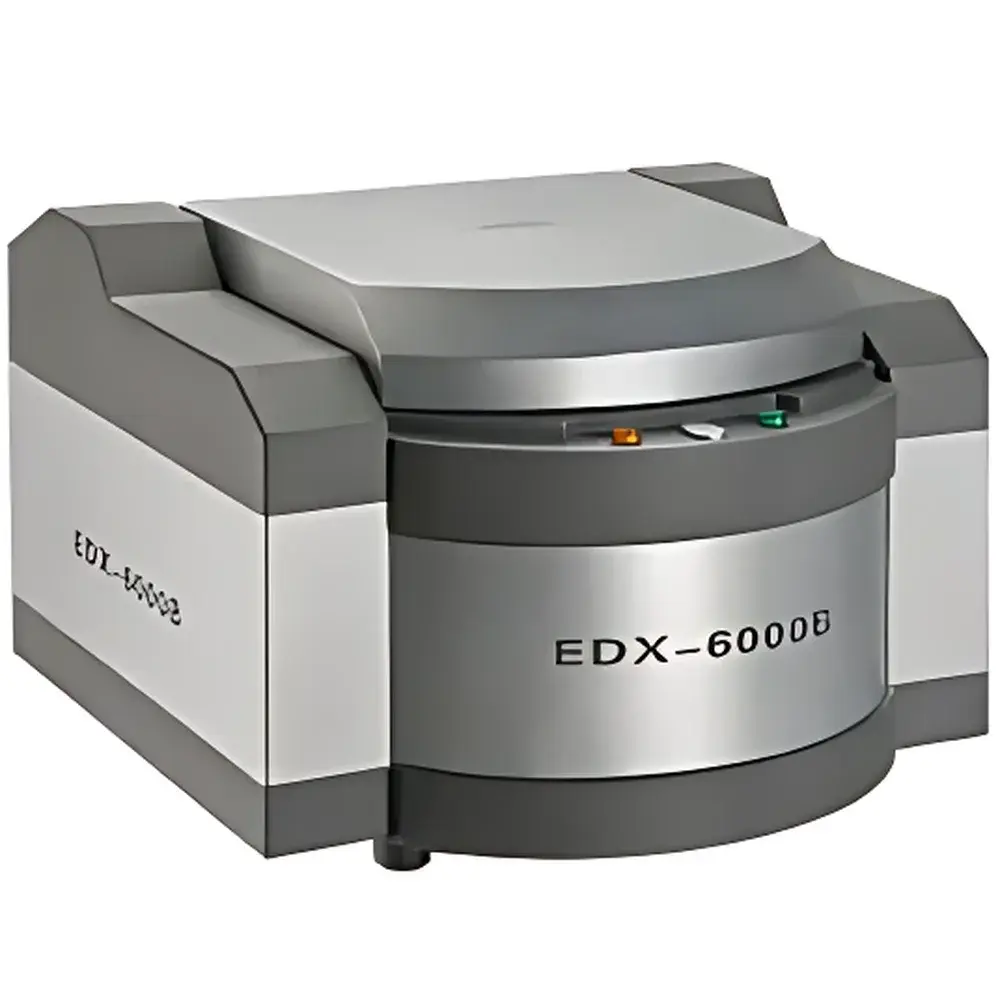
SkyRay Instrument EDX6000B Energy Dispersive X-Ray Fluorescence Spectrometer
| Brand | SkyRay Instrument |
|---|---|
| Origin | Jiangsu, China |
| Manufacturer Type | Original Equipment Manufacturer (OEM) |
| Product Category | Domestic |
| Model | EDX6000B |
| Form Factor | Benchtop/Floor-standing |
| Application Scope | General-purpose |
| Elemental Range | Na–U |
| Quantitative Range | 0.1 ppm – 99.99 wt% |
| Energy Resolution | ≤125 eV at Mn Kα |
| Repeatability | ≤0.05% RSD (for major elements >96 wt%) |
| Detector | FAST-SDD (Silicon Drift Detector, ultra-thin window, Peltier-cooled) |
Overview
The SkyRay Instrument EDX6000B is a benchtop/floor-standing energy dispersive X-ray fluorescence (EDXRF) spectrometer engineered for high-precision, non-destructive elemental analysis across industrial and regulatory compliance laboratories. Based on the fundamental principle of X-ray fluorescence—where primary X-rays excite atoms in a sample, causing emission of characteristic secondary X-rays—the EDX6000B delivers quantitative and qualitative data through spectral deconvolution of emitted photon energies. Its design emphasizes robustness for routine use in cement production control, metallurgical process monitoring, geological surveying, RoHS/WEEE compliance screening, and thin-film thickness measurement. The instrument integrates a high-stability end-window X-ray tube, a Peltier-cooled FAST-SDD detector with ultra-thin polymer window, and an automated vacuum chamber—enabling reliable detection of light elements down to sodium (Na) without helium purge or complex gas handling.
Key Features
- FAST-SDD detector with ≤125 eV energy resolution at Mn Kα (5.89 keV), ensuring high peak separation and accurate multi-element deconvolution
- Integrated vacuum sample chamber optimized for enhanced sensitivity to low-Z elements (Na–F), critical for cement clinker, slag, and silicate matrices
- Motorized filter and collimator turret with automatic switching—configurable per sample type to optimize excitation conditions and minimize spectral overlap
- 10-position auto-rotating sample tray enabling unattended sequential analysis of heterogeneous batches
- Dual-mode operation: air mode for heavy metals (e.g., Pb, Cd, Cr, Hg, Br) and vacuum mode for light elements (e.g., Al, Si, P, S, Cl, Ca)
- High-resolution integrated camera and optical alignment system for precise positioning of irregular solids, powders, and liquid cells
- Rugged mechanical architecture with vibration-damped base and EMI-shielded enclosure, meeting IEC 61000-4 electromagnetic compatibility standards
Sample Compatibility & Compliance
The EDX6000B accommodates solid blocks, pressed pellets, loose powders, fused beads, and sealed liquid cells (up to 40.7 × 26 mm cup dimensions). It supports ASTM C114 (cement chemical analysis), ISO 29581-2 (cement constituents), ISO 12885 (metallic coatings), and IEC 62321-5 (RoHS screening by XRF). All analytical methods are fully traceable and support GLP/GMP audit requirements—including full electronic records, user access logs, method versioning, and instrument calibration history. Software-generated reports comply with FDA 21 CFR Part 11 when deployed with appropriate IT infrastructure and administrative controls.
Software & Data Management
The proprietary SkyRay QuantMaster™ software provides multivariate non-linear regression algorithms with matrix-matched and fundamental parameter (FP) calibration options. It includes independent, element-specific correction models for absorption, enhancement, and inter-element effects—validated against NIST SRM reference materials (e.g., NIST 278, 670b, 688). The interface supports method templates for cement raw mix, sintered clinker, scrap metal sorting, and PCB coating verification. All spectra, quantification results, and acquisition parameters are stored in encrypted SQLite databases with time-stamped audit trails. Export formats include CSV, PDF, XML, and ASTM E135-compliant data exchange structures.
Applications
- Cement manufacturing: real-time quantification of CaO, SiO₂, Al₂O₃, Fe₂O₃, MgO, SO₃, and alkalis (Na₂O/K₂O) in raw meal, kiln feed, and finished clinker
- Metallurgy: grade identification of ferrous/non-ferrous alloys; inclusion analysis in steel; coating thickness and composition (e.g., Zn, Ni, Sn, Cr on steel substrates)
- Geology & mining: rapid assay of exploration core samples, ore concentrates, and tailings for economic elements (Cu, Pb, Zn, Au, REEs) and gangue components
- Environmental compliance: screening of consumer electronics, plastics, and packaging per EU RoHS Directive limits (Cd < 100 ppm, Pb/Cr/Hg/Br < 1000 ppm)
- Quality assurance labs: incoming material verification, supplier certification, and batch release testing under ISO/IEC 17025-accredited workflows
FAQ
What is the minimum detectable thickness for metallic coatings?
The EDX6000B achieves a practical lower limit of 5 nm for homogeneous single-layer coatings (e.g., Zn on steel) under optimized vacuum and excitation conditions.
Does the system support certified reference material (CRM) calibration?
Yes—QuantMaster™ includes built-in CRM libraries (NIST, BAM, USGS) and supports custom CRM-based calibration curves with uncertainty propagation.
Is vacuum operation required for all analyses?
No—vacuum is selectively engaged only for light-element analysis (Z ≤ 15); heavy-element quantification (e.g., Pb, Cd, Cr) is performed in air mode.
How is instrument performance verified over time?
Daily system checks include detector resolution verification (Mn Kα FWHM), tube output stability monitoring, and drift correction using internal reference channels.
Can the EDX6000B be integrated into a LIMS environment?
Yes—via ODBC-compliant database export, RESTful API endpoints, and ASTM E135-compliant XML data packets for seamless LIMS ingestion.




