
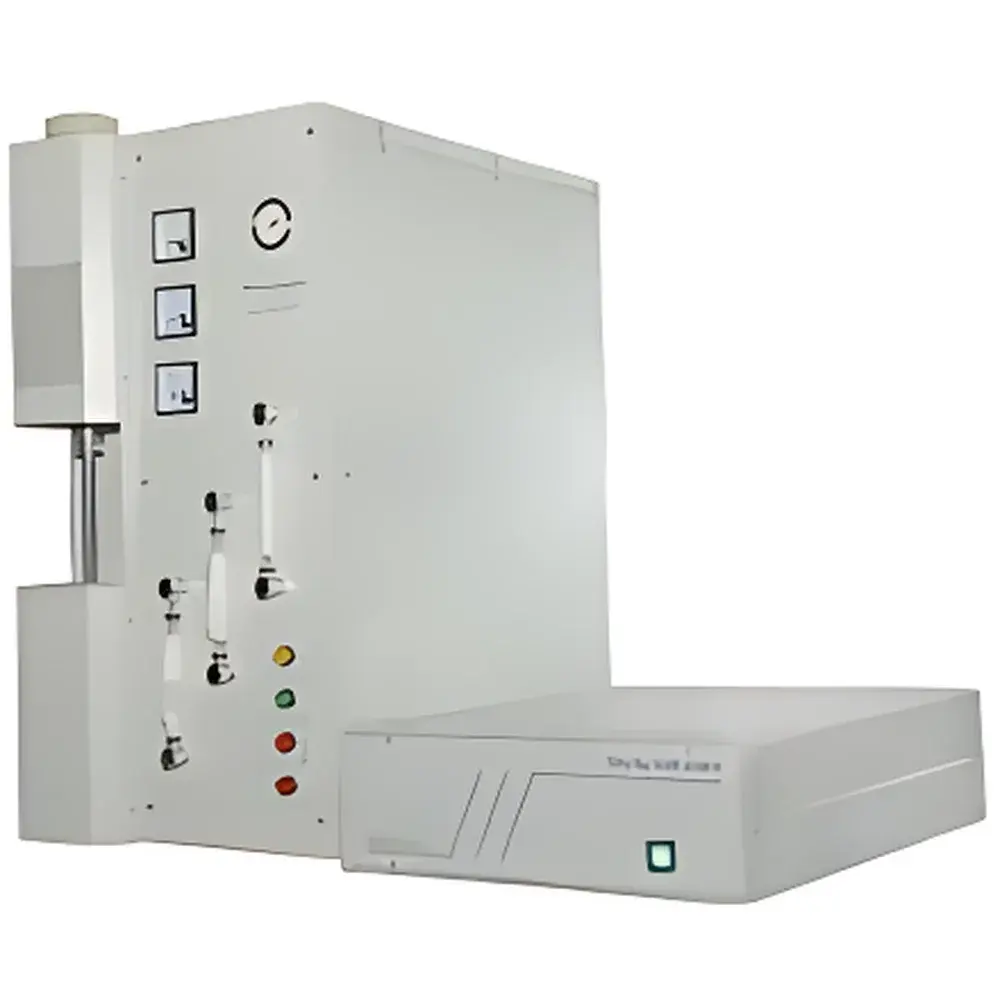
Skyray Instrument CS-188 High-Frequency Infrared Carbon-Sulfur Analyzer
| Brand | Skyray Instrument |
|---|---|
| Origin | Jiangsu, China |
| Manufacturer Type | Original Equipment Manufacturer (OEM) |
| Product Origin | Domestic (China) |
| Model | CS-188 |
| Pricing | Upon Request |
Overview
The Skyray Instrument CS-188 High-Frequency Infrared Carbon-Sulfur Analyzer is a fully integrated elemental analysis system engineered for precise, rapid, and trace-level quantification of total carbon (C) and sulfur (S) in solid inorganic and metallurgical samples. It operates on the principle of high-frequency induction combustion coupled with dual-channel non-dispersive infrared (NDIR) detection. During analysis, a weighed sample is combusted at up to 2.5 kW and 20 MHz in a controlled oxygen atmosphere, converting all carbon and sulfur into CO₂ and SO₂ gases. These gaseous oxides are swept through optimized gas pathways into dedicated NDIR cells, where absorbance at characteristic wavelengths (4.26 µm for CO₂, 7.35 µm for SO₂) is measured photometrically. The CS-188 implements proprietary real-time compensation algorithms—including temperature, pressure, mass flow, peak width, and background CO₂ correction—to eliminate environmental and instrumental drift, ensuring metrological stability across shifts and ambient conditions. Designed to meet ISO 9556 (carbon) and ISO 4935 (sulfur) requirements, it delivers certified performance for quality control laboratories operating under ISO/IEC 17025, ASTM E1019, and GLP-compliant workflows.
Key Features
- High-frequency induction furnace (2.5 kW, 20 MHz) with front-stage high-oxygen pre-oxidation and rear-stage oxygen flow regulation—ensuring complete combustion of refractory matrices including cast iron, high-alloy steels, and ceramics.
- Dual-infrared detection architecture featuring independent CO₂ and SO₂ channels, plus a unique CO-specific NDIR sensor—the only commercially deployed system offering direct CO compensation for total carbon calculation, eliminating underreporting in carbide-rich or low-oxygen combustion scenarios.
- Multi-parameter dynamic compensation: integrated Pt100 temperature sensor, piezoresistive barometric transducer, digital thermal-mass flow controller (not float-type), and spectral baseline normalization algorithm—each feeding real-time corrections into the quantitative model.
- Automated fault diagnostics and redundancy: continuous monitoring of valve actuation status, detector signal integrity, furnace current/voltage, gas pressure, and thermal stability; automatic shutdown on high-voltage overcurrent (with programmable dwell time ≤ 60 s) to extend power tube service life.
- Optimized optical path design with gold-coated reflective surfaces and thermoelectrically stabilized detectors—achieving 0.1 ppm instrument sensitivity and sub-ppm baseline noise.
Sample Compatibility & Compliance
The CS-188 accommodates solid, non-volatile samples weighing 0.2–1.0 g, including ferrous and non-ferrous metals (steels, cast irons, Ni/Co-based superalloys), ores, slags, cements, refractories, catalysts, and geological materials. Sample introduction uses ceramic crucibles with tungsten or tin additives as required. All hardware and software modules comply with ISO 9556:2018 (steel—determination of carbon content) and ISO 4935:2018 (steel—determination of sulfur content). System validation protocols support audit readiness for FDA 21 CFR Part 11 (electronic records/signatures), EU Annex 11 (computerized systems), and CNAS-CL01:2018 (testing laboratory accreditation). Routine calibration employs NIST-traceable certified reference materials (CRMs) such as IRMM-016 (low-C steel), BCS-CRM 328 (high-S cast iron), and GBW(E)010221 (ferromanganese).
Software & Data Management
The CS-188 is operated via Windows-based Skyray CSEasy v4.x software, compliant with ALCOA+ data integrity principles. It provides full audit trail functionality—including user login/logout timestamps, parameter change logs, raw signal archiving (absorbance vs. time), and version-controlled method storage. Database architecture supports relational querying with multi-criteria filters (date range, operator ID, material type, CRM batch). Calibration curves are stored with uncertainty propagation; results display confidence intervals based on RSD history. Reporting includes customizable Excel export (with embedded metadata), PDF certificate generation, and LIMS-compatible CSV output. Software enforces role-based access control (administrator, analyst, reviewer) and supports electronic signature workflows aligned with 21 CFR Part 11 Subpart B.
Applications
- Metallurgical QC/QA: Rapid verification of C/S specification compliance in incoming raw materials, melt shop samples, and finished rolled products.
- Foundry process control: Monitoring carbon equivalent (CE) and sulfide inclusion levels in ductile iron and gray iron production.
- Mining & mineral processing: Quantifying organic carbon in coal assays and sulfur speciation in pyritic ores.
- Cement & construction materials: Determining loss-on-ignition (LOI)-correlated carbonates and sulfate-bearing phases in clinker and blended cements.
- Environmental testing labs: Analysis of fly ash, slag, and waste incineration residues per EPA Method 5050 and ISO 14852.
- Research institutions: Supporting phase diagram studies, oxidation kinetics modeling, and catalyst deactivation analysis via high-precision C/S stoichiometry tracking.
FAQ
What is the minimum detectable concentration for carbon and sulfur?
The instrument sensitivity is specified at 0.1 ppm for both elements under optimal operating conditions using recommended CRMs and standard combustion parameters.
Does the CS-188 support automated calibration verification?
Yes—software includes scheduled auto-check routines that re-analyze a designated CRM at user-defined intervals and trigger alerts if recovery falls outside ±2σ of historical mean.
Can the system be integrated with a laboratory information management system (LIMS)?
It supports bidirectional HL7 and ASTM E1384-compliant ASCII/CSV data exchange; API integration is available via optional OPC UA server module.
Is routine maintenance documented within the software?
Maintenance logs—including detector cleaning dates, filter replacements, and furnace liner inspections—are timestamped, signed, and retained in the secure audit trail database.
What safety certifications does the CS-188 hold?
The analyzer complies with IEC 61010-1:2010 (Safety Requirements for Electrical Equipment for Measurement, Control, and Laboratory Use) and carries CE marking for EMC and Low Voltage Directive conformity.
Related Products




