
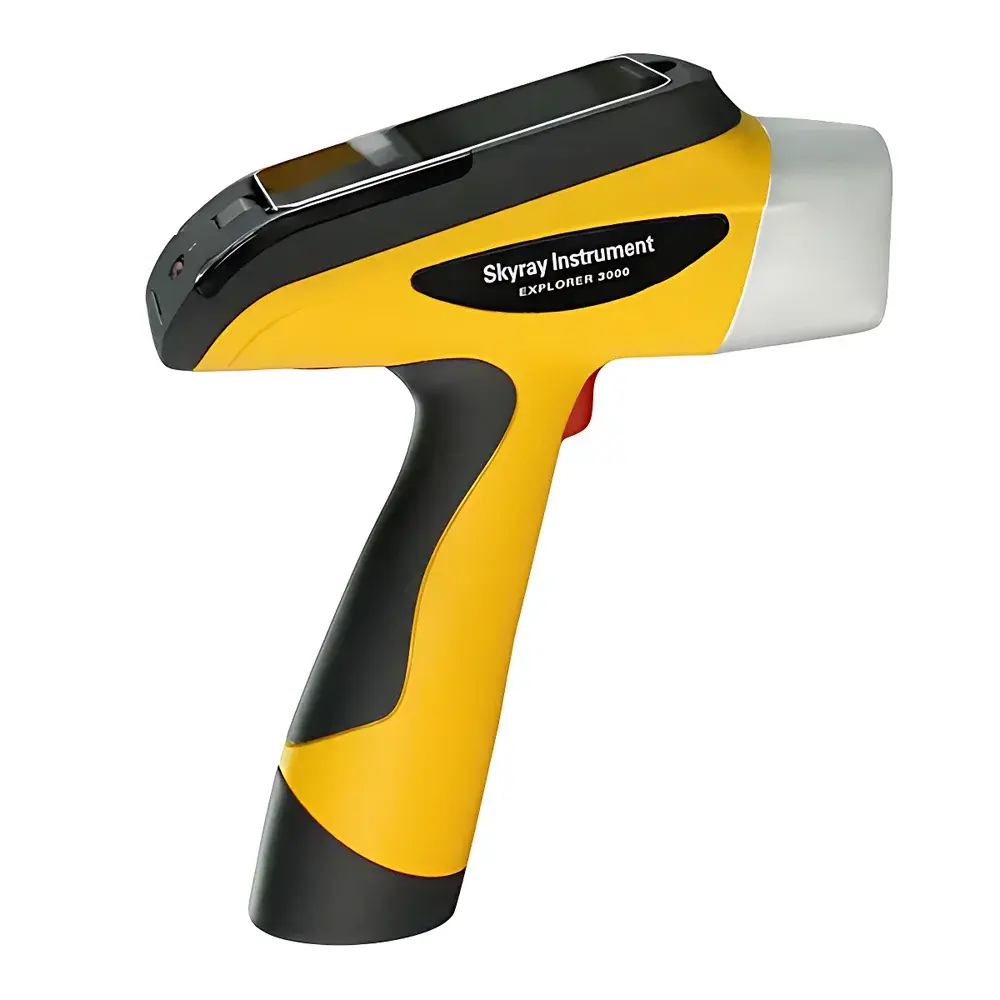
SkyRay Instrument Explorer 3000 Portable Energy Dispersive X-Ray Fluorescence Spectrometer
| Brand | SkyRay Instrument |
|---|---|
| Origin | Jiangsu, China |
| Manufacturer Type | OEM Manufacturer |
| Product Category | Domestic |
| Model | Explorer 3000 |
| Application | Handheld / Portable |
| Industry-Specific Use | Electronics |
| Detector | Fast Silicon Drift Detector (Fast-SDD) |
Overview
The SkyRay Instrument Explorer 3000 is a handheld energy dispersive X-ray fluorescence (EDXRF) spectrometer engineered for rapid, non-destructive elemental analysis of regulated hazardous substances in compliance-critical industries. Based on fundamental XRF physics—where primary X-rays excite atoms in the sample, inducing characteristic secondary (fluorescent) X-ray emission—the Explorer 3000 quantifies elemental composition by measuring the energy and intensity of emitted photons. Its core design targets RoHS (Restriction of Hazardous Substances), WEEE, CPSIA, and EU Toy Safety Directive (2009/48/EC) enforcement, delivering lab-grade performance in field-deployable form. Unlike benchtop systems requiring sample preparation or vacuum environments, the Explorer 3000 operates in ambient air with direct surface measurement, enabling real-time screening of Cr, Pb, Hg, Cd, Br, As, Se, Sb, and Ba—nine priority elements under IEC 62321-5:2013 and EN 71-3:2019.
Key Features
- Fast-SDD Detector: High-resolution silicon drift detector with <140 eV Mn Kα resolution at 100,000 cps, optimized for low-Z to mid-Z element detection in complex matrices.
- Digital Multi-Channel Analyzer (MCA): Proprietary firmware supporting up to 500 kcps effective spectral throughput, enabling sub-60-second quantification with statistical reproducibility ≤5% RSD (n=10, certified reference materials).
- Optimized Excitation Geometry: Ultra-short source-to-sample distance and dual-stage collimation/filter system (12-position automatic filter wheel) minimize background scatter and enhance peak-to-background ratios for trace-level detection.
- Ruggedized Field Architecture: IP54-rated sealed enclosure with shock-absorbing ergonomic grip, 270° rotatable 5-inch capacitive touchscreen, and integrated 8-MP optical camera for precise targeting and geo-referenced data logging.
- Extended Operational Autonomy: Optional 27,000 mAh Li-ion battery pack supports >72 hours of intermittent operation; hot-swappable battery design with internal backup capacitor ensures zero-interruption power transition.
- Triple-Layer Radiation Safety: Active beam-gating via proximity sensor, reinforced lead-composite shielding (≥2 mm Pb equivalent), and mechanical safety interlock with physical shutter override—fully compliant with IEC 62495:2010 and local regulatory requirements for portable X-ray devices.
Sample Compatibility & Compliance
The Explorer 3000 accommodates heterogeneous, irregular, and oversized samples without sectioning—including intact PCB assemblies, molded plastic housings, laminated packaging films, battery casings, and large-scale toy components. Its open-beam configuration eliminates size constraints inherent to chamber-based instruments. Method validation follows ASTM E2857-22 (Standard Guide for Validation of EDXRF for RoHS Screening) and ISO 17025:2017 quality management principles. Data integrity meets FDA 21 CFR Part 11 requirements through audit-trail-enabled software, electronic signatures, and role-based access control. Routine calibration verification uses NIST-traceable multielement thin-film standards (e.g., SRM 2822), with drift correction algorithms compensating for temperature-induced detector gain shifts.
Software & Data Management
Bundled SkyRay RoHS Pro software features dual-mode operation: User Mode enables one-touch pass/fail classification against configurable regulatory thresholds (e.g., Cd ≤100 ppm, Pb ≤1000 ppm); Expert Mode supports custom curve development, matrix-matched standardization, and empirical coefficient adjustment for high-accuracy quantification. All spectra are stored with metadata (GPS coordinates, operator ID, timestamp, instrument serial number) in encrypted SQLite databases. Export formats include CSV, PDF reports (with embedded spectra), and XML for LIMS integration. Firmware updates and method libraries are distributed via secure OTA channels with SHA-256 signature verification.
Applications
- On-site screening of electronic components and printed circuit boards per IEC 62321-5 protocols
- Supplier qualification audits for raw material compliance (e.g., solder alloys, plastic resins, pigments)
- In-line verification of packaging materials—including ink-coated cartons, metallized films, and adhesive layers
- Recycling stream sorting of WEEE fractions (e.g., CRT glass, circuit board scrap, lithium-ion battery modules)
- Border inspection and customs clearance testing under EU Regulation (EC) No 1907/2006 (REACH)
- Toy and children’s product safety verification per EN 71-3 migration limits and ASTM F963-23 Section 4.3.5
FAQ
Is the Explorer 3000 certified for use in regulated laboratory environments?
Yes—it complies with ISO/IEC 17025:2017 general requirements for competence of testing laboratories when operated within validated methods and documented procedures.
Can it quantify elements below RoHS threshold levels?
Detection limits range from 2–10 ppm for heavy metals in polymer matrices (per ASTM E2857-22 validation), depending on element atomic number and sample homogeneity.
Does the instrument require annual radiation safety certification?
Regulatory requirements vary by jurisdiction; users must consult local radiation protection authorities—SkyRay provides full technical documentation to support licensing applications.
How is spectral interference between adjacent elements (e.g., As Kα and Pb Lα) resolved?
Deconvolution employs iterative least-squares fitting with fundamental parameter (FP) modeling and empirically derived peak shape functions, validated against CRMs with known interferences.
What maintenance is required for long-term performance stability?
Annual detector resolution verification using Mn Kα source, biannual calibration check with certified standards, and routine cleaning of the X-ray window with isopropyl alcohol wipes.






