
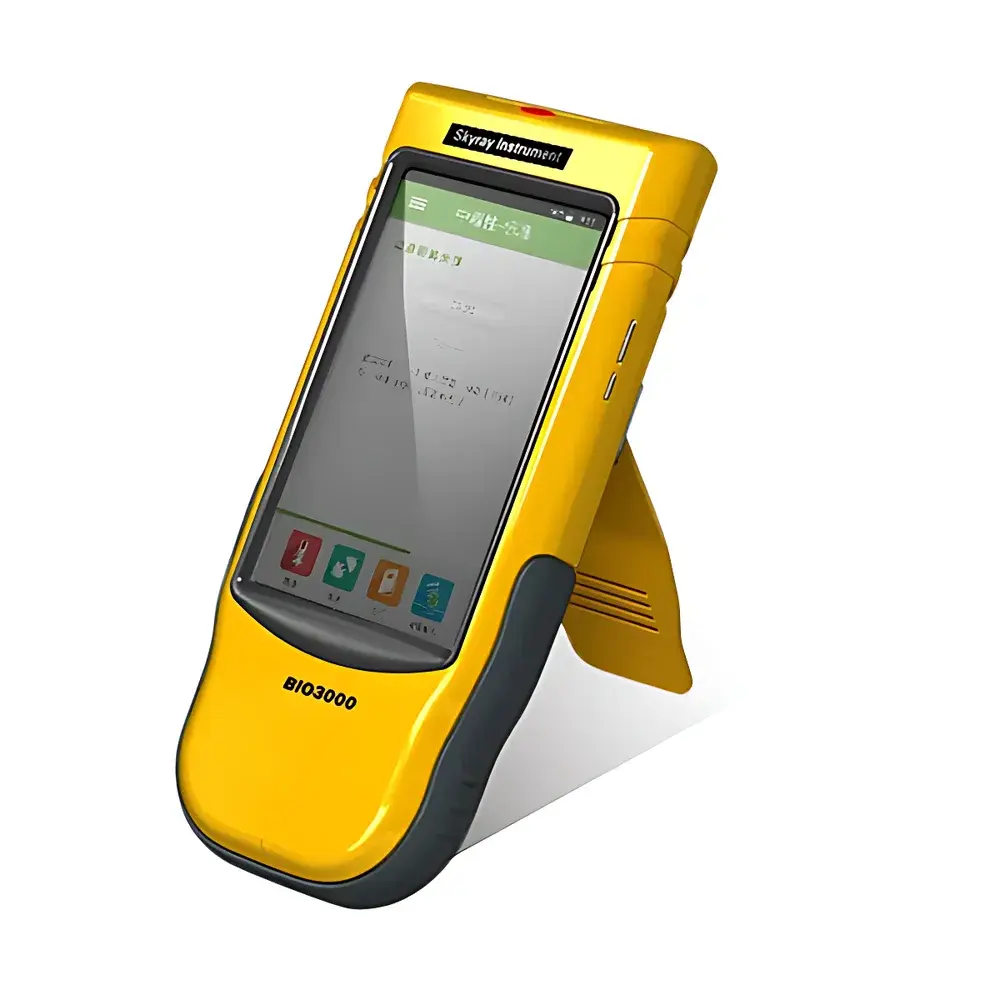
SkyRay BIO3000 Portable Water Toxicity Analyzer
| Brand | SkyRay Instrument |
|---|---|
| Origin | Jiangsu, China |
| Manufacturer Type | Manufacturer |
| Country of Origin | Domestic (China) |
| Model | BIO3000 |
| Price Range | USD 14,000–42,500 |
| Instrument Type | Portable |
| Test Organism | Bioluminescent Bacteria |
| Operating Temperature | 0–40 °C |
| Reagent Storage Temperature | Room Temperature |
| Coefficient of Variation (Repeatability) | <5% |
| Sample Throughput | 1 sample per run |
| Assay Time | <25 min |
| Detection Range | 0–65,535 RLU |
| Inhibition Range | 0–100% (linear response 10–90%) |
| Spectral Sensitivity | 320–1100 nm |
| Power Supply | 220 V ±10%, 50 Hz |
| Weight | 450 g |
| Dimensions | 90 × 220 × 40 mm |
| IP Rating | IP65 |
| Battery Life | >12 h continuous operation |
| Data Storage | 4 GB internal (expandable), >100,000 records |
| Connectivity | USB, Bluetooth, Wi-Fi |
| Software Platform | Android-based embedded OS with guided workflow |
| Compatible Strains | *Vibrio qinghaiensis* sp.-Q67, *Photobacterium phosphoreum*, or *Vibrio fischeri* (ISO 11348-3 compliant) |
| Bacterial Lyophilized Stock Stability | 12 months at –18 °C |
| Environmental Operating Conditions | 5–40 °C, 10–90% RH (at 25 °C) |
Overview
The SkyRay BIO3000 Portable Water Toxicity Analyzer is an engineered field-deployable instrument designed for rapid, on-site assessment of the integrated biological toxicity of aqueous samples. It implements the standardized bioluminescence inhibition assay—specifically aligned with GB/T 15441–1995 and ISO 11348-3—using freeze-dried, cryopreserved strains of luminous bacteria (*Vibrio qinghaiensis*, *Photobacterium phosphoreum*, or *Vibrio fischeri*). Upon exposure to toxicants, bacterial metabolic activity declines, resulting in quantifiable reduction of light emission (measured in relative light units, RLU). The instrument captures this photonic signal via a high-sensitivity photomultiplier tube (PMT) with spectral response spanning 320–1100 nm, enabling broad-spectrum detection of both organic and inorganic toxicants—including heavy metals, pesticides, pharmaceuticals, endocrine disruptors, and industrial effluent constituents—without prior knowledge of compound identity. Its portability, rugged IP65-rated enclosure, and battery-powered operation make it suitable for emergency response, remote watershed monitoring, and routine surveillance where laboratory infrastructure is unavailable.
Key Features
- Compliance with internationally recognized standards: fully validated against ISO 11348-3 (Part 3: Method using *Vibrio fischeri*) and GB/T 15441–1995 for freshwater and wastewater toxicity screening.
- Integrated ATP detection capability—enabling parallel assessment of microbial viability and metabolic stress in environmental matrices.
- Android-based embedded software with step-by-step guided workflows, real-time graphical feedback, and auto-calibration routines—minimizing operator dependency and training burden.
- Multi-modal connectivity (USB, Bluetooth 5.0, IEEE 802.11 b/g/n Wi-Fi) supports seamless data export, remote firmware updates, and integration into centralized LIMS or GIS-based pollution mapping platforms.
- High reproducibility: coefficient of variation <5% across repeated measurements under controlled conditions, verified per ISO/IEC 17025 calibration protocols.
- Compact form factor (90 × 220 × 40 mm) and ultra-lightweight design (450 g) facilitate single-hand operation and extended field deployment without fatigue.
Sample Compatibility & Compliance
The BIO3000 accepts liquid samples directly—no filtration or pre-concentration required for most surface water, drinking water, wastewater influent/effluent, landfill leachate, cooling tower water, and food processing rinse water. It accommodates turbid or colored matrices within defined optical path limits and provides built-in background subtraction to mitigate interference. All assay procedures adhere to Good Laboratory Practice (GLP) documentation requirements, with full audit trails for instrument usage, calibration events, reagent lot tracking, and result generation—supporting regulatory submissions under EPA, EU Water Framework Directive (WFD), and China’s Ministry of Ecology and Environment (MEE) guidelines. The system meets electromagnetic compatibility (EMC) Class B requirements and conforms to IEC 61326-1 for measurement control equipment used in industrial and environmental applications.
Software & Data Management
The proprietary Android application delivers secure, timestamped data capture with configurable user roles and password-protected access levels. Each measurement record includes raw RLU values, calculated inhibition percentages, strain identification, reagent expiration date, ambient temperature/humidity metadata, GPS coordinates (when enabled), and digital signature fields for QA/QC sign-off. Data are stored locally in encrypted SQLite databases compliant with NIST SP 800-171 security controls. Export formats include CSV, PDF reports (with embedded QR codes for traceability), and HL7-compatible XML for interoperability with public health surveillance systems. Optional cloud synchronization enables real-time dashboard visualization of spatial toxicity trends across distributed monitoring networks.
Applications
- Emergency response: Rapid triage of contamination events following chemical spills, natural disasters, or suspected bioterror incidents.
- Drinking water safety: Source-to-tap verification of treatment efficacy and early warning of breakthrough toxicity in distribution systems.
- Wastewater management: Influent toxicity screening to protect biological treatment processes; effluent compliance monitoring prior to discharge.
- Research & education: Quantitative ecotoxicology studies, QSAR model validation, and comparative toxicity profiling of emerging contaminants.
- Regulatory compliance: Field verification of permit limits under China’s “Water Pollution Prevention and Control Action Plan” and cross-border harmonization with OECD Test No. 201 (Algal Growth Inhibition) and ISO 11348 series.
FAQ
What bacterial strains are supplied with the instrument, and how are they qualified?
The BIO3000 ships with lyophilized *Vibrio qinghaiensis* sp.-Q67 (GB/T 15441–1995 compliant) and optional *Vibrio fischeri* (ISO 11348-3 compliant) vials. Each batch undergoes independent viability and luminescence stability testing per ISO 11348-1 Annex A.
Can the instrument be used for regulatory reporting?
Yes—when operated according to validated SOPs and maintained under documented calibration schedules, data meet evidentiary requirements for submission to Chinese provincial ecological environment bureaus and international equivalents.
Is ATP detection performed simultaneously with toxicity measurement?
No—ATP quantification requires separate reagent addition and a dedicated 30-second incubation cycle; however, both assays share identical sample handling and optical detection hardware.
How is instrument performance verified in the field?
Built-in reference standards (non-toxic control and certified zinc sulfate positive control) are included in each kit; daily system suitability checks are automatically logged and flagged if RLU deviation exceeds ±10% of baseline.
Does the software support multi-user environments with role-based permissions?
Yes—administrators can define read-only, operator, and QA reviewer profiles with granular access to calibration logs, report generation, and database export functions.







