
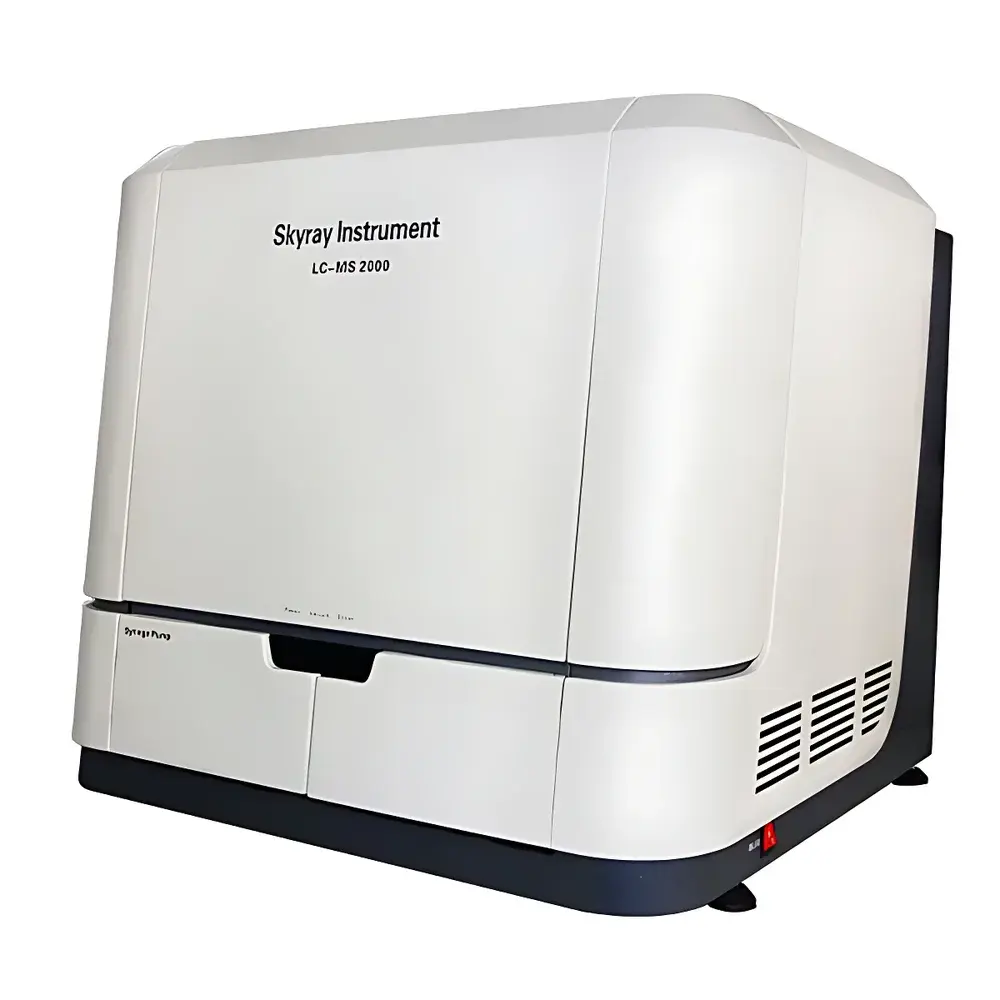
SkyRay LC-MS 2000 Single Quadrupole Liquid Chromatography Mass Spectrometer
| Brand | SkyRay Instrument |
|---|---|
| Origin | Jiangsu, China |
| Manufacturer Type | Original Equipment Manufacturer (OEM) |
| Instrument Type | Single Quadrupole LC-MS |
| Mass Range | m/z 10–2000 amu |
| Sensitivity | ≥50:1 S/N (RMS) for 10 pg reserpine in ESI+ mode |
| Resolution | Unit mass resolution (peak width at 10% height: ≤0.7 amu) |
| Mass Accuracy | ≤±0.20 amu |
| Ionization Sources | ESI (standard), APCI & APPI (optional) |
| Polarity Switching Time | ≤20 ms (−10 kV to +10 kV) |
| Vacuum System | High-speed imported turbomolecular pump |
| Software | ChemAnalyst v3.x with 21 CFR Part 11 compliance modules, audit trail, user privilege management, and GLP/GMP-ready workflow support |
Overview
The SkyRay LC-MS 2000 is a compact, single quadrupole liquid chromatography–mass spectrometry (LC-MS) system engineered for robust quantitative and qualitative analysis in regulated and research laboratory environments. It integrates high-efficiency reversed-phase or HILIC liquid chromatography with a mass-selective detector operating on the principle of mass filtering via radiofrequency (RF) and direct current (DC) voltage scanning across a quadrupole mass analyzer. The instrument employs electrospray ionization (ESI) as its standard atmospheric pressure ion source, optimized with a patented vortex-heated gas delivery system that ensures precise, uniform thermal control—critical for reproducible ionization efficiency across diverse analyte classes including polar small molecules, peptides, and thermally labile pharmaceuticals. Its compact mechanical architecture reduces footprint by over 30% compared to legacy benchtop LC-MS platforms, while the upgraded high-capacity turbomolecular vacuum system minimizes chemical background noise and enhances signal stability during extended acquisition runs.
Key Features
- Single quadrupole mass analyzer with unit mass resolution (≤0.7 amu at 10% peak height) and mass accuracy ≤±0.20 amu—validated per JJG 1168–2019 (Chinese National Verification Regulation for Mass Spectrometers)
- ESI source with precision temperature control (±0.5 °C) and rapid polarity switching (≤20 ms between −10 kV and +10 kV), enabling seamless dual-mode analysis within a single chromatographic run
- Patented hexapole ion guide system significantly improves ion transmission efficiency—particularly for high-mass ions (m/z > 800)—enhancing sensitivity and dynamic range
- Modular ion source options: ESI (standard), APCI and APPI (field-upgradable), supporting broad compound coverage from non-polar hydrocarbons to highly polar metabolites
- Integrated ChemAnalyst software with dual-language UI (English/Chinese), automated sequence control, and full 21 CFR Part 11 compliance—including electronic signatures, role-based access control, and immutable audit trails
- High-throughput capability via optional autosampler integration; supports unattended operation for up to 192 samples with customizable injection protocols and retention time locking
Sample Compatibility & Compliance
The LC-MS 2000 accommodates liquid samples compatible with standard HPLC/UHPLC mobile phases (e.g., water/acetonitrile/formic acid gradients) and is routinely deployed for analysis of complex matrices including biological fluids (plasma, urine), food homogenates, environmental extracts (water, soil, air filters), polymer leachates, and pharmaceutical formulations. It meets performance criteria outlined in ISO/IEC 17025:2017 for testing laboratories and supports method validation per ICH Q2(R2), USP , and FDA Bioanalytical Method Validation Guidance. All data handling workflows comply with GLP and GMP requirements, including full traceability of raw data, processing parameters, calibration history, and operator actions—enabling successful inspection readiness for regulatory audits.
Software & Data Management
ChemAnalyst v3.x serves as the central acquisition, processing, and reporting platform. It provides real-time spectral visualization, peak integration with adaptive baseline correction, library searching against NIST/EPA/Wiley mass spectral databases, and customizable report templates compliant with LIMS export standards (ASTM E1467, ASTM E2524). Raw data files are stored in vendor-neutral .d format with embedded metadata (instrument configuration, calibration status, sequence log). The software includes built-in data integrity safeguards: automatic hash generation for raw files, time-stamped audit logs for all user actions, and configurable retention policies aligned with ALCOA+ principles (Attributable, Legible, Contemporaneous, Original, Accurate, Complete, Consistent, Enduring, Available).
Applications
- Pharmaceutical & Biomedical: Quantitative bioanalysis of small-molecule drugs and metabolites; purity assessment of synthetic intermediates and active pharmaceutical ingredients (APIs); screening of peptide therapeutics and natural product extracts
- Food Safety: Multi-residue detection of pesticides (organophosphates, neonicotinoids), veterinary drug residues (tetracyclines, sulfonamides), mycotoxins (aflatoxins, ochratoxin A), and unauthorized dyes (e.g., Sudan dyes)
- Environmental Monitoring: Targeted analysis of volatile organic compounds (VOCs), polycyclic aromatic hydrocarbons (PAHs), phthalate esters (PAEs), brominated flame retardants (PBDEs, PBBs), and endocrine disruptors (bisphenol A, alkylphenols)
- Industrial Compliance: RoHS 2.0 and REACH SVHC screening in electronics, plastics, and coatings; elemental impurity profiling per ICH Q3D
- Forensic Toxicology: Rapid identification of stimulants, opioids, and novel psychoactive substances (NPS) in blood and hair specimens
FAQ
What regulatory standards does the LC-MS 2000 support for data integrity?
It complies with 21 CFR Part 11, EU Annex 11, and ALCOA+ principles through ChemAnalyst’s integrated audit trail, electronic signature, and role-based access control modules.
Can the system perform scheduled polarity switching during a single LC run?
Yes—polarity switching occurs in ≤20 ms without interrupting data acquisition, allowing simultaneous positive/negative ion mode detection per chromatographic peak.
Is method transfer possible from other commercial LC-MS platforms?
Method parameters (retention times, collision energies, dwell times) are exportable/importable in CSV/XML formats; retention time locking and internal standard normalization facilitate cross-platform comparability.
What maintenance intervals are recommended for the ESI source and vacuum system?
Source cleaning is advised every 50–100 sample injections depending on matrix complexity; turbomolecular pump oil replacement is scheduled every 12 months or 8,000 operating hours, whichever comes first.
Does the instrument support isotopic pattern matching for structural confirmation?
Yes—ChemAnalyst includes isotopic distribution simulation (based on elemental composition) and overlay comparison against acquired spectra for confident molecular formula assignment within the m/z 10–2000 range.






