
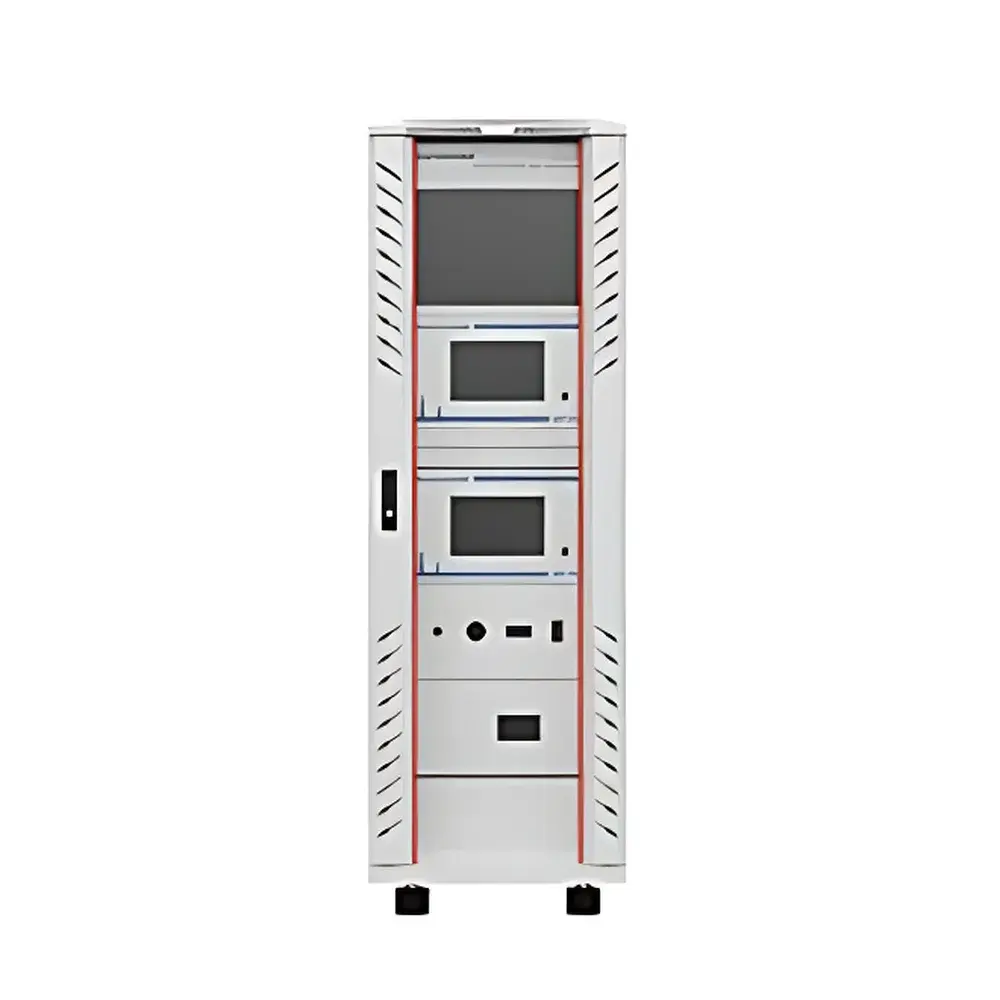
SkyRay Instrument EVOCs-2000 Continuous Ambient Air Volatile Organic Compounds (VOCs) Monitoring System
| Brand | SkyRay Instrument |
|---|---|
| Origin | Jiangsu, China |
| Manufacturer Type | Original Equipment Manufacturer (OEM) |
| Country of Origin | China |
| Model | EVOCs-2000 |
| Detection Principle | Gas Chromatography with Flame Ionization Detection (GC-FID) |
| Instrument Type | Online Analytical System |
| Typical Configuration | Dual-Channel GC-Based VOC Analyzer (C₂–C₅ and C₆–C₁₂) |
| Measurement Range | Quantitative analysis of ≥57 speciated VOCs per HJ 1010–2018 |
| Resolution | Peak resolution ≥1.0 for critical pairs — cyclopentane/isopentane, 2,3-dimethylpentane/2-methylhexane, and o-xylene/styrene |
| Accuracy | ±10% relative to certified reference standards |
Overview
The SkyRay Instrument EVOCs-2000 is a fully automated, dual-channel gas chromatography–flame ionization detection (GC-FID) system engineered for unattended, real-time quantification of speciated volatile organic compounds (VOCs) in ambient air. It operates on the principle of cryogenic preconcentration followed by thermal desorption, capillary column separation, and selective FID detection—enabling compliance with HJ 1010–2018 and supporting regulatory monitoring under China’s National Ambient Air Quality Monitoring Network (NAAQMN). The system implements a two-tier chromatographic architecture: a low-carbon channel (C₂–C₅ hydrocarbons) and a high-carbon channel (C₆–C₁₂ aromatic and aliphatic compounds), each equipped with independent programmable temperature ramping, dedicated cold traps, and optimized carrier gas flow control. This design ensures reproducible retention times, baseline stability, and resolution of structurally similar isomers—critical for photochemical ozone formation potential (POCP) assessment and source apportionment studies.
Key Features
- Dual independent GC-FID modules: Low-carbon (C₂–C₅) and high-carbon (C₆–C₁₂) channels operate concurrently with separate cryo-traps, column ovens, and detector electronics—eliminating cross-channel interference and enabling simultaneous analysis without duty-cycle compromise.
- Cryogenic preconcentration using semiconductor-cooled traps reaching −35 °C, eliminating reliance on liquid nitrogen while maintaining quantitative adsorption efficiency for trace-level VOCs (sub-pptv sensitivity).
- Rapid thermal desorption with heating rates >50 °C/s, ensuring narrow peak widths, improved signal-to-noise ratio, and enhanced chromatographic fidelity for co-eluting species.
- Fully inertized sample pathway: All wetted surfaces—including stainless-steel tubing, Swagelok fittings, and valve manifolds—are chemically passivated (SilcoNert® or equivalent) to minimize adsorption/desorption hysteresis of reactive VOCs (e.g., aldehydes, terpenes, and oxygenates).
- Integrated moisture removal: A heated Nafion™ membrane dryer and optional chilled condenser remove water vapor prior to trapping—preserving trap integrity and preventing ice formation or column contamination.
- Overlapping sampling cycle: While one sample undergoes thermal desorption and chromatographic analysis, the next sample is simultaneously collected and preconcentrated—achieving ≤60-minute reporting intervals with >95% data capture uptime.
- Full thermal management: Entire sample path—from inlet manifold through trap and column—to detector is actively heated (50–200 °C), preventing condensation and carryover between injections.
- Precision gas control: Mass flow controllers (MFCs) regulate sampling flow; electronic pressure controllers (EPCs) maintain consistent carrier and detector gas pressures—ensuring method robustness across ambient pressure fluctuations.
Sample Compatibility & Compliance
The EVOCs-2000 accepts ambient air directly via standardized sampling manifolds (per HJ 654–2013), as well as discrete samples from SUMMA® canisters and Tedlar® bags. Its analytical scope covers all 57 target compounds specified in HJ 1010–2018—including BTEX, C₂–C₅ alkanes/alkenes, C₆–C₈ aromatics, and selected carbonyls—each quantified against NIST-traceable calibration standards. The system satisfies QA/QC requirements outlined in the “Technical Specification for Quality Control of Continuous VOC Monitoring in National Ambient Air Networks (Trial)” including daily zero/span checks, multi-point calibration verification, and system suitability testing (SST) for resolution and retention time stability. Data logging complies with GLP-aligned audit trails, and raw chromatograms, integration parameters, and calibration records are retained locally for ≥180 days—supporting retrospective validation and regulatory review.
Software & Data Management
The integrated industrial PC runs proprietary Windows-based acquisition and processing software featuring full Chinese–English bilingual interface, method editor with sequence scheduling, and automatic peak identification using retention time locking (RTL) algorithms. All chromatographic parameters—including oven ramps, trap temperatures, detector gains, and integration baselines—are configurable and stored in encrypted method files. Raw data (ASCII .csv and native .raw formats), processed results, instrument status logs, and QA/QC reports are automatically archived and transmitted via TCP/IP (Ethernet), RS-485, or 4G LTE to central environmental monitoring platforms. Optional OPC UA server support enables seamless integration into SCADA or EMS infrastructure. Software architecture adheres to principles aligned with FDA 21 CFR Part 11 for electronic record integrity—featuring user role-based access control, digital signature capability, and immutable audit trail generation.
Applications
- Ambient air quality monitoring networks requiring PAMS (Photochemical Assessment Monitoring Stations) compliance.
- Industrial park boundary and fenceline monitoring for early leak detection and emission attribution.
- Super-site atmospheric chemistry research—supporting ozone precursor reactivity modeling and VOC–NOₓ sensitivity analysis.
- Emergency response scenarios: Rapid deployment for fugitive emission characterization during chemical incidents or storage tank overfills.
- Long-term trend analysis for regulatory reporting under national VOC reduction programs and regional airshed management plans.
FAQ
What VOC compounds does the EVOCs-2000 quantify?
It quantifies all 57 target VOCs defined in HJ 1010–2018—including ethane, propane, benzene, toluene, xylenes, ethylbenzene, styrene, and C₆–C₁₂ alkylbenzenes—with method-specific calibration for each compound.
Does the system meet international standards such as ISO or ASTM?
While primarily designed for HJ 1010–2018 compliance, its GC-FID methodology aligns with ISO 16017-1 (indoor air) and ASTM D5504 (natural gas)—with performance validation possible via third-party intercomparison using EPA TO-14A/TO-15 protocols.
Can the system be integrated with existing environmental data platforms?
Yes—via Modbus TCP, OPC UA, or HTTP REST API, enabling direct ingestion into provincial or national environmental information systems (e.g., China’s MEP Online Platform).
Is remote diagnostics and software update supported?
Yes—through secure SSH tunneling and TLS-encrypted web interface; firmware updates and method revisions can be deployed remotely with version-controlled rollback capability.
What maintenance intervals are recommended for routine operation?
Trap cartridges: 6 months or 1,000 cycles; FID jet cleaning: quarterly; GC column bake-out: monthly; full system performance verification: every 90 days per HJ 1010–2018 QA/QC protocol.







