
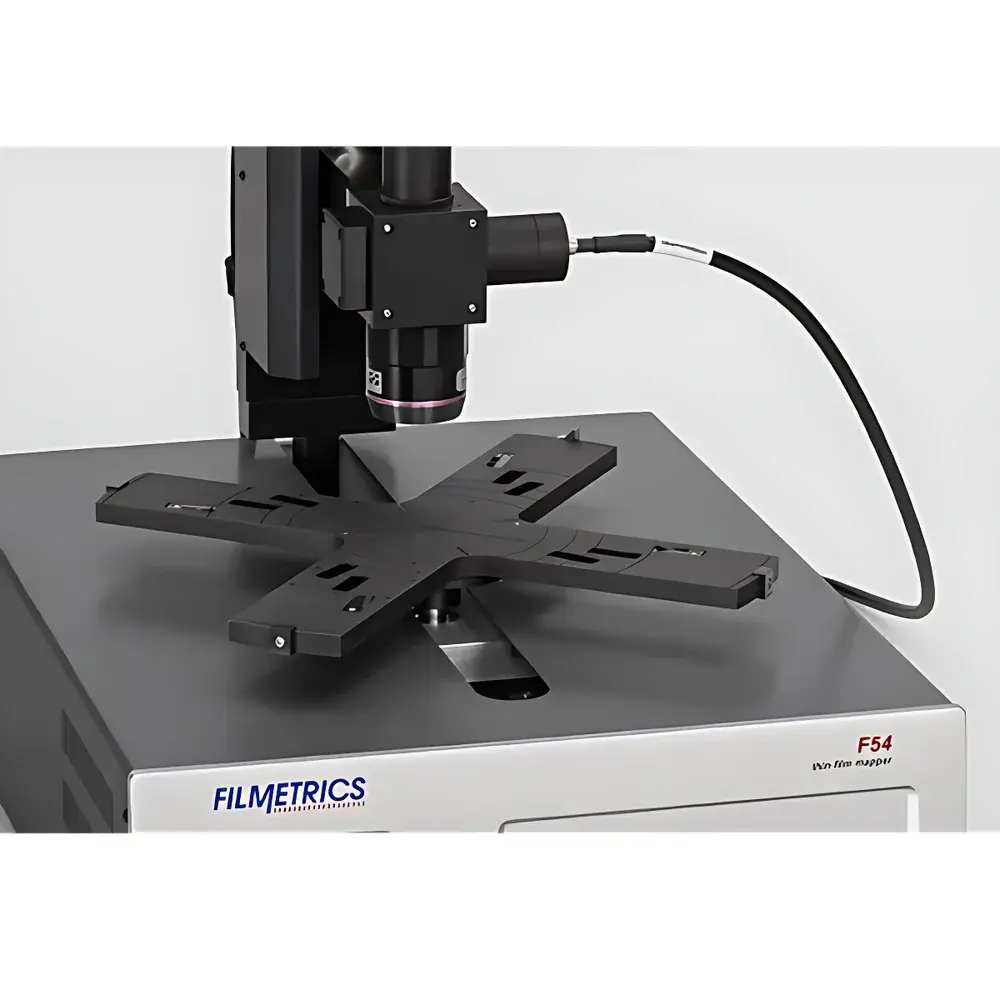
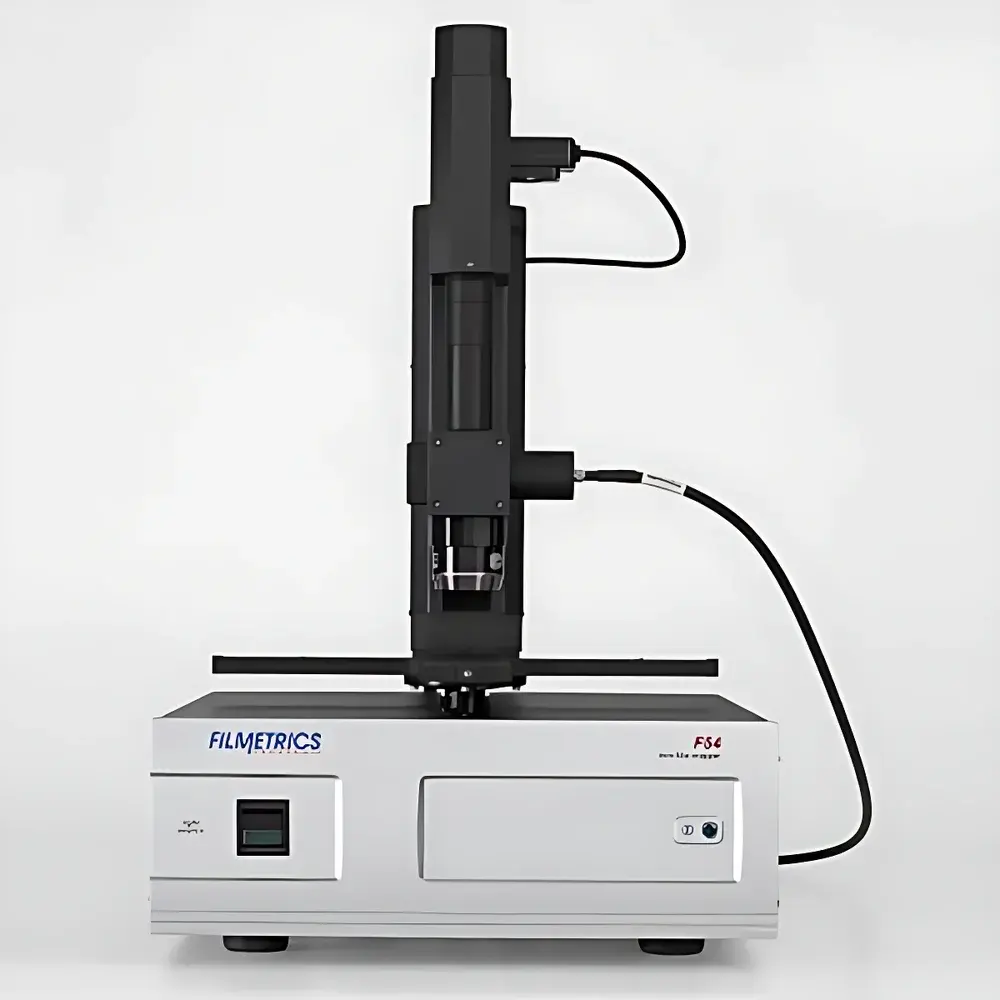
KLA Filmetrics F54 Series White Light Interferometric Thin-Film Thickness Measurement System
| Brand | KLA |
|---|---|
| Origin | USA |
| Manufacturer | KLA Corporation |
| Product Type | Imported Instrument |
| Model | F54 Series |
| Pricing | Upon Request |
| Thickness Range | 4 nm – 100 µm (depending on configuration) |
| Wavelength Range | 190–1700 nm (F54-UVX) |
| Spot Size | Down to 1 µm (with 50× objective) |
| Aperture Options | 500, 250, 100, and 50 µm |
| Measurement Speed | Up to 2 points per second |
| Maximum Sample Diameter | 450 mm |
| Built-in Material Library | >130 refractive index & extinction coefficient datasets |
| Compliance | ASTM F398, ISO/IEC 17025-compatible operation environment |
| Software | Filmetrics F54 Metrology Suite v6.x (Windows 10/11, USB 3.0 interface) |
Overview
The KLA Filmetrics F54 Series is a benchtop white light interferometric thin-film thickness measurement system engineered for high-precision, non-contact, and non-destructive characterization of single- and multi-layer dielectric, semiconductor, and optical coatings. Operating on the principle of spectral reflectance analysis, the F54 acquires interference spectra from broadband illumination reflected at film-substrate and air-film interfaces; proprietary algorithms then solve the optical model using Fresnel equations and least-squares fitting to extract layer thicknesses, optical constants (n, k), and interfacial roughness—without requiring ellipsometric modeling or vacuum environments. Designed for integration into R&D labs, process development cleanrooms, and inline QA/QC stations, the system delivers sub-nanometer repeatability on SiO₂, SiNₓ, photoresists, ITO, DLC, and polymer films across wafers up to 450 mm in diameter.
Key Features
- Motorized R-Theta stage with programmable mapping: supports concentric circle, linear scan, grid, and custom point lists—up to thousands of measurement locations per run
- Modular optical head architecture: interchangeable objectives (5×, 10×, 15×, 50×) and aperture modules enabling spot sizes from 1 µm to 500 µm for micro-scale and macro-scale metrology
- Multi-spectral platform options: F54-UV (190–1100 nm), F54-NIR (950–1700 nm), F54-EXR (380–1700 nm), and F54-UVX (190–1700 nm) ensure optimal signal-to-noise ratio across diverse material systems—from ultra-thin ALD oxides (<5 nm) to thick polymer stacks (>80 µm)
- Integrated spectrometer and stabilized halogen/deuterium light source with thermal management for <0.05% intensity drift over 8-hour operation
- Out-of-the-box calibration traceability: includes BK7 reference slide, SiO₂-on-Si thickness standards (4″, 6″, 200 mm), and focus/thickness verification artifacts compliant with NIST-traceable practices
- Filmetrics Metrology Suite software with FDA 21 CFR Part 11-ready audit trail, electronic signature support, and GLP/GMP-compliant report generation
Sample Compatibility & Compliance
The F54 accommodates rigid and semi-rigid substrates including silicon, sapphire, fused silica, glass, quartz, and metal wafers—flat or slightly warped (up to 50 µm TTV). It measures transparent, translucent, and semi-transparent films without sample preparation or metallization. The system meets key industry requirements: optical models are validated against ASTM F398 (Standard Test Method for Measuring Thickness of Transparent Films Using Spectral Reflectance), and data integrity workflows align with ISO/IEC 17025:2017 clause 7.7 (Ensuring Validity of Results). All configurations operate within Class 1000 cleanroom environments and support ESD-safe handling protocols. Vacuum chucking and optional motorized Z-focus compensation accommodate warped or bowed substrates.
Software & Data Management
Filmetrics Metrology Suite v6.x provides intuitive recipe-driven operation: users define measurement patterns, optical models (single-layer, two-layer, graded-index), and pass/fail criteria via guided wizards—no programming expertise required. Real-time spectral preview, automatic peak detection, and iterative convergence monitoring ensure robust fit validation. Raw spectra, fitted parameters, and uncertainty estimates (±0.1 nm typical for 100 nm SiO₂ on Si) are stored in HDF5 format with embedded metadata (timestamp, operator ID, instrument serial, environmental logs). Export options include CSV, XML, and PDF reports compliant with internal QA templates or external regulatory submissions. Remote diagnostics, firmware updates, and cloud-based method library sharing are enabled via secure HTTPS connection.
Applications
- Process development of ALD, PECVD, and spin-coated dielectrics in semiconductor front-end-of-line (FEOL) and back-end-of-line (BEOL) fabrication
- Quality control of anti-reflective, hard-coat, and barrier layers on display glass, solar cells, and medical optics
- Research on 2D materials (MoS₂, h-BN), perovskite photovoltaic stacks, and biopolymer thin films
- In-process thickness monitoring during roll-to-roll coating and sputtering deposition
- Failure analysis of delamination, blistering, and interfacial oxidation via comparative spectral residual analysis
FAQ
What is the minimum measurable thickness for SiO₂ on silicon?
For F54-UVX configuration, the practical lower limit is ~0.4 nm with optimized signal averaging and high-quality reference calibration—validated per ASTM F398 Annex A3.
Can the F54 measure opaque or absorbing films such as metals or doped semiconductors?
Yes—provided the film is semi-transparent in the selected wavelength range (e.g., ultrathin TiN or Cr measured in UV-VIS; Ge or GaAs in NIR), and an appropriate optical model incorporating complex refractive index is applied.
Is GLP/GMP documentation support included?
Yes—the software includes configurable audit trails, user access levels, electronic signatures, and IQ/OQ documentation templates aligned with FDA 21 CFR Part 11 and EU Annex 11 requirements.
How often does the system require recalibration?
Under stable lab conditions (23 ± 1 °C, <50% RH), annual verification against certified thickness standards is recommended; daily focus validation using the TS-Focus-SiO₂-4-10000 artifact is advised for production-critical use.
Does the F54 support automated integration with factory MES or SECS/GEM?
Via optional API package (Filmetrics Connect SDK), the system supports RESTful HTTP endpoints and SECS/GEM HSMS communication for bidirectional data exchange with host manufacturing execution systems.



