
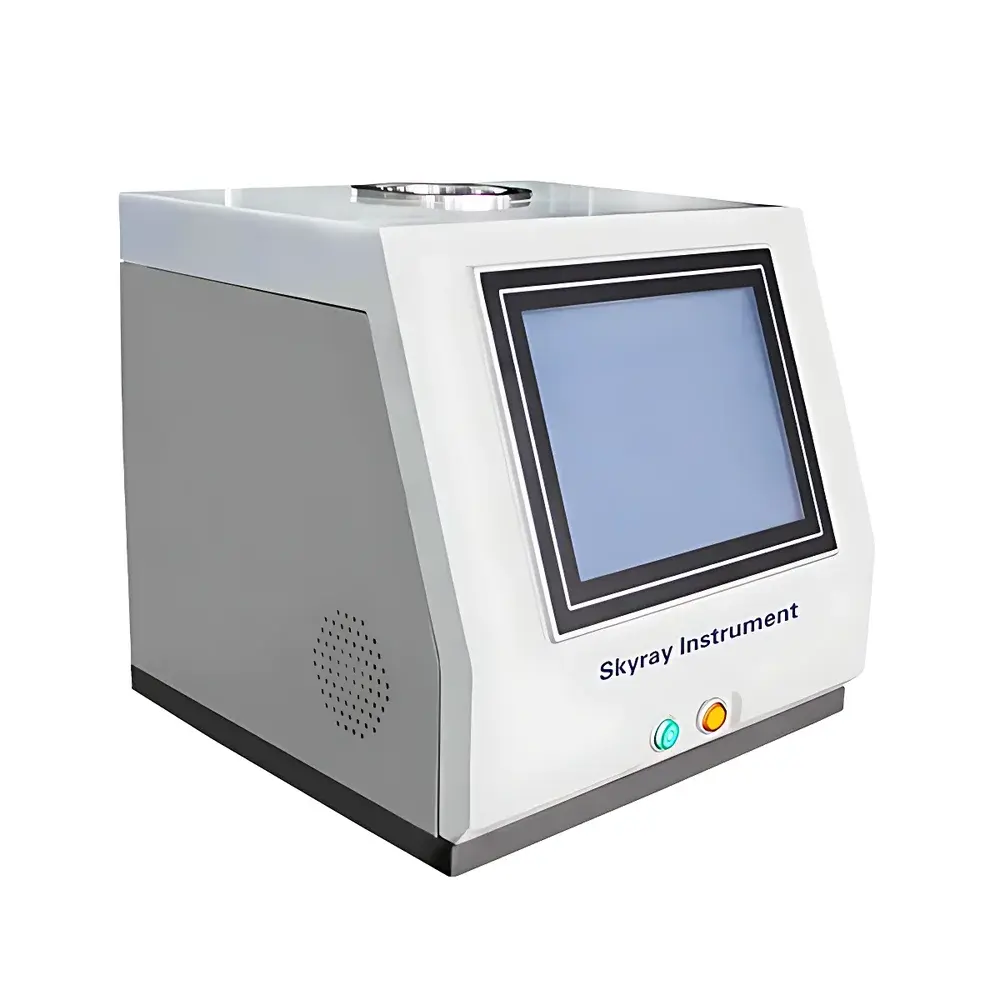
SkyRay Instrument SEE100 Energy Dispersive X-Ray Fluorescence Spectrometer for Soil Heavy Metal Analysis
| Brand | SkyRay Instrument |
|---|---|
| Origin | Jiangsu, China |
| Manufacturer Type | Original Equipment Manufacturer (OEM) |
| Product Type | Domestic |
| Model | SEE100 |
| Configuration | Benchtop/Floor-standing |
| Application Domain | Soil & Atmospheric Environmental Monitoring |
| Elemental Range | S (16) to U (92) |
| Quantification Range | 0.1 ppm – 99.99% (matrix-dependent) |
| Energy Resolution | ≤125 eV at Mn Kα |
| Detector | FAST-SDD (Silicon Drift Detector) |
| Excitation Source | Adjustable X-ray Tube (5–55 kV, 50–1000 µA) |
| Measurement Time | 60–300 s per sample |
| Simultaneous Elements | ≥30 |
| Sample Forms | Solid, Powder, Slurry, Liquid |
| Compliance | HJ 780–2015, GBZ 115–2002, ISO 12847, ASTM D6388 |
Overview
The SkyRay Instrument SEE100 is a benchtop/floor-standing energy dispersive X-ray fluorescence (ED-XRF) spectrometer engineered for rapid, non-destructive quantification of heavy metals and trace elements in soil, sediment, sludge, and related environmental matrices. Based on fundamental XRF physics—where primary X-rays excite inner-shell electrons in sample atoms, inducing characteristic secondary (fluorescent) X-ray emission—the SEE100 delivers laboratory-grade elemental analysis without digestion or chemical reagents. Its core architecture integrates a high-stability microfocus X-ray tube with variable voltage/current control (5–55 kV / 50–1000 µA), a cryogen-free FAST-SDD detector offering ≤125 eV energy resolution at Mn Kα, and a robust sample chamber optimized for heterogeneous environmental solids. Designed explicitly for compliance-driven environmental laboratories, the SEE100 meets the performance criteria specified in China’s HJ 780–2015 standard for soil heavy metal determination and aligns with internationally recognized methodologies including ISO 12847 (soil analysis by ED-XRF) and ASTM D6388 (XRF screening of contaminated soils).
Key Features
- Optimized excitation geometry with selectable collimation and fixed-beam alignment to maximize signal-to-background ratio for low-Z to high-Z elements (S to U)
- FAST-SDD detector with real-time pulse processing and digital multi-channel analyzer (MCA) firmware, enabling high count-rate throughput (>100,000 cps) and minimal spectral peak overlap
- Automated high-voltage and current regulation ensures consistent excitation conditions across diverse soil matrices, minimizing matrix-induced absorption/enhancement effects
- Integrated safety architecture compliant with GBZ 115–2002: triple-layer radiation shielding, interlocked chamber door, labyrinth-style beam containment, and fail-safe X-ray tube cutoff
- Benchtop or floor-standing configuration supports flexible lab integration; compact footprint (380 × 360 × 418 mm) accommodates limited space without compromising analytical stability
- Pre-calibrated quantitative methods for 15 priority pollutants defined in Chinese environmental regulations (Pb, Cd, Hg, As, Cr, Ni, Cu, Zn, V, Co, Mn, Mo, Se, Sb, Tl), with optional method development for custom elements
Sample Compatibility & Compliance
The SEE100 accepts unprepared or minimally prepared samples—including air-dried bulk soil, homogenized powders, pressed pellets, slurries, and filter-collected particulates—eliminating acid digestion bottlenecks while maintaining regulatory acceptability for screening and semi-quantitative profiling. It satisfies data quality objectives outlined in HJ 780–2015 for detection limits (e.g., Cd: ≤0.2 mg/kg, As: ≤1.0 mg/kg, Pb: ≤5.0 mg/kg in soil), and supports method validation per ISO/IEC 17025 requirements. Instrument design conforms to electromagnetic compatibility (EMC) standards IEC 61326-1 and electrical safety standard IEC 61010-1. While not FDA 21 CFR Part 11–certified out-of-the-box, audit trails, user access controls, and electronic signature capability can be implemented via optional software modules compliant with GLP/GMP workflows.
Software & Data Management
The proprietary SkyRay EDXRF software suite provides full spectral acquisition, deconvolution, matrix correction (based on fundamental parameter and empirical calibration models), and reporting in accordance with environmental data submission formats. It supports batch analysis, statistical process control (SPC) charting, spatial mapping integration (via CSV/XLS georeferenced output), and automated report generation compliant with CNAS and provincial EPB templates. Raw spectra and processed results are stored with immutable timestamps, operator ID, instrument parameters, and calibration history—enabling full traceability. Data export options include PDF, Excel, XML, and ASCII for LIMS interoperability. Optional cloud-based remote monitoring and fleet management tools allow centralized instrument health diagnostics and method version control across multi-site environmental testing networks.
Applications
- Rapid field-deployable or lab-based soil screening for brownfield site assessment, landfill monitoring, and agricultural land evaluation
- High-throughput pre-screening prior to confirmatory ICP-MS/ICP-OES analysis—reducing lab backlogs and consumables cost by >60%
- In situ verification of remediation effectiveness during thermal desorption, soil washing, or phytostabilization projects
- Regulatory compliance testing for construction material reuse (e.g., excavated soil reclamation under GB 36600–2018)
- Research applications in geochemistry, pedology, and atmospheric deposition studies involving crustal element ratios (e.g., Zr/Rb, Th/U)
- Mobile laboratory integration: modular power conditioning and vibration-dampened mounting enable stable operation in vehicle-mounted configurations
FAQ
Does the SEE100 require vacuum or helium purge for light element analysis?
No—its optimized Be window detector and high-sensitivity SDD enable reliable detection of sulfur (S) and chlorine (Cl) in ambient air mode; vacuum/helium purging is optional for enhanced Na–Mg sensitivity.
Can the SEE100 quantify total mercury in organic-rich soils?
Yes—when used with pressed pellet preparation and certified reference materials (CRMs) matching organic carbon content, it achieves <10% RSD for Hg at 1–50 mg/kg levels, consistent with HJ 780–2015 precision requirements.
Is method transfer possible from ICP-based labs to SEE100 workflows?
Yes—SkyRay provides cross-platform correlation protocols and CRM-matched calibration sets to align SEE100 results with ICP-MS reference data, facilitating seamless transition in accredited laboratories.
What maintenance intervals are recommended for routine operation?
Detector Peltier cooler and X-ray tube operating hours are monitored in real time; annual preventive maintenance includes collimator cleaning, detector energy calibration verification, and high-voltage supply stability check.
Does the system support automated sample changers?
The SEE100 platform is mechanically and software-compatible with third-party 54-position autosamplers; integration requires factory-configured I/O interface and synchronization firmware (optional add-on).



