
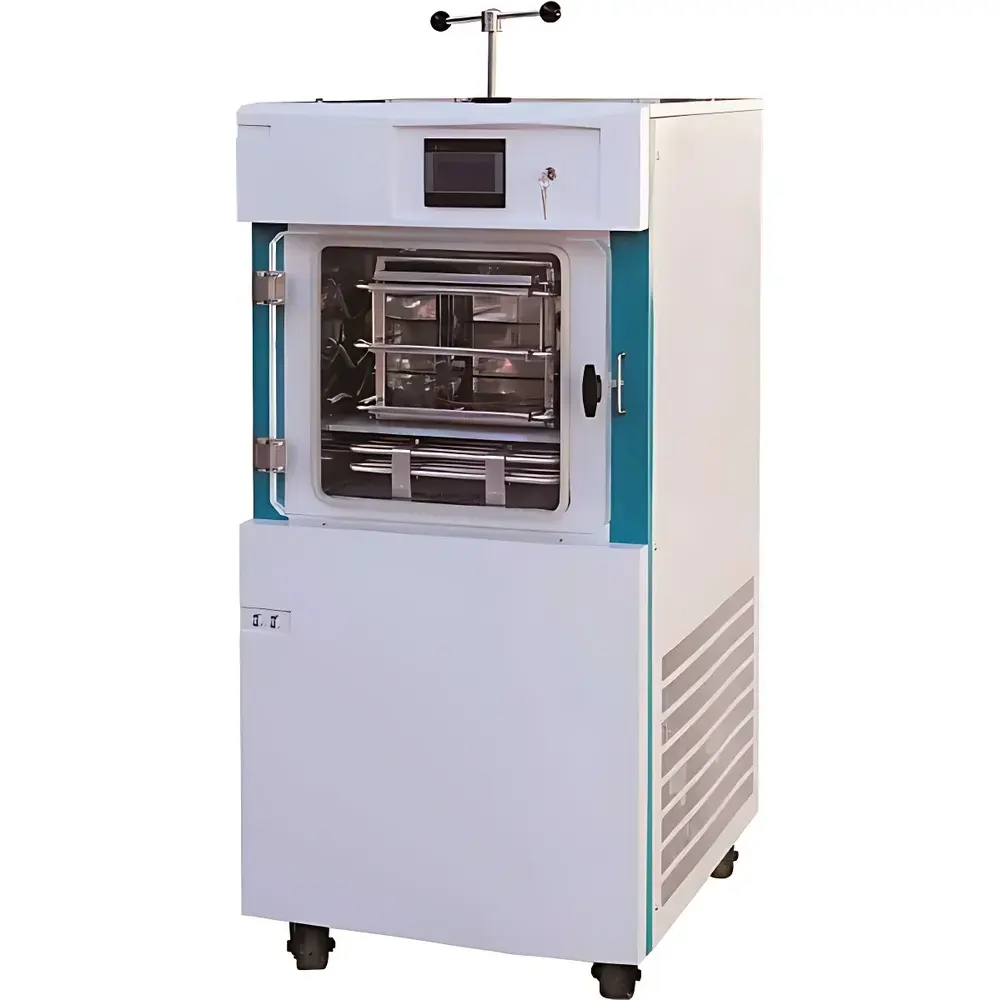
BIOCOOL Pilot2-4H Industrial-Scale Freeze Dryer
| Brand | BIOCOOL |
|---|---|
| Origin | Beijing, China |
| Manufacturer Type | Authorized Distributor |
| Country of Origin | China |
| Model | Pilot2-4H |
| Instrument Type | Standard Shelf-Type Freeze Dryer |
| Application Scope | Pilot-Scale Production |
| Lyophilization Area | 0.2 m² |
| Ultimate Vacuum | <6 Pa |
| Condensate Capacity (24 h) | 6 L/24 h |
| Cold Trap Temperature | <−80 °C |
Overview
The BIOCOOL Pilot2-4H is an industrial-grade shelf-type freeze dryer engineered for reproducible, scalable lyophilization in pilot-scale pharmaceutical, biotechnology, and academic research environments. It operates on the fundamental principle of sublimation—removing water from frozen samples under deep vacuum while maintaining product integrity through precise thermal control. Unlike laboratory benchtop units, the Pilot2-4H integrates process-critical engineering features—including independent shelf temperature control, programmable vacuum regulation, and real-time multi-parameter monitoring—to support GMP-aligned process development, formulation optimization, and technology transfer from R&D to manufacturing. Its −80 °C cold trap, high-capacity condensation system (6 L/24 h), and robust vacuum architecture (<6 Pa ultimate pressure) ensure efficient removal of both bulk and bound moisture from heat-sensitive biologicals, vaccines, diagnostics reagents, and functional food matrices.
Key Features
- Shelf-based lyophilization with independent PID-controlled heating and cooling per shelf, utilizing high-efficiency silicon oil circulation for uniform thermal distribution and minimal gradient deviation (±0.5 °C across shelf surface).
- Advanced vacuum management system enabling dynamic pressure modulation during primary and secondary drying—critical for preventing collapse, bubbling, or vial breakage in sensitive formulations.
- Non-electric cold trap defrost mechanism: eliminates electrical hazards and thermal shock, reduces downtime, and avoids contamination risks associated with immersion-style defrosting.
- Pulse-controlled inert gas backfill system with three adjustable flow rates (slow/medium/fast) to prevent powder dispersion, particle loss, or structural disruption during final chamber pressurization.
- Industrial-grade 10.1″ touchscreen HMI with intuitive workflow navigation; supports full manual intervention for process parameter exploration and fully automated execution once protocols are validated.
- Integrated real-time data acquisition at 50 ms sampling frequency for shelf temperature, product temperature (via optional thermocouples), chamber pressure, and cold trap temperature—enabling rigorous process analytical technology (PAT) compliance.
- Onboard memory stores up to 90 days of continuous operational data; optional USB export and PC database integration (ODBC-compliant) support long-term trend analysis and 21 CFR Part 11–ready audit trails when paired with compliant software.
- Pre-programmable storage for up to 500 user-defined or standardized lyophilization cycles, including ramp rates, hold times, pressure setpoints, and shelf temperature profiles.
Sample Compatibility & Compliance
The Pilot2-4H accommodates a broad range of sample formats: bulk trays (up to 0.2 m²), stoppered vials (with optional hydraulic or manual stoppering), and external flask manifolds. It is optimized for aqueous solutions, suspensions, emulsions, and pastes with eutectic temperatures above −40 °C. While not intended for high-boiling-point organic solvents without add-on solvent traps, its modular design permits integration of optional accessories—including solvent condensation modules, oil mist filters, and vacuum pump anti-backstreaming valves—to extend compatibility. The system meets mechanical safety standards per IEC 61010-1 and incorporates dual-level overtemperature protection, low-voltage (36 V) shelf heating circuits, and interlocked drainage logic to prevent vacuum failure. Its architecture supports alignment with ISO 22000, USP , and FDA guidance for lyophilized product development—particularly when used with optional co-crystallization point detection and endpoint determination modules.
Software & Data Management
The embedded control firmware provides full cycle scripting capability—from freezing ramping and annealing to primary drying slope monitoring and secondary drying endpoint validation. All parameters are timestamped and stored with metadata (operator ID, batch ID, cycle version). Optional PC-based remote supervision enables live status viewing and alarm notification within a 1.5 km line-of-sight range. Data export supports CSV and XML formats compatible with LIMS and MES platforms. Calibration routines for shelf temperature sensors and Pirani/Penning vacuum gauges are accessible via administrator mode, ensuring metrological traceability over extended service intervals. Firmware updates preserve historical protocol libraries and maintain backward compatibility with previously saved cycles.
Applications
- Process development and scale-up studies for parenteral biologics, monoclonal antibodies, and mRNA-LNP formulations.
- Stabilization of diagnostic enzymes, ELISA reagents, and rapid test strip components requiring residual moisture ≤1.5% w/w.
- Preservation of probiotic cultures, microbial consortia, and fermentation-derived metabolites without cryoprotectant dependency.
- Lyophilization of botanical extracts, nutraceutical powders, and peptide-based cosmeceuticals where crystallinity and dissolution kinetics are critical quality attributes.
- Supporting QbD (Quality by Design) initiatives through empirical mapping of critical process parameters (CPPs) against critical quality attributes (CQAs) such as reconstitution time, cake structure, and residual solvent content.
FAQ
What is the maximum allowable load volume for the Pilot2-4H?
The unit supports a total lyophilization area of 0.2 m², typically accommodating up to 12–16 standard 2R vials per shelf layer (depending on tray configuration), or up to 6 L of bulk material across four shelves.
Does the system comply with 21 CFR Part 11 requirements?
Out-of-the-box electronic records meet ALCOA+ principles; full Part 11 compliance requires deployment of validated third-party software with role-based access control, electronic signatures, and audit trail review functionality.
Can the cold trap handle acetone or ethanol condensation?
Standard configuration is rated for water vapor only; optional organic solvent traps with −105 °C condensing capability must be installed for non-aqueous applications.
Is shelf temperature calibration traceable to NIST standards?
Yes—calibration procedures include reference to certified RTD probes with documented uncertainty budgets; certificate of calibration is provided upon request.
What maintenance intervals are recommended for the vacuum pump and compressor?
Oil-lubricated rotary vane pumps require oil replacement every 500 operating hours; compressors undergo annual performance verification per ISO 8573-1 air purity classification testing.



