
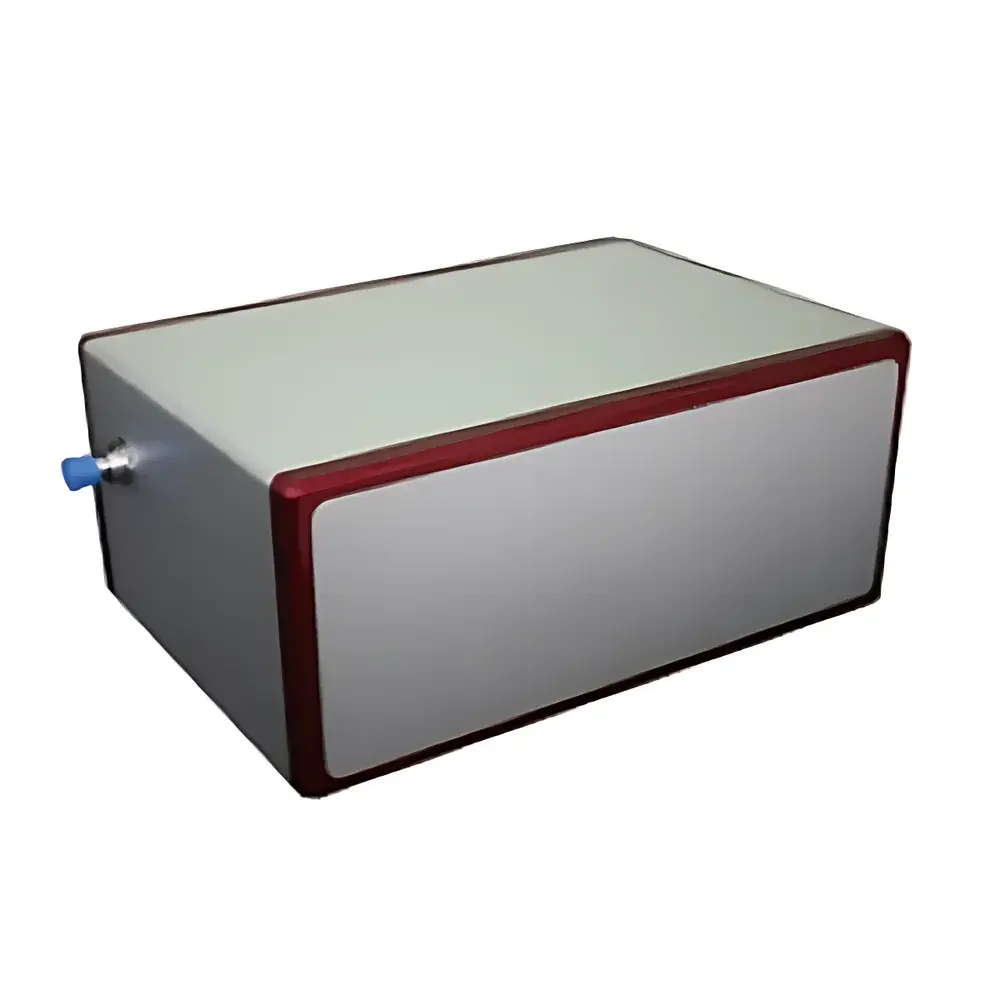
Arcoptix FTNIR-L1 Portable Fourier Transform Near-Infrared Spectrometer
| Brand | Arcoptix |
|---|---|
| Origin | Switzerland |
| Model | FTNIR-L1 |
| Instrument Type | Portable |
| Spectral Range | 11000–3850 cm⁻¹ (0.9–2.6 µm) |
| Resolution | 4 or 8 cm⁻¹ |
| Wavenumber Accuracy | < 2% (1100–2500 nm) over 10 hours |
| Detector | Single-element TE-cooled InGaAs photodiode |
| Input | Fiber-coupled |
Overview
The Arcoptix FTNIR-L1 is a compact, fiber-optic coupled Fourier Transform Near-Infrared (FT-NIR) spectrometer engineered for high-fidelity spectral acquisition in laboratory, industrial, and field-deployable environments. Unlike dispersive grating-based NIR instruments—whose performance degrades beyond ~2100 nm due to detector cutoff and optical aberrations—the FTNIR-L1 leverages interferometric measurement principles rooted in the Michelson interferometer architecture to deliver continuous, high-stability spectral data across the full 0.9–2.6 µm range (equivalent to 11000–3850 cm⁻¹). This broad coverage enables robust quantification of C–H, O–H, and N–H overtones and combination bands critical for pharmaceutical raw material verification, agricultural moisture/protein analysis, polymer composition screening, and fuel quality assessment. Its single-element, thermoelectrically cooled InGaAs detector eliminates pixel-to-pixel non-uniformity, fixed-pattern noise, and dark current drift—common limitations in array-based detectors—while the absence of moving gratings or slits ensures immunity to stray light contamination and mechanical misalignment over time.
Key Features
- Fiber-optic input interface compatible with standard SMA-905 connectors, enabling flexible integration with remote sampling probes, flow cells, or diffuse reflectance accessories
- Interferometer-based optical design with solid-state alignment and no moving mirrors during spectral acquisition—optimized for long-term wavenumber stability (< 2% deviation over 10 hours in the 1100–2500 nm region)
- Resolution selectable at 4 cm⁻¹ (typical) or 8 cm⁻¹, corresponding to spectral sampling intervals of < 0.5 nm at 1000 nm and < 2.5 nm at 2500 nm
- Compact aluminum housing with passive thermal management; designed for operation in ambient temperatures from 10 °C to 35 °C without active cooling
- Single-element InGaAs photodiode with two-stage TE cooling, achieving effective dark current suppression and enhanced signal-to-noise ratio for low-light applications
- No internal calibration source required; supports external reference measurements using certified NIST-traceable standards for routine instrument validation
Sample Compatibility & Compliance
The FTNIR-L1 accepts samples via fiber-optic coupling, supporting transmission, attenuated total reflectance (ATR), and diffuse reflectance configurations when paired with appropriate accessories. It is suitable for liquid, solid, and semi-solid matrices—including tablets, grains, powders, oils, and aqueous solutions—without requiring sample dilution or extensive preparation. The system complies with fundamental spectroscopic metrology practices aligned with ISO/IEC 17025 requirements for testing laboratories. While not pre-certified for regulated GMP environments, its stable interferometric architecture and deterministic spectral response support method validation under ICH Q2(R2) guidelines. Data integrity is maintained through timestamped spectral acquisition and metadata logging, facilitating audit readiness in GLP-compliant workflows.
Software & Data Management
The spectrometer operates via Arcoptix’s cross-platform FTIR control software (Windows/macOS/Linux), which provides real-time interferogram visualization, apodization selection (e.g., Blackman-Harris), phase correction, and Fourier transformation. Export formats include CSV, JCAMP-DX, and HDF5, ensuring compatibility with chemometric platforms such as MATLAB, Python (SciPy, scikit-learn), Unscrambler, and Pirouette. Raw interferograms are preserved alongside processed spectra, enabling retrospective reprocessing with updated calibration models or baseline correction algorithms. The software supports batch acquisition, spectral averaging, and user-defined ROI integration—essential for process analytical technology (PAT) deployment. Audit trail functionality records operator ID, acquisition parameters, and timestamped modifications, aligning with FDA 21 CFR Part 11 expectations for electronic records where enabled by institutional IT policy.
Applications
- Pharmaceutical: Identification and assay of active pharmaceutical ingredients (APIs) and excipients in blend uniformity studies and tablet dissolution monitoring
- Agriculture: Rapid determination of moisture, protein, starch, and oil content in cereals, oilseeds, and forage materials
- Food & Beverage: Authentication of origin and adulteration detection in honey, olive oil, milk powder, and fruit juices
- Polymer Science: Quantitative analysis of copolymer ratios, plasticizer content, and degradation markers in thermoplastics and elastomers
- Fuel Analysis: Measurement of ethanol content in gasoline blends and biodiesel concentration in diesel fuels per ASTM D7862 and EN 14078
- Research: Time-resolved NIR kinetics for catalytic reactions, hydration dynamics, and crystallization processes
FAQ
Is the FTNIR-L1 compliant with FDA 21 CFR Part 11?
The hardware and software architecture support Part 11 compliance when deployed within a validated institutional environment—including electronic signatures, audit trails, and access controls—but formal certification requires site-specific validation by the end user.
Can the resolution be upgraded post-purchase?
Resolution is determined by the maximum optical path difference (OPD) of the interferometer and is fixed at factory configuration; 4 cm⁻¹ and 8 cm⁻¹ options are selected at time of order.
Does the system include a built-in reference laser?
No—wavenumber calibration relies on external reference standards (e.g., polystyrene film or rare-earth oxide filters); this design enhances long-term stability by eliminating laser drift dependencies.
What fiber specifications are recommended for optimal throughput?
600 µm core diameter, 0.22 NA silica-silica fiber with UV-VIS-NIR grade coating is recommended; shorter lengths (< 2 m) minimize modal noise and attenuation above 2200 nm.
Is spectral library matching supported out-of-the-box?
Yes—the software includes basic correlation search and PLS regression tools; third-party libraries (e.g., ATR-FTNIR databases from Bruker or Bio-Rad) can be imported in JCAMP-DX format.



