
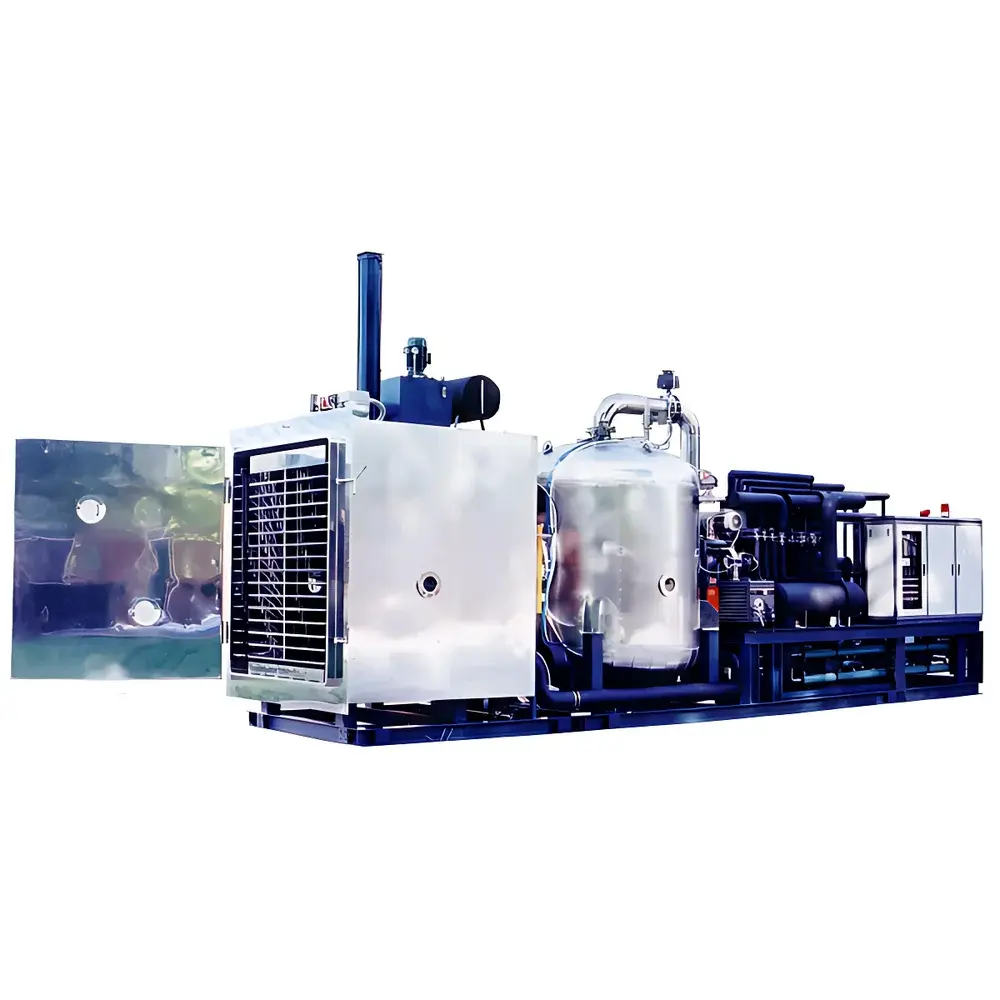
BIOCOOL LYO-25 Production-Scale Freeze Dryer
| Brand | BIOCOOL |
|---|---|
| Origin | Beijing, China |
| Model | LYO-25 |
| Type | Standard Shelf-Type Freeze Dryer |
| Application | Production-Scale |
| Lyophilization Area | 25 m² |
| Ultimate Vacuum | <4 Pa |
| Condensate Capacity (24 h) | 500 kg/24 h |
| Cold Trap Temperature | <−75 °C |
Overview
The BIOCOOL LYO-25 Production-Scale Freeze Dryer is an industrial-grade, GMP-compliant lyophilization system engineered for reproducible, scalable, and regulatory-ready freeze drying of pharmaceuticals, biologics, diagnostics, and high-value functional foods. It operates on the fundamental principle of sublimation—removing water from frozen materials under deep vacuum while maintaining product integrity through precise thermal control. The system integrates primary drying (ice sublimation) and secondary drying (adsorbed moisture desorption) within a single, fully enclosed stainless-steel chamber, enabling batch processing of up to 52,500 standard 22-mm vials or equivalent bulk loads. Designed to meet stringent requirements for process validation and continuous manufacturing, the LYO-25 delivers consistent performance across production campaigns, supporting both clinical-phase material supply and commercial-scale output.
Key Features
- Shelf Pre-Freezing Capability: Integrated shelf refrigeration enables in-situ freezing prior to primary drying—eliminating external ultra-low temperature freezers and reducing contamination risk.
- Programmable Process Control System: Fully customizable lyo cycles with up to 2000 stored protocols; supports ramp-hold profiles, vacuum modulation, and pressure-controlled drying stages.
- Advanced Vacuum Regulation: Dynamic vacuum control during both freezing and drying phases prevents boil-over, collapse, and foaming—critical for sensitive proteins, vaccines, and amorphous formulations.
- Pulse Backfill System: Three-speed inert gas (N₂ or argon) reintroduction—slow, medium, or fast—minimizes particle dispersion and preserves structural morphology of lyophilized cakes.
- High-Fidelity Monitoring: Real-time data acquisition at 50 ms intervals for shelf temperature, condenser temperature, chamber pressure, and vacuum level.
- Robust Chamber Construction: Complies with GB150-2011, PED 2014/68/EU, and ASME Section VIII Div. 1; rated for ±0.15 MPa differential pressure; interior mirror-polished (Ra ≤ 0.4 µm) with sanitary CIP/SIP-compatible geometry.
- Automated Sterilization & Cleaning: SIP employs pulsed vacuum steam sterilization with Fo-value logging, triple overpressure protection, and integrated cooling; CIP utilizes orbital-welded piping, helium-leak-verified seals, and German vacuum-assisted moisture removal.
Sample Compatibility & Compliance
The LYO-25 accommodates diverse sample formats—including vials (Ø22 mm), trays, ampoules, and bulk containers—across liquid, suspension, and paste matrices. Its design supports lyophilization of thermolabile biologics (e.g., monoclonal antibodies, viral vectors, mRNA-LNPs), sterile APIs, probiotics, and nutraceuticals. Regulatory compliance includes adherence to FDA 21 CFR Part 11 (electronic records/signatures with audit trail), EU Annex 1 (sterile manufacturing), WHO TRS 986, and ISO 13485:2016. All wetted surfaces are electropolished AISI 316L stainless steel; welds undergo 100% X-ray inspection and helium mass spectrometry leak testing (<1×10⁻⁹ mbar·L/s). Pressure vessel certification is provided per PED and ASME standards.
Software & Data Management
The embedded HMI features a 15-inch industrial touchscreen with intuitive navigation—requiring no external documentation for routine operation. Process data—including shelf temperature curves, vacuum trends, and condenser load—are logged continuously and exportable in CSV or PDF format. Optional modules include: (i) co-located co-crystallization point (eutectic temperature) measurement via resistance thermometry; (ii) comprehensive process data recording compliant with ALCOA+ principles; (iii) PC-based remote monitoring (up to 1.5 km via Ethernet); and (iv) full calibration suite for shelf and condenser temperature sensors, as well as capacitance manometers. Software architecture supports 21 CFR Part 11 user role management, electronic signatures, and immutable audit trails.
Applications
The LYO-25 serves as a core platform in regulated environments including contract development and manufacturing organizations (CDMOs), biopharmaceutical production facilities, vaccine manufacturing sites, and advanced food R&D centers. Typical applications include: terminal sterilization of parenteral formulations; stabilization of live attenuated vaccines; production of lyophilized diagnostic reagents (e.g., ELISA kits, PCR master mixes); preservation of stem cell therapies and exosome preparations; and dehydration of heat-sensitive botanical extracts and probiotic cultures. Its scalability bridges early-phase process development (with LYO-1 to LYO-10 systems) to commercial launch—enabling direct tech transfer without requalification.
FAQ
Is the LYO-25 compliant with FDA 21 CFR Part 11?
Yes—the control system provides full electronic record and signature functionality, including user authentication, audit trail generation, and data immutability.
What is the maximum allowable shelf temperature range?
Shelf temperature is controllable from −75 °C to +80 °C, with uniformity maintained within ±1.0 °C across the entire 25 m² surface.
Can the system be validated for GMP production?
Yes—it is supplied with IQ/OQ documentation templates, DQ support files, and vendor-qualified test protocols aligned with ASTM E2500 and ISPE Baseline Guide.
What optional accessories are available for organic solvent handling?
An optional organic solvent trap, dry vacuum pump package, cascade refrigeration unit, and vacuum oil mist filter are offered to extend compatibility with acetone, ethanol, or tert-butanol-based formulations.
Does the system support automated cycle optimization?
While not AI-driven, its programmable logic controller enables iterative protocol refinement using real-time endpoint detection (via pressure rise test), allowing systematic process parameter optimization per ICH Q5C and Q8(R2).



