
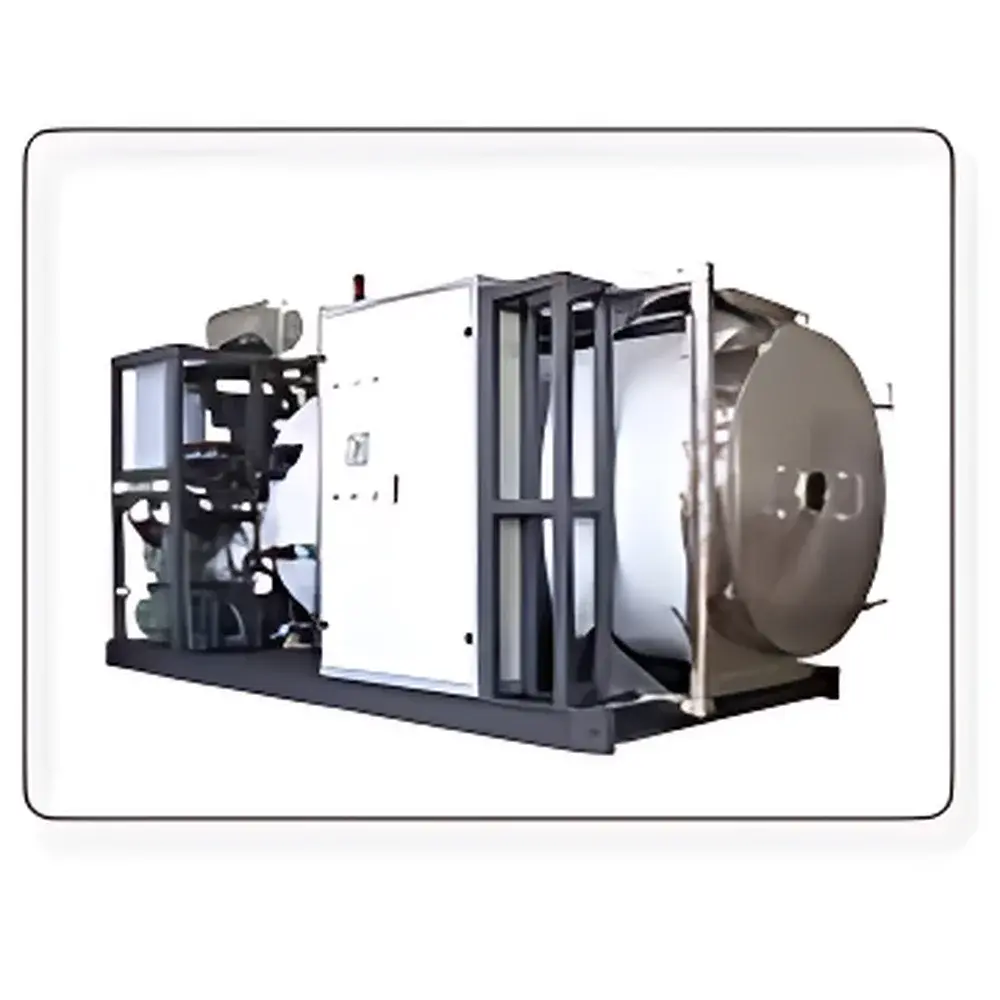
BIOCOOL LYO-7SE Production-Scale Freeze Dryer
| Brand | BIOCOOL |
|---|---|
| Origin | Beijing, China |
| Model | LYO-7SE |
| Instrument Type | Shelf-Type Freeze Dryer |
| Application | Production-Scale Lyophilization |
| Freeze-Drying Area | 7.5 m² |
| Ultimate Vacuum | <4 Pa |
| Condenser Capacity (24 h) | 150 kg/24h |
| Condenser Temperature (No-Load) | <−75 °C |
| Shelf Temperature Range | −55 °C to +110 °C |
| Shelf Configuration | 7+1 shelves |
| Shelf Spacing | 100 mm |
| Programmable Recipes | 2000 |
| Data Acquisition Rate | 50 ms |
| Touchscreen Interface | Industrial HMI Panel |
| Optional Features | Eutectic Point Tester, Dry Vacuum Pump, Cascade Compressor System, Solvent Trap, Vacuum Oil Mist Filter, Remote Monitoring (up to 1.5 km) |
Overview
The BIOCOOL LYO-7SE is a production-scale shelf-type freeze dryer engineered for reproducible, scalable lyophilization of heat-sensitive biopharmaceuticals, herbal extracts, functional food ingredients, and advanced nanomaterials. It operates on the fundamental principle of sublimation under deep vacuum: frozen water is removed directly from the solid phase to vapor without passing through the liquid state, preserving structural integrity, bioactivity, and chemical stability. Designed for continuous batch processing in pilot and small-to-medium manufacturing environments, the LYO-7SE integrates robust thermal management, precise vacuum control, and programmable process logic to meet the stringent demands of process validation and regulatory compliance. Its architecture supports both manual operation and fully automated cycle execution—including pre-freezing, primary drying (sublimation), secondary drying (desorption), and inert gas backfill—making it suitable for GMP-aligned workflows when paired with optional qualification packages.
Key Features
- Shelf-based pre-freezing capability enables uniform thermal conditioning prior to primary drying, eliminating reliance on external ultra-low temperature freezers.
- Triple-mode pulse backfill system (slow/medium/fast) ensures controlled repressurization with nitrogen or other inert gases, minimizing particle dispersion and mass loss in fragile amorphous or fibrous matrices.
- Intelligent vacuum regulation during both primary and secondary drying stages prevents boil-over, cake collapse, and vial breakage by dynamically adjusting pressure setpoints based on real-time product behavior.
- Leak-tight welded stainless-steel shelves manufactured using certified orbital welding techniques ensure long-term integrity and ease of cleaning—critical for cross-batch consistency.
- Automated endpoint detection algorithm evaluates residual moisture trends during late-stage desorption, terminating secondary drying only when predefined moisture thresholds are met.
- Industrial-grade 10.1-inch touchscreen HMI provides intuitive navigation, multilingual support, and context-sensitive guidance—enabling operator independence without procedural documentation.
- Comprehensive data logging at 50 ms intervals captures shelf temperature, condenser temperature, chamber pressure, and valve status, supporting full traceability and post-process analysis.
- Temperature and vacuum sensor calibration functions allow on-site verification and adjustment, maintaining metrological confidence across extended operational lifecycles.
Sample Compatibility & Compliance
The LYO-7SE accommodates vials (Φ22 mm), trays, and custom containers up to 33,600 units per batch. It is routinely deployed for lyophilizing monoclonal antibodies, vaccine intermediates, probiotic formulations, botanical concentrates, enzyme preparations, and ceramic nanoparticle dispersions. While the base configuration meets ISO 22000 and general pharmaceutical Good Manufacturing Practice (GMP) expectations for equipment qualification, full regulatory alignment—including FDA 21 CFR Part 11-compliant electronic records, audit trails, and user access controls—requires integration of optional software modules and third-party validation services. The system complies with IEC 61000-6-2 (EMC immunity) and IEC 61000-6-4 (EMC emission) standards. Structural design conforms to ASME BPVC Section VIII Div. 1 for pressure vessel safety.
Software & Data Management
The embedded control system supports creation, storage, and recall of up to 2000 process recipes—each defining ramp rates, hold durations, pressure profiles, and termination criteria. All operational parameters and sensor outputs are timestamped and archived locally on industrial-grade SSD storage. Optional PC-based remote monitoring enables real-time visualization and alarm notification over Ethernet (up to 1.5 km via fiber-optic extension). Process data exports in CSV format for integration with LIMS, MES, or statistical process control (SPC) platforms. Optional add-ons include e-signature-enabled recipe locking, change history tracking, and deviation reporting aligned with ALCOA+ principles.
Applications
- Biopharmaceutical development: Stabilization of therapeutic proteins, peptides, and viral vectors.
- Traditional medicine: Preservation of active constituents in concentrated herbal decoctions and TCM injectables.
- Functional foods: Encapsulation of probiotics, omega-3 oils, and polyphenol-rich plant extracts.
- Diagnostic reagents: Long-term stabilization of enzyme-linked immunoassay (ELISA) components and PCR master mixes.
- Nanomaterial synthesis: Drying of metal-organic frameworks (MOFs), liposomal suspensions, and colloidal quantum dots without aggregation.
- Feed additives: Production of thermostable microbial inoculants and phytogenic growth promoters.
FAQ
What is the difference between the LYO-7SE and standard GMP-compliant models?
The LYO-7SE is an economic production model optimized for cost-effective scalability; it does not support Clean-in-Place (CIP) or Steam-in-Place (SIP) functionality and lacks factory-installed 21 CFR Part 11 software features. Standard models offer full GMP configurability, including validated sterilization cycles, redundant sensors, and integrated validation documentation.
Can the LYO-7SE be qualified for regulatory submission?
Yes—when equipped with optional IQ/OQ documentation packages, calibrated reference standards, and third-party validation support, the system can serve as part of a validated lyophilization process compliant with ICH Q5C, Q8, and Q9 guidelines.
Is organic solvent compatibility available?
Yes—optional cold trap extensions with solvent-specific condensation surfaces and cryo-cooled baffles enable safe capture of acetone, ethanol, and ethyl acetate vapors during lyophilization of solvent-based formulations.
What maintenance intervals are recommended?
Vacuum pump oil replacement every 500 operating hours; condenser coil inspection quarterly; shelf surface passivation annually; full system calibration every 12 months or after major component replacement.
Does the system support PAT (Process Analytical Technology) integration?
The LYO-7SE provides analog and digital I/O ports (4–20 mA, RS485, Modbus TCP) for integration with external NIR probes, Raman spectrometers, or tunable diode laser absorption sensors used in real-time moisture monitoring.



