
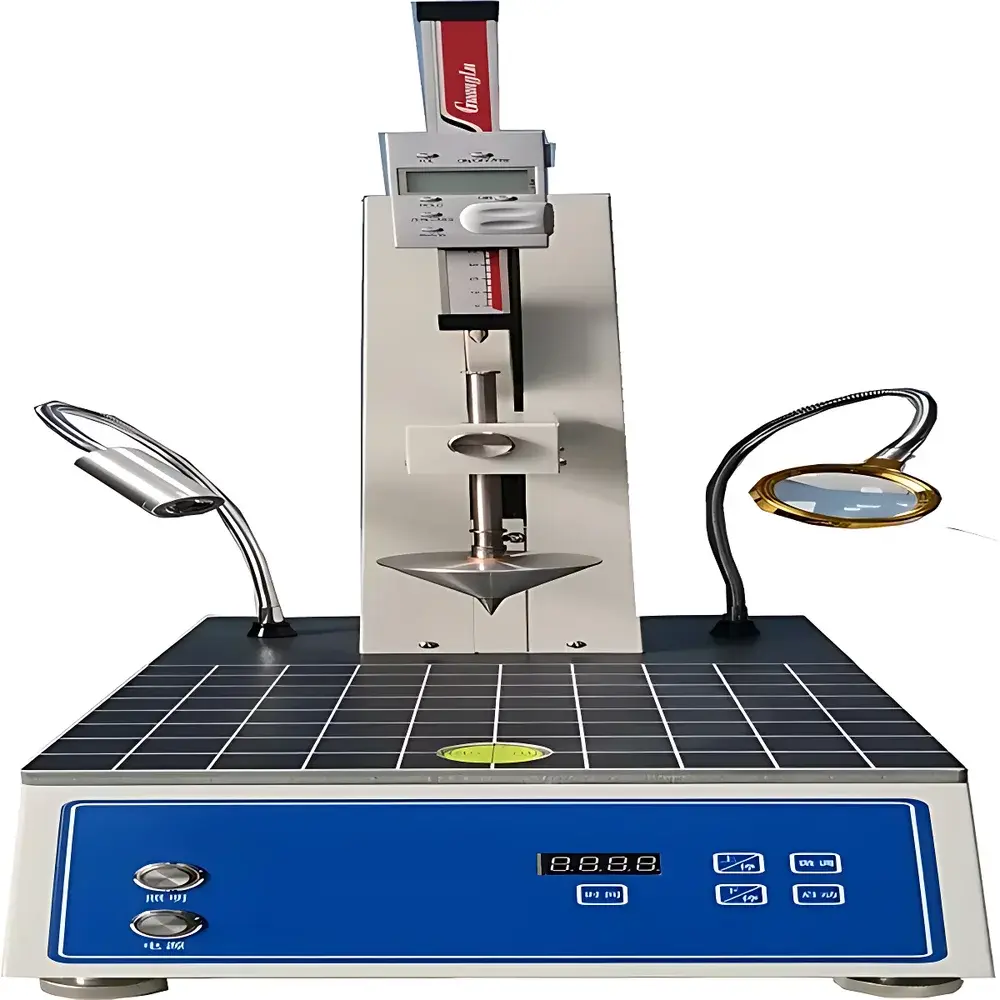
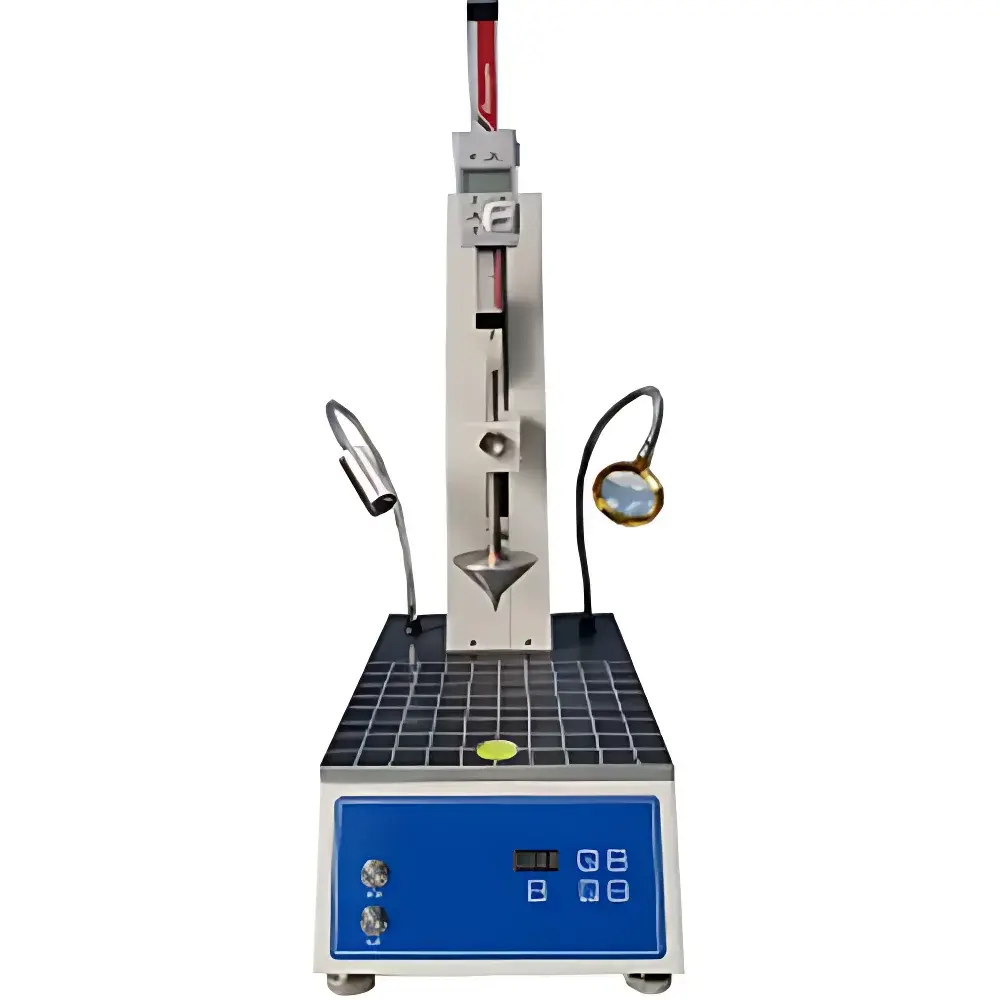
MITONG SYD-2801C-1 Penetration Tester for Bitumen and Grease
| Brand | MITONG (Shanghai Mitong Instrument Co., Ltd.) |
|---|---|
| Origin | Shanghai, China |
| Model | SYD-2801C-1 |
| Penetration Range | 0–700 dmm |
| Temperature Control Range | 0–65 °C |
| Temperature Stability | ±0.1 °C at 25 °C |
| Penetration Resolution | 0.01 mm |
| Penetration Accuracy | ±1 dmm |
| Standard Needle | 50 mm length, 2.5 g ±0.05 g |
| Standard Cone | 102.5 g ±0.05 g |
| Timing Options | 5, 8, 10, 12, 30, 60 s (±0.1 s tolerance) |
| Bath Type | Rigid borosilicate glass cylinder with magnetic stirrer |
| Power Supply | AC 220 V ±10%, 50 Hz, ≤300 W |
Overview
The MITONG SYD-2801C-1 Penetration Tester is a precision mechanical instrument engineered for standardized consistency measurement of semi-solid and viscous materials under controlled thermal and temporal conditions. It operates on the fundamental principle of gravitational penetration: a standardized needle or cone is allowed to descend vertically under a defined load for a specified duration onto a horizontally leveled sample surface maintained at a precise temperature. The depth of penetration—expressed in tenths of a millimeter (0.1 mm = 1 dmm)—is measured optically or digitally and serves as an inverse indicator of material hardness or consistency. This method is universally recognized in petroleum, road construction, and lubrication industries for characterizing bituminous binders, greases, petroleum jellies, and other thermorheologically sensitive materials. The instrument complies strictly with ASTM D5, ASTM D217, ISO 2137, and critically, the Chinese national standards GB/T 4509–2010 (for bitumen), GB/T 269–2019 (for lubricating grease), and JTG E20–2011 T0604 (for highway engineering applications).
Key Features
- Dual-mode testing capability: configurable for both needle penetration (bitumen, gels) and cone penetration (greases, petroleum jellies) via interchangeable standard assemblies per GB/T 269 and GB/T 4509 specifications.
- High-stability temperature-controlled water bath: rigid borosilicate glass cylinder (≥2.5 L capacity) equipped with PID-regulated 200 W heating element, digital temperature display, and embedded magnetic stirrer for uniform thermal distribution (±0.1 °C at 25 °C, ambient ≤20 °C).
- Precision mechanical actuation system: dual-stage vertical adjustment (coarse + fine focus) enables accurate needle-tip alignment with sample surface; eliminates parallax error and ensures repeatable contact geometry.
- Digitally timed penetration cycle: six preset durations (5, 8, 10, 12, 30, 60 s) with timing accuracy better than ±0.1 s—fully compliant with mandatory test windows in GB/T 4509 and ASTM D5.
- Optical and digital readout integration: calibrated linear encoder coupled with cold LED illumination and integrated 5× magnifier facilitates unambiguous visual verification and cross-validation of digital penetration values (0–700 dmm range, 0.01 mm resolution).
- Modular accessory support: includes ASTM/GB-compliant standard needle (50 mm, 2.5 g ±0.05 g), standard cone (102.5 g ±0.05 g), sample pans, calibrated thermometer (range −2 °C to 50 °C, ±0.1 °C), and manual grease homogenizer (distributor rod).
Sample Compatibility & Compliance
The SYD-2801C-1 supports a broad spectrum of temperature-sensitive semi-solids beyond its primary scope. In addition to bitumen and NLGI-grade lubricating greases, it is routinely employed for quality control of waxes, asphalt emulsions, polymer-modified binders, pharmaceutical ointments (per USP <911>), and food-grade fats including margarine, butter, and shortening—provided samples are preconditioned per relevant method requirements (e.g., ISO 17455 for edible fats). All mechanical components—including needle holder, release mechanism, and depth transducer—are constructed from corrosion-resistant stainless steel and hardened aluminum alloys to ensure long-term dimensional stability. The instrument meets CE marking prerequisites for laboratory equipment (2014/30/EU EMC Directive, 2014/35/EU LVD), and its operational protocol aligns with GLP documentation practices when paired with external audit-ready lab notebooks or LIMS-integrated reporting workflows.
Software & Data Management
The SYD-2801C-1 operates as a standalone benchtop instrument without embedded firmware or proprietary software. All measurements are recorded manually or via external data loggers compatible with RS-232 or USB-to-serial interfaces (optional adapter required). Digital penetration readings are displayed on a high-contrast LCD with backlighting and can be exported to spreadsheet-compatible formats using third-party serial capture tools. For regulated environments requiring electronic records compliance (e.g., FDA 21 CFR Part 11 or ISO/IEC 17025), users may integrate the device into validated laboratory information management systems (LIMS) through hardware-triggered timestamped logging—leveraging the instrument’s TTL-level trigger output (available upon request). Calibration certificates traceable to NIM (National Institute of Metrology, China) or NIST-equivalent reference standards are supplied with each unit.
Applications
- Bitumen grading and conformity verification per GB/T 4509–2010 and JTG E20–2011 T0604 for highway pavement design and construction QA/QC.
- Lubricant consistency classification (NLGI grades) and batch-to-batch homogeneity assessment in grease manufacturing per GB/T 269–2019 and ASTM D217.
- Quality assurance of petroleum jellies, paraffin waxes, and sealing compounds in petrochemical refining and packaging operations.
- R&D screening of polymer-modified bitumen (PMB) formulations, where penetration index (PI) derived from multi-temperature tests informs viscoelastic performance modeling.
- Raw material inspection of food-grade fats and dairy analogues in confectionery and bakery supply chains, supporting HACCP-based process control protocols.
FAQ
What standards does the SYD-2801C-1 comply with?
It conforms to GB/T 4509–2010, GB/T 269–2019, JTG E20–2011 T0604, ASTM D5, ASTM D217, and ISO 2137.
Is the instrument suitable for testing modified bitumen?
Yes—provided the sample is properly conditioned at the specified test temperature (e.g., 25 °C) and homogenized prior to testing; results are used to calculate penetration index and assess temperature susceptibility.
Can I use non-standard needles or cones?
No—only certified GB/ASTM-compliant needles (2.5 g, 50 mm) and cones (102.5 g) should be used to ensure metrological validity and regulatory acceptance of test reports.
What maintenance is required for long-term accuracy?
Monthly verification of needle tip geometry (via optical comparator), annual calibration of temperature sensor and depth transducer against NIM-traceable references, and periodic cleaning of bath chamber and magnetic stirrer assembly.
Does the unit include a calibration certificate?
Yes—each SYD-2801C-1 ships with a factory-issued calibration report covering temperature stability, timing accuracy, and penetration linearity across the full 0–700 dmm range.






