
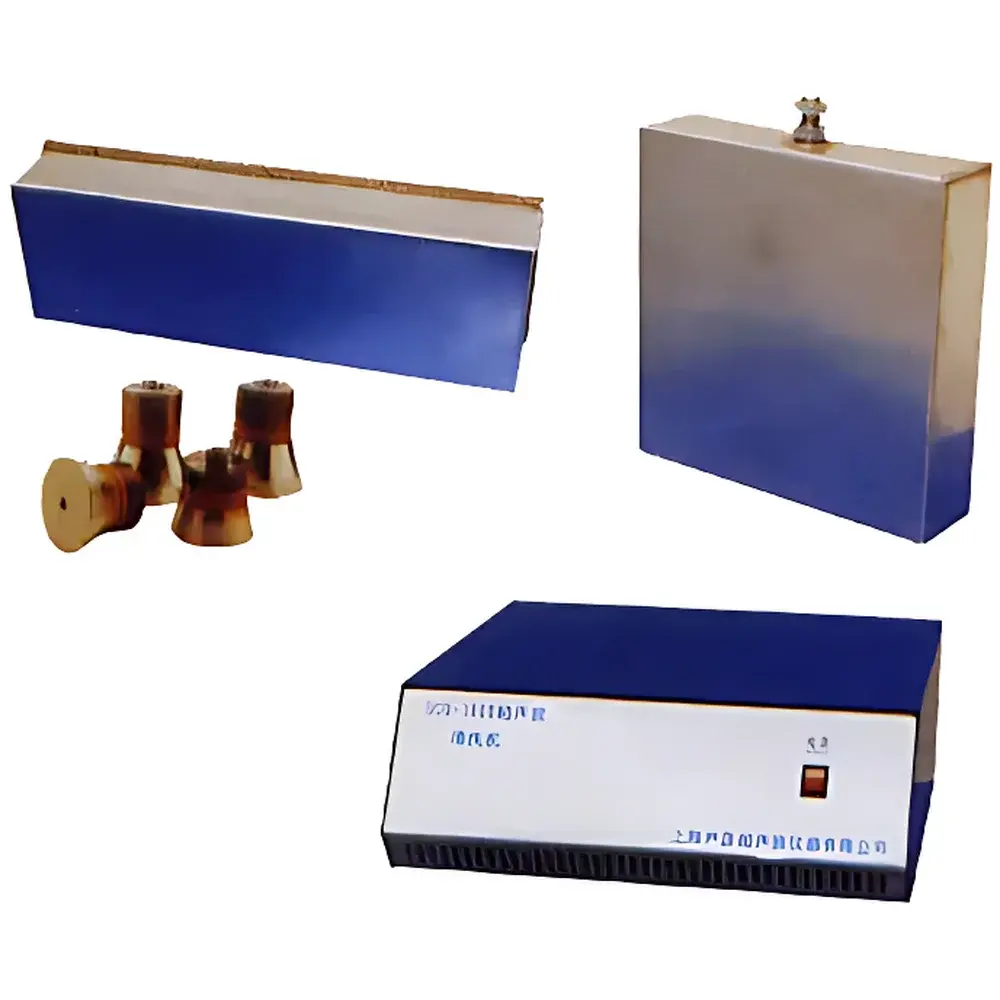
SCQ-900R Immersion-Type Ultrasonic Cleaner by Sycs (Shengyan Ultrasonics)
| Brand | Sycs (Shengyan Ultrasonics) |
|---|---|
| Origin | Shanghai, China |
| Model | SCQ-900R |
| Power Output | 900 W |
| Operating Frequencies | 25 kHz / 40 kHz |
| Transducer Count | 18 units |
| Dimensions (Transducer Assembly) | 450 × 350 × 100 mm |
| Construction | Full 304 stainless steel housing and transducer mounting frame |
| Mounting Flexibility | Bottom-, side-, or top-mounted immersion configuration |
| Compliance | Designed for laboratory and industrial cleaning per ISO 13485-aligned manufacturing practices (as applicable to equipment suppliers), compatible with GLP/GMP-relevant cleaning validation protocols |
Overview
The SCQ-900R Immersion-Type Ultrasonic Cleaner is a modular, high-intensity ultrasonic cleaning system engineered for integration into custom or existing liquid processing tanks. Unlike benchtop or tank-integrated units, this device employs a detachable transducer assembly—comprising 18 piezoelectric ceramic elements mounted on a rigid 304 stainless steel plate—that couples acoustically into the cleaning medium via direct immersion. It operates at dual selectable frequencies (25 kHz for high-energy macro-cavitation in heavy-duty degreasing and carbon removal; 40 kHz for finer particle detachment and delicate substrate compatibility), enabling process optimization across diverse material classes and contamination profiles. The system separates the ultrasonic generator (control and power electronics) from the transducer module via a shielded high-frequency coaxial cable, minimizing electromagnetic interference and permitting remote placement of the generator in controlled or non-hazardous zones. Its design adheres to fundamental principles of acoustic cavitation physics: transient microbubble formation, growth, and asymmetric collapse generate localized shockwaves and microstreaming—mechanisms proven effective for dislodging particulates, organic residues, oxides, and biofilms from complex geometries including blind holes, internal channels, and recessed surfaces.
Key Features
- Full 304 stainless steel transducer housing ensures corrosion resistance against acidic, alkaline, and saline cleaning solutions—critical for repeated exposure in electroplating, semiconductor rinse, or medical instrument reprocessing environments.
- Modular architecture enables flexible installation: transducer plates can be mounted horizontally on tank bottoms, vertically on sidewalls, or inverted on tank lids—supporting retrofit applications without structural modification.
- Dual-frequency operation (25 kHz / 40 kHz) provides process adaptability: lower frequency delivers higher cavitation intensity for robust contaminants (e.g., machining oils, carbon deposits); higher frequency offers improved spatial resolution and reduced surface erosion risk for optics, MEMS devices, or thin-film substrates.
- IGBT-based generator with digital microprocessor control ensures stable output amplitude, thermal overload protection, and real-time duty cycle monitoring—enhancing reproducibility across cleaning cycles.
- EMI-suppressed cabling and grounded metal enclosure meet IEC 61000-6-3 emission standards, ensuring coexistence with sensitive analytical instrumentation in shared laboratory spaces.
Sample Compatibility & Compliance
The SCQ-900R is validated for use with aqueous alkaline, neutral, and mild acidic cleaning chemistries—including chelating agents, surfactants, and enzymatic formulations—commonly employed in ISO 15883-compliant washer-disinfectors and ASTM F3127-18–aligned medical device cleaning validation studies. Its immersion configuration supports cleaning of stainless steel surgical instruments, titanium orthopedic implants, borosilicate glassware, silicon wafers, precision-machined hydraulic components, and fiber-optic connectors. While not a Class II medical device itself, its performance characteristics align with user requirements specified in AAMI TIR34:2014 for ultrasonic-assisted cleaning stages within multi-step reprocessing workflows. All wetted surfaces comply with FDA 21 CFR 177.2400 for indirect food-contact materials, and construction materials are traceable per mill test reports.
Software & Data Management
The SCQ-900R generator includes an integrated digital display showing real-time operating frequency, power level (% of rated 900 W), elapsed time, and temperature input (when paired with optional PT100 sensor). Though it lacks network connectivity or proprietary software, its analog/digital I/O interface supports integration into PLC-controlled cleaning lines or LIMS-linked validation systems via 4–20 mA output and dry-contact relay signals. Audit trail functionality—including start/stop timestamps, frequency selection, and manual override logs—is maintained locally in non-volatile memory, satisfying basic ALCOA+ data integrity expectations for routine cleaning operations under GLP or ISO/IEC 17025 environments.
Applications
- Pre-sterilization cleaning of reusable surgical instruments and endoscopes prior to autoclaving or low-temperature sterilization.
- Removal of photoresist residuals, etch byproducts, and metallic contaminants from silicon wafers and photomasks in semiconductor front-end fabrication.
- Decontamination of HPLC columns, GC injectors, and sample vials in analytical chemistry laboratories.
- Extraction of intracellular metabolites and nucleic acids from tissue homogenates in life science research.
- Surface activation and oxide layer removal from aluminum, magnesium, and copper alloys prior to anodizing or coating.
- Ultrasonic-assisted degassing of solvents and polymer solutions prior to casting or thin-film deposition.
FAQ
Can the SCQ-900R be used in explosion-proof environments?
No—the standard unit is not certified for hazardous locations (ATEX, UL 1203, or IECEx). Explosion-proof variants require custom engineering with intrinsically safe barriers and purged enclosures.
Is the transducer plate compatible with deionized water only, or can it operate in solvent-based baths?
It is compatible with water-miscible solvents (e.g., isopropanol, ethanol, terpenes) when bath temperature remains below 60 °C and vapor concentration is controlled per OSHA PEL limits. Chlorinated or highly flammable solvents require explosion-rated generators and ventilation interlocks.
What maintenance intervals are recommended for sustained performance?
Transducer bonding integrity should be verified annually via impedance spectroscopy; cooling fans and generator capacitors inspected quarterly; and stainless steel housing passivated biannually in aggressive chemical service.
Does the system support automated cycle programming?
Not natively—but external timers or programmable logic controllers (PLCs) can trigger start/stop commands via the unit’s dry-contact input terminals.
How is cleaning efficacy validated when using this immersion system?
Validation follows ASTM E2810-22: quantitative assessment using standardized test soils (e.g., bovine serum albumin, carbon black, or machine oil) on representative substrates, measured via gravimetric loss, contact angle change, or residual protein assay (BCA).



