
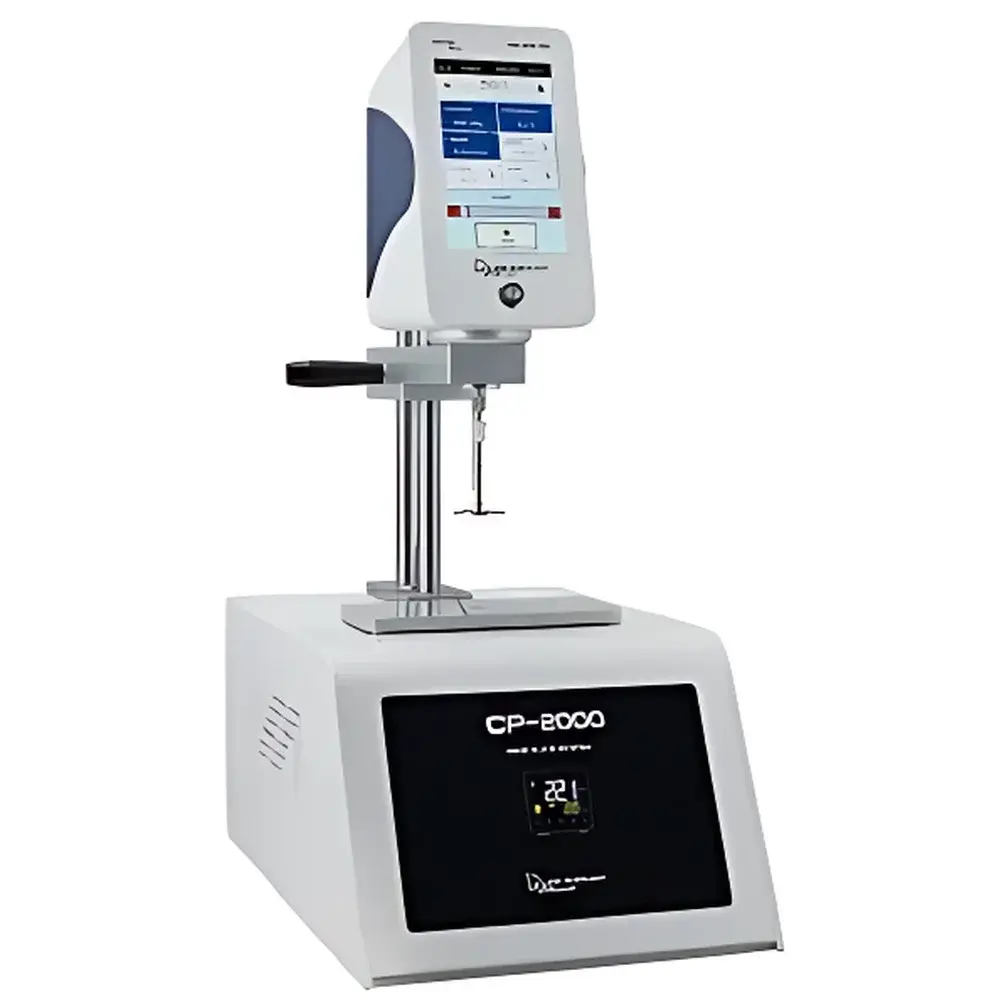
Lamy RM200+CP-1 Cone-Plate Viscometer
| Brand | Lamyrheology |
|---|---|
| Origin | France |
| Model | RM200+CP-1 |
| Instrument Type | Rotational Viscometer (Fixed Benchtop) |
| Viscosity Range | 1–540,000,000 mPa·s |
| Rotational Speed | 0.3–1500 rpm |
| Torque Range | 0.05–30 mN·m (standard) |
| Temperature Control | Peltier air-air (5–80 °C ±0.2 °C) |
| Display | 7″ capacitive touchscreen |
| Compliance | ASTM D2196, ISO 2555, ISO 3219, USP <911>, GLP-ready audit trail via RHEOMATIP software |
| Interface | RS232, USB, 4–20 mA analog output |
| Safety | User authentication with 4-digit password |
| Dimensions (main unit) | 300 × 490 × 570 mm |
| Weight | 16 kg |
Overview
The Lamy RM200+CP-1 Cone-Plate Viscometer is a high-precision, benchtop rotational viscometer engineered for rigorous rheological characterization of structured fluids under controlled shear and thermal conditions. Based on the fundamental principle of cone-and-plate geometry—where a precisely angled conical rotor rotates above a flat, temperature-regulated plate—the instrument generates a uniform shear rate across the sample gap, enabling accurate determination of shear-dependent viscosity, yield stress, thixotropic recovery, and flow curve parameters without wall-slip artifacts. Designed and manufactured in France by Lamyrheology, the RM200+CP-1 integrates a brushless electronic motor drive system (spring-free architecture), eliminating mechanical hysteresis and calibration drift associated with traditional torsion-spring mechanisms. Its self-contained Peltier-based temperature control eliminates reliance on external recirculating baths, delivering rapid, stable thermal conditioning from 5 °C to 80 °C (±0.2 °C) with air-to-air heat exchange—ideal for low-volume samples (<1 mL) and applications requiring frequent temperature ramping or step-change protocols.
Key Features
- Integrated 7″ capacitive touchscreen interface enabling real-time visualization of viscosity, torque, shear rate, time, temperature, and measurement system identification—no PC required for routine operation
- Peltier-driven cone-plate temperature control (CP-1 module) with dual-mode capability: standard air-air (5–80 °C) and optional liquid-coupled (−20 to 120 °C, requires external bath)
- High-dynamic-range torque sensor (0.05–30 mN·m; up to 40 mN·m in AC 115 configuration) supporting both low-viscosity Newtonian liquids and ultra-high-viscosity non-Newtonian gels and pastes
- Direct on-screen calculation and display of yield stress (via Bingham or Casson models), thixotropic area (hysteresis loop integration), and plastic viscosity—no post-processing required
- Embedded Pt100 temperature probe, RS232/USB connectivity, 4–20 mA analog output, and USB printer support for standalone documentation
- User-level access control with configurable username and 4-digit password—supports multi-user lab environments compliant with GLP audit requirements
- Modular compatibility with Lamy’s RM100 TOUCH, RM200 TOUCH, and FIRST TOUCH platforms for cross-platform method transfer and data harmonization
Sample Compatibility & Compliance
The RM200+CP-1 accommodates a broad spectrum of complex fluids—including emulsions, suspensions, polymer melts, pharmaceutical gels, cosmetic creams, food pastes, and industrial coatings—without sample degradation or edge effects common in coaxial cylinder systems. The CP-1 cone-plate geometry ensures full sample utilization and minimal shear history, critical for reproducible yield stress quantification per ASTM D2196 and ISO 2555. All firmware and RHEOMATIP software modules adhere to ALCOA+ principles (Attributable, Legible, Contemporaneous, Original, Accurate, Complete, Consistent, Enduring, Available) and support 21 CFR Part 11-compliant electronic signatures when deployed in regulated QC/QA environments. Instrument validation documentation—including IQ/OQ templates, traceable calibration certificates (NIST-traceable torque and temperature standards), and compliance matrices for ISO/IEC 17025 and GMP Annex 15—is available upon request.
Software & Data Management
RHEOMATIP software serves as the central hub for advanced method development, automated test sequencing, and regulatory-grade data management. It enables full control of temperature ramps, shear rate sweeps, oscillatory tests (when paired with optional oscillation modules), and time-sweep protocols—including programmable rest periods for thixotropy assessment. All raw torque/time/temperature data are stored with embedded metadata (operator ID, timestamp, environmental conditions, calibration status). Audit trails record every parameter change, user login/logout event, and data export action. Export formats include CSV, PDF reports (with customizable templates), and XML for LIMS integration. Data integrity is preserved via write-protected storage and optional encrypted database backup.
Applications
- Pharmaceuticals: Yield stress profiling of topical gels and ointments per USP ; viscosity stability testing of injectables and suspensions under thermal stress
- Cosmetics: Texture mapping of creams and serums via flow curves and thixotropic recovery analysis; formulation optimization for pump dispensing performance
- Foods: Quality control of ketchups, mayonnaise, and dairy spreads using Herschel-Bulkley modeling; shelf-life prediction via time-dependent structural recovery
- Coatings & Inks: Shear-thinning behavior quantification for spray application simulation; sag resistance evaluation at low shear
- Chemicals & Polymers: Melt viscosity characterization of thermoplastics; crosslinking kinetics monitoring via time-sweep at fixed temperature
FAQ
Does the RM200+CP-1 require annual spring recalibration?
No. The instrument employs a spring-free, electronically commutated motor and digital torque transduction—eliminating mechanical wear and the need for periodic spring replacement or re-zeroing.
Can I perform oscillatory measurements with this system?
The base RM200+CP-1 is configured for steady-state rotational rheology. Oscillatory capability requires optional hardware upgrades (e.g., dynamic motor controller and strain-controlled mode firmware) and must be specified at time of order.
Is the Peltier temperature range sufficient for cryogenic or high-temperature applications?
The standard air-air Peltier module operates from 5 °C to 80 °C. For sub-zero or >80 °C work, the optional liquid-coupled Peltier interface allows connection to external thermostats (e.g., Huber, Julabo) covering −20 °C to 120 °C.
How is data traceability ensured for FDA-regulated labs?
RHEOMATIP supports role-based user accounts, electronic signatures, immutable audit logs, and automatic generation of 21 CFR Part 11–compliant PDF reports with digital signatures and hash-verified metadata.
What sample volume is required for CP-1 cone-plate measurements?
Typical sample volume is 0.5–0.8 mL, depending on cone angle (1° or 2°) and gap setting—significantly less than cylinder-based geometries, reducing material cost and waste.
Related Products



