
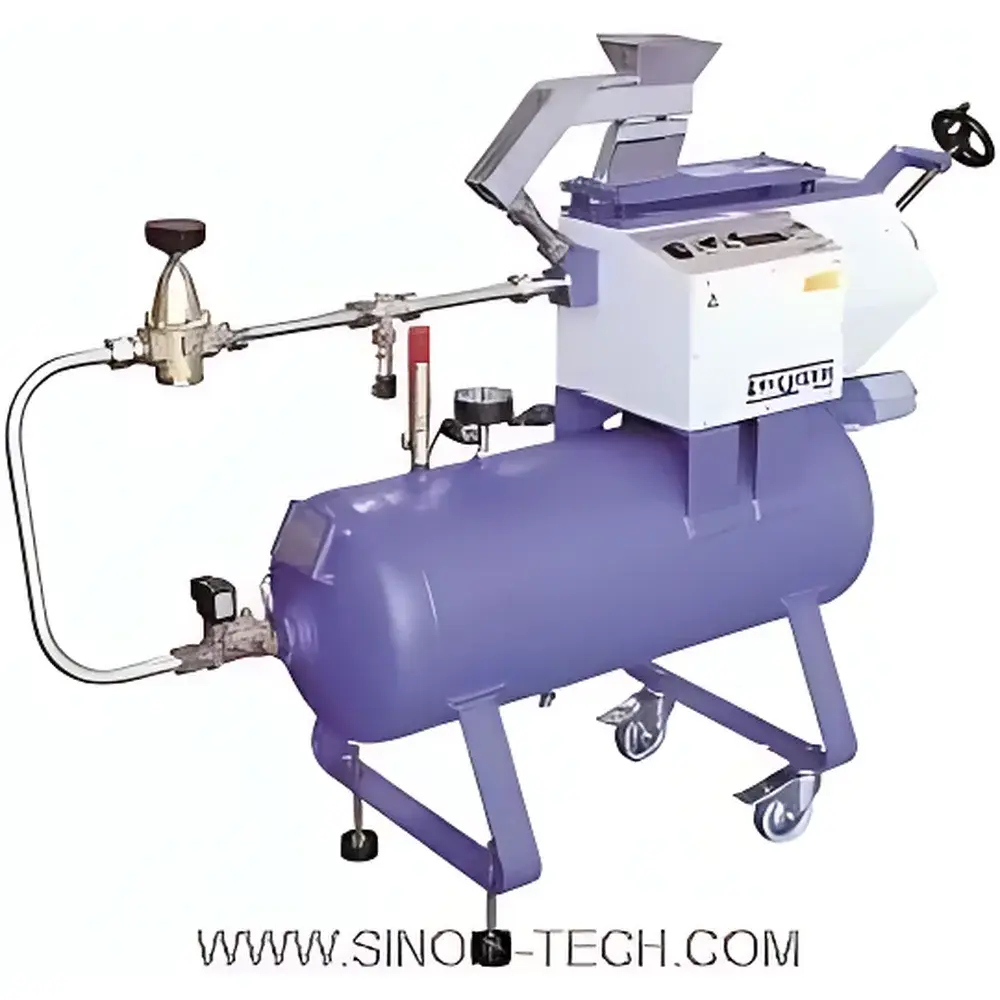
ILISIN #508MC VDA Gravel Impact Tester
| Origin | Germany |
|---|---|
| Manufacturer Type | Authorized Distributor |
| Origin Category | Imported |
| Model | #508MC |
| Instrument Type | Gravel Impact Testing System |
| Compressed Air Supply | 6–10 bar (min. 6 bar, max. 10 bar), 13 mm ID hose |
| Operating Pressure Range | 0–3 bar (calibrated scale) |
| Gravel Feed Duration | 5–30 s (adjustable) |
| Power Supply | 230 V / 50 Hz (optional voltages available) |
| Gravel Specification | 4–5 mm sharp-edged granite particles (GHDiamant 06302) |
| Dimensions (L×D×H) | 175 × 50 × 122 cm |
| Net Weight | ~100 kg |
Overview
The ILISIN #508MC VDA Gravel Impact Tester is a precision-engineered physical property testing instrument designed to evaluate the resistance of automotive coating systems—including single- and multi-layer paint, primer, clear coat, and alternative protective finishes—to high-velocity gravel impact. Developed in collaboration with the German Association of the Automotive Industry (VDA), the system implements the standardized gravel impact methodology defined in VDA 233-202 and aligned with DIN EN ISO 20567-1, ASTM D3170/D3170M (Chipping Resistance of Coatings), and SAE J400. The test principle relies on controlled acceleration of calibrated abrasive particles via compressed air through a convergent nozzle, striking the specimen at a fixed angle of 54° relative to the surface plane—a geometry rigorously specified for reproducible energy transfer and impact morphology. Unlike pendulum or drop-weight impact testers, the #508MC employs continuous multi-impact exposure under stabilized pneumatic conditions, enabling statistically robust assessment of chipping onset, flaking propagation, and substrate exposure across large-area samples.
Key Features
- Integrated air reservoir buffer system minimizes transient pressure fluctuations from external compressors, ensuring consistent impact energy delivery across all test cycles.
- Digitally monitored operating pressure (0–3 bar range, Class 1 accuracy) with real-time display on a multifunctional LCD interface.
- Adjustable gravel feed duration (5–30 seconds) synchronized with programmable total impact count (cumulative and current counter).
- Vibratory particle feed mechanism ensures uniform, non-clogging delivery of sharp-edged 4–5 mm granite gravel (GHDiamant 06302) meeting VDA-specified hardness and angularity requirements.
- Modular sample stage compatible with manual clamping (standard) or optional pneumatically actuated fixtures for rapid setup and operator safety.
- Tool-free integration of Peugeot-Citroën–certified test jig (D241312 compliance kit, order no. 706.01.32) for OEM-specific evaluation protocols.
Sample Compatibility & Compliance
The #508MC accommodates flat or moderately curved panels up to 300 × 300 mm (standard fixture) and supports both metallic (steel, aluminum) and composite substrates used in automotive body-in-white and trim applications. All test procedures comply with GLP-aligned documentation requirements: test parameters (pressure, feed time, count), ambient temperature/humidity logging, and operator ID can be manually recorded per run. The system meets mechanical safety standards per EN ISO 12100 and incorporates emergency stop circuitry conforming to EN 60204-1. While not inherently 21 CFR Part 11 compliant, its parameter traceability supports audit-ready reporting when integrated into validated laboratory quality management systems (e.g., ISO/IEC 17025).
Software & Data Management
The #508MC operates as a stand-alone hardware platform with embedded microcontroller logic—no proprietary software installation required. All operational parameters are set and verified via front-panel controls and LED/LCD feedback. For laboratories requiring digital data capture, optional RS-232 or USB-to-serial adapters enable ASCII log export of pressure readings, elapsed feed time, and cumulative impact counts to external PCs. Exported logs are compatible with common LIMS platforms and support statistical analysis (e.g., Weibull distribution fitting for chipping threshold estimation) when paired with post-test image analysis tools (e.g., ISO 4628-2-rated digital microscopy or automated edge-detection algorithms).
Applications
Primary use cases include R&D validation of new coating formulations, supplier qualification against OEM specifications (e.g., VW PV3952, Ford CETP 00.00-L-467), and production line quality control of cured paint systems. Secondary applications extend to evaluating stone-chip resistance of aerospace primers, railway vehicle coatings, and protective polymer films for agricultural machinery. The instrument is routinely deployed in third-party testing labs accredited to ISO/IEC 17025 for automotive component certification and supports failure mode analysis in root-cause investigations following field-reported chipping incidents.
FAQ
What gravel specification is mandatory for VDA-compliant testing?
GHDiamant 06302—4–5 mm sharp-edged granite particles with defined Mohs hardness (≥6.5) and angularity index (AI ≥ 0.75)—is required to meet VDA 233-202 and ISO 20567-1 material traceability clauses.
Can the #508MC be used without an in-house compressed air network?
Yes; the unit accepts portable oil-free compressors rated ≥10 bar output and ≥120 L/min free air delivery, provided the 13 mm ID supply hose and integrated air dryer/filter (accessory 0161.01.32) are installed.
Is calibration certification included with shipment?
Each unit ships with factory-verified pressure transducer calibration (traceable to DAkkS-accredited standards) and a certificate of conformance to VDA 233-202 Annex A mechanical verification protocol.
How frequently must the gravel feed mechanism be maintained?
Vibratory feeder components require visual inspection before each test series; full cleaning and lubrication of the hopper gate and linear actuator are recommended every 500 test cycles or quarterly—whichever occurs first.
Does the system support automated image-based chipping quantification?
No; the #508MC is a mechanical test platform only. Quantitative chipping assessment requires downstream imaging (e.g., 10× macro lens + grayscale thresholding per ISO 4628-2) and is performed independently of the impact event.



