
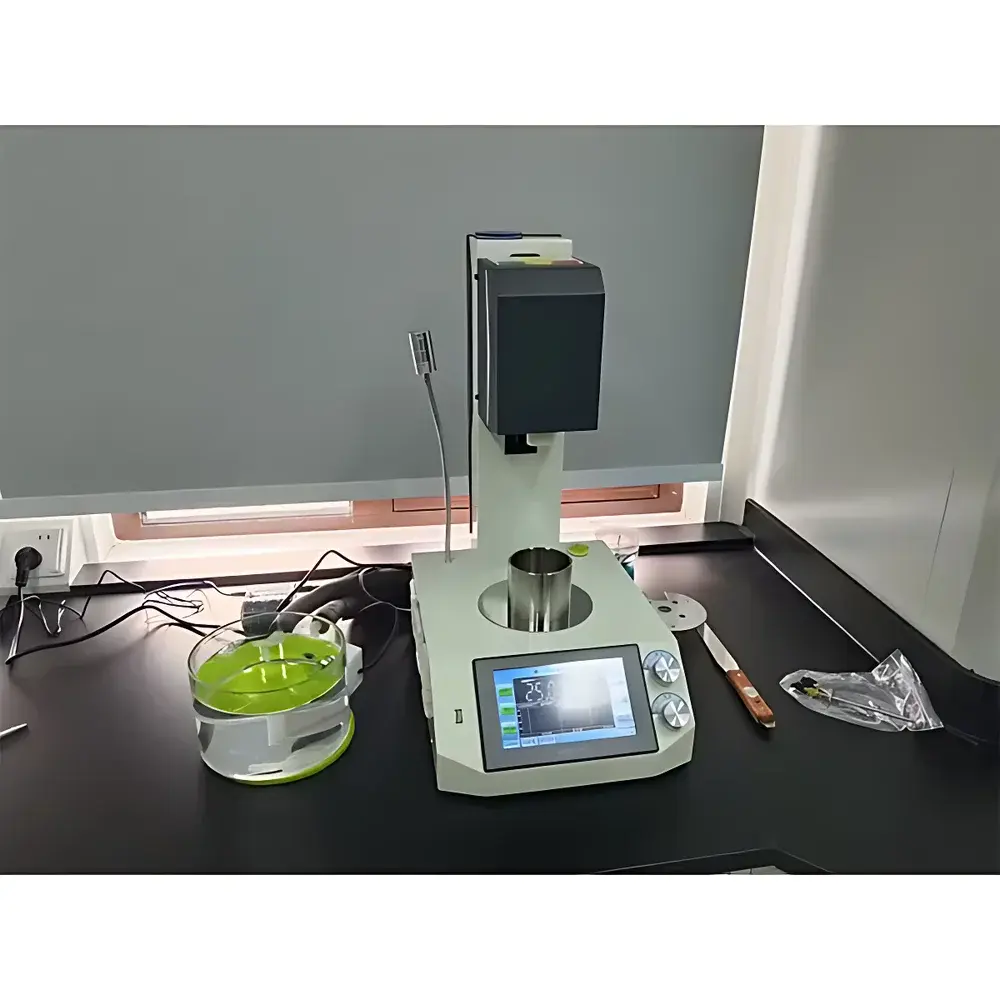
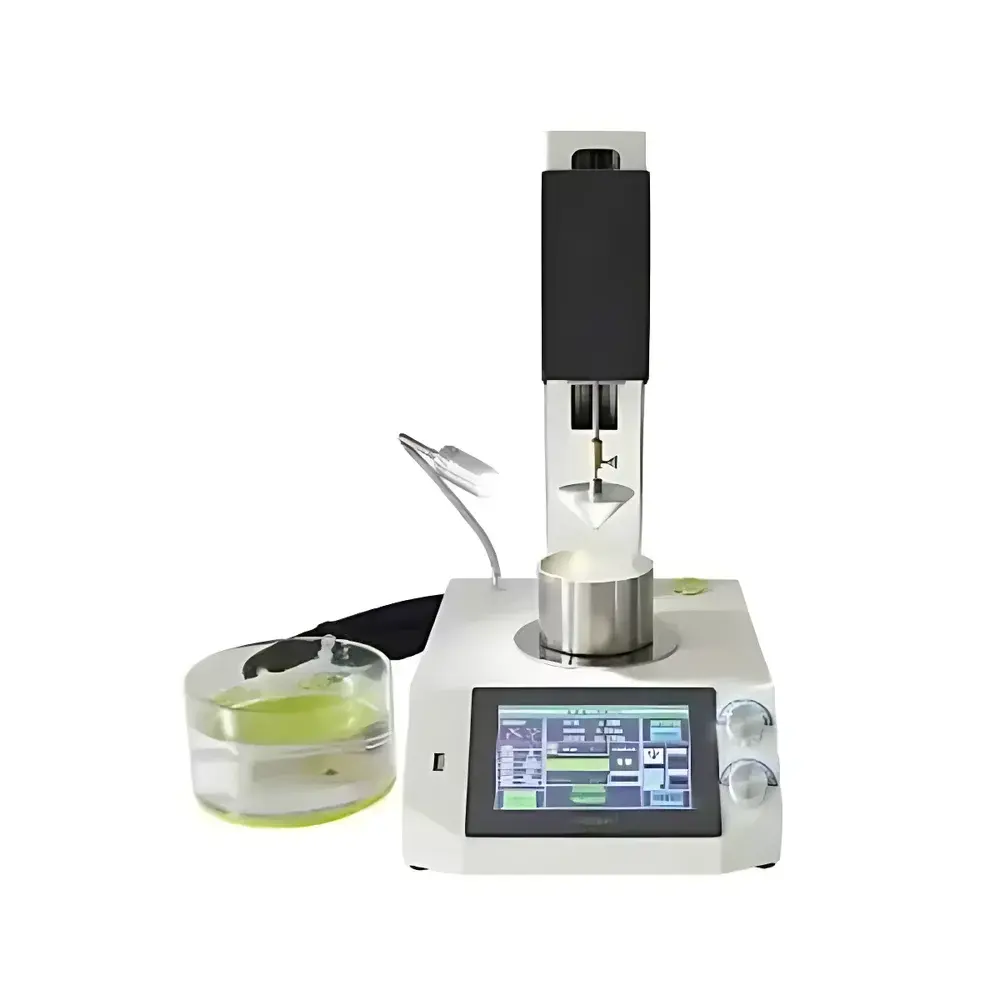
MITONG SYP-0983H Automated Penetrometer for Pharmaceutical Semi-Solids
| Brand | MITONG |
|---|---|
| Origin | Shanghai, China |
| Model | SYP-0983H |
| Penetration Range | 0–650 dmm |
| Minimum Readout | 0.1 dmm |
| Resolution | 0.01 mm |
| Penetration Accuracy | ±1 dmm |
| Temperature Control Range | 0.00–50.00 °C |
| Temperature Stability | ±0.1 °C |
| Timing Range | 0–250 s |
| Timing Accuracy | ±0.1 s |
| LVDT Displacement Sensor Range | 0–66 mm |
| Displacement Resolution | 0.01 mm |
| Cone Mass (Type I) | 102.5 ± 0.05 g |
| Cone Rod Mass | 47.5 ± 0.05 g |
| Power Supply | 220 ± 10% VAC / 50 Hz |
| Net Weight | 12.5 kg |
| Dimensions (L×W×H) | 390 × 310 × 575 mm |
Overview
The MITONG SYP-0983H Automated Penetrometer is a precision-controlled instrument engineered for the quantitative measurement of penetration depth in semi-solid pharmaceutical formulations—including ointments, eye ointments, and their base materials such as petrolatum, wool fat, and beeswax—under standardized thermal and mechanical conditions. It operates in strict accordance with the Chinese Pharmacopoeia (2025 Edition), Volume IV, General Chapter 0983 “Penetration Test”, which defines penetration as the depth (in tenths of a millimeter, or dmm) to which a standardized cone assembly penetrates a specimen under gravity at 25.0 °C over a precisely controlled 5-second interval. The instrument implements a true free-fall principle: the cone is released from rest without initial velocity or constraint, ensuring compliance with the fundamental physical requirement of the pharmacopoeial method. Its integrated Peltier-based thermostatic bath—capable of both heating and cooling—maintains sample temperature within ±0.1 °C across a 0.00–50.00 °C range, satisfying the stringent thermal preconditioning requirements for reproducible rheological assessment of temperature-sensitive matrices.
Key Features
- Fully automated test sequence: motorized vertical positioning, gravity-driven cone release, real-time displacement acquisition, and result calculation—all executed without manual intervention.
- High-fidelity displacement measurement using a linear variable differential transformer (LVDT) sensor with a 0–66 mm range and 0.01 mm resolution; non-contact design eliminates mechanical friction during cone descent.
- Integrated thermostatic bath employing PID-controlled semiconductor (Peltier) modules for rapid, stable temperature regulation—no external chiller or heater required.
- Intuitive 7-inch capacitive touchscreen interface with multilingual support (English default), graphical real-time feedback, and on-screen calibration prompts.
- Modular cone assembly compliant with Chinese Pharmacopoeia 2020 Edition specifications: Type I cone mass = 102.5 ± 0.05 g; cone rod mass = 47.5 ± 0.05 g; quick-release mechanism ensures repeatable mounting and traceable alignment.
- Dual-mode operation: standalone mode via touchscreen or PC-connected mode via RS-485 (MODBUS RTU protocol) for centralized lab data aggregation and audit-ready logging.
- On-device data storage for up to 200 test records, including timestamp, temperature, penetration value, and operator ID; exportable via USB flash drive in CSV format.
Sample Compatibility & Compliance
The SYP-0983H is validated for use with low-viscosity to highly structured semi-solids commonly encountered in topical dosage form development and quality control. It accommodates standard 50 mL or 100 mL cylindrical metal or glass sample cups (not supplied), with optional cup-height adapters to ensure consistent cone immersion geometry. All mechanical and thermal performance parameters meet or exceed the metrological requirements outlined in ChP 0983, ISO 2137 (Petroleum products—Penetration of lubricating grease), and ASTM D217 (Standard Test Methods for Penetration of Lubricating Grease). While primarily designed for pharmacopoeial compliance, its operational envelope also supports internal R&D protocols aligned with ICH Q5E (Comparability of Biotechnological/Biological Products) and USP <1151> (Pharmaceutical Dosage Forms). The system architecture supports GLP-compliant workflows through configurable user access levels, electronic signature prompts, and tamper-evident audit trails when operated in networked mode.
Software & Data Management
The instrument ships with MITONG’s proprietary PC software (v3.2+), compatible with Windows 10/11 (64-bit), enabling remote test initiation, parameter configuration, live displacement waveform visualization, and batch statistical analysis (mean, SD, RSD, trend charts). Raw displacement vs. time datasets are logged at ≥100 Hz sampling rate, permitting post-hoc evaluation of transient deformation behavior beyond the standard 5-second endpoint. Data exports comply with ALCOA+ principles: attributable, legible, contemporaneous, original, accurate, complete, consistent, enduring, and available. When connected to a validated LIMS or ELN environment via MODBUS, the device transmits structured JSON payloads containing metadata (test ID, operator, lot number, environmental conditions) and primary results—fully traceable for FDA 21 CFR Part 11 compliance where electronic records and signatures are enforced.
Applications
- Batch release testing of ointment and cream bases per ChP 0983 acceptance criteria (e.g., 100–300 dmm for hydrophilic bases; 200–400 dmm for oleaginous bases).
- Stability-indicating assessment of thermal degradation or polymorphic transitions affecting consistency (e.g., monitoring penetration drift after accelerated aging at 40 °C/75% RH).
- Formulation optimization: correlating penetration values with active pharmaceutical ingredient (API) loading, surfactant concentration, or thickener type (carbomer vs. cellulose derivatives).
- Supplier qualification of raw materials (e.g., viscosity grading of white petrolatum USP/NF).
- Process validation of homogenization or cooling rates in semi-solid manufacturing lines.
- Regulatory submission support: generating GMP-aligned reports for NDA, ANDA, or DMF dossiers requiring physicochemical characterization data.
FAQ
What pharmacopoeial standards does the SYP-0983H directly support?
It is fully compliant with ChP 2025 Volume IV, General Chapter 0983, and functionally equivalent to ASTM D217 and ISO 2137 methodologies.
Is the cone assembly certified to national metrological standards?
Yes—the Type I cone and rod assemblies are manufactured and calibrated in accordance with JJG 849–2013 (Verification Regulation for Penetrometers) and include individual traceable calibration certificates.
Can the instrument perform tests at temperatures other than 25 °C?
Yes—it supports user-defined test temperatures from 0.00 °C to 50.00 °C with ±0.1 °C stability, enabling temperature-dependent rheogram generation.
How is data integrity ensured during power interruption?
The embedded controller features non-volatile memory that retains all active test parameters and partial results; upon recovery, the system resumes or flags incomplete runs for review.
Does the system support 21 CFR Part 11 compliance out-of-the-box?
The hardware and firmware provide foundational controls (audit trail, role-based access, electronic signatures); full Part 11 compliance requires site-specific validation of the software deployment and network infrastructure.





