
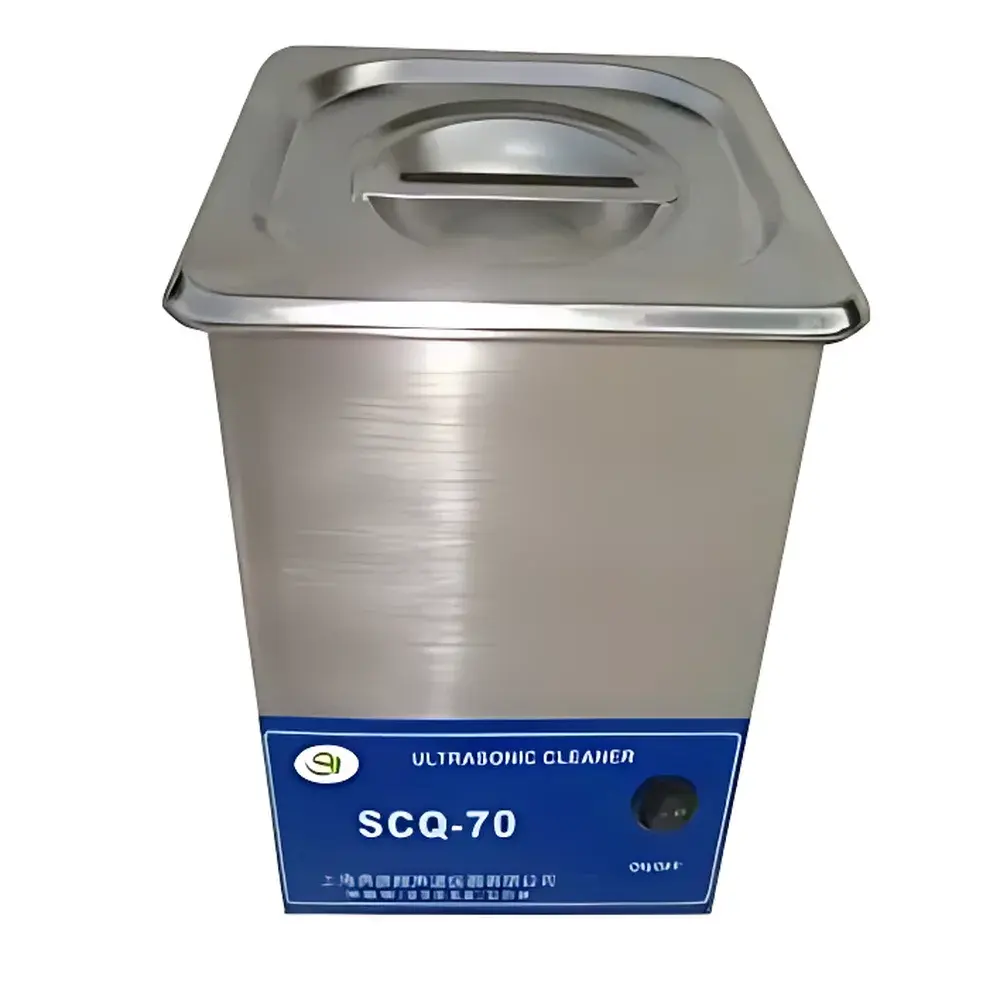
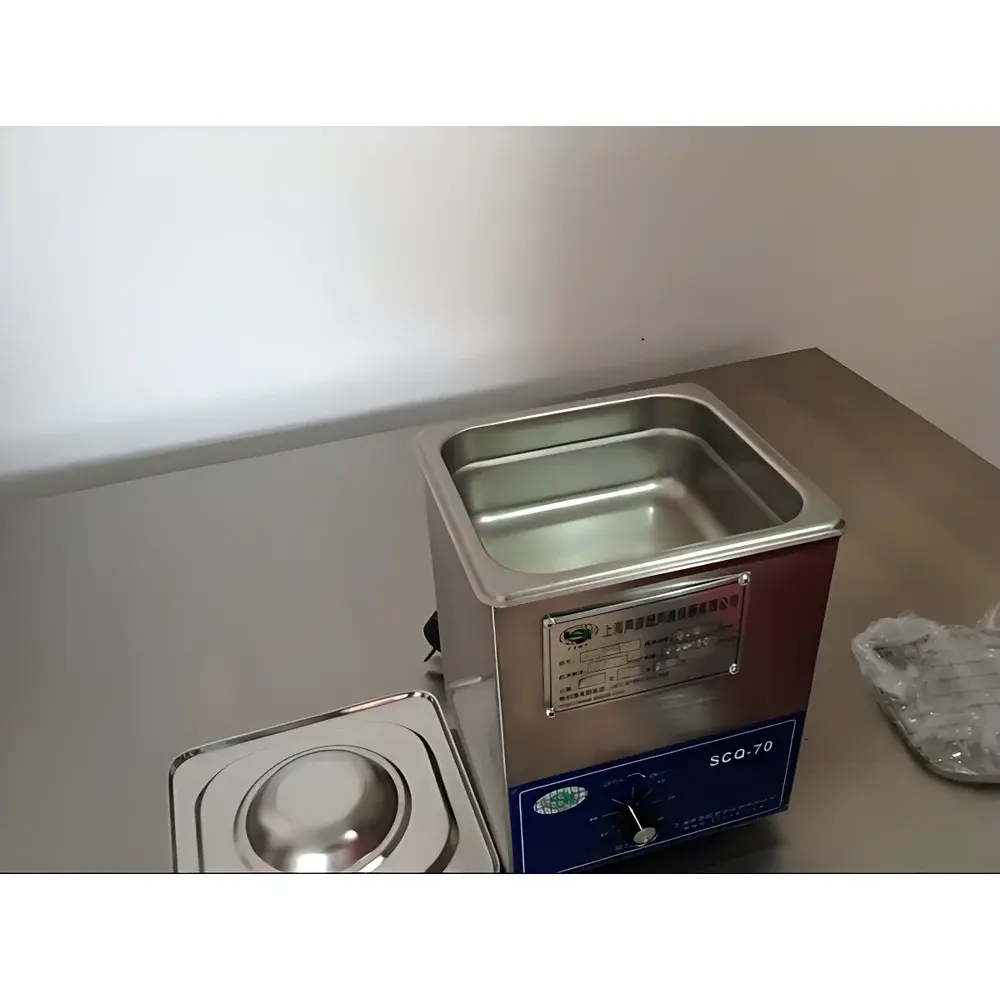
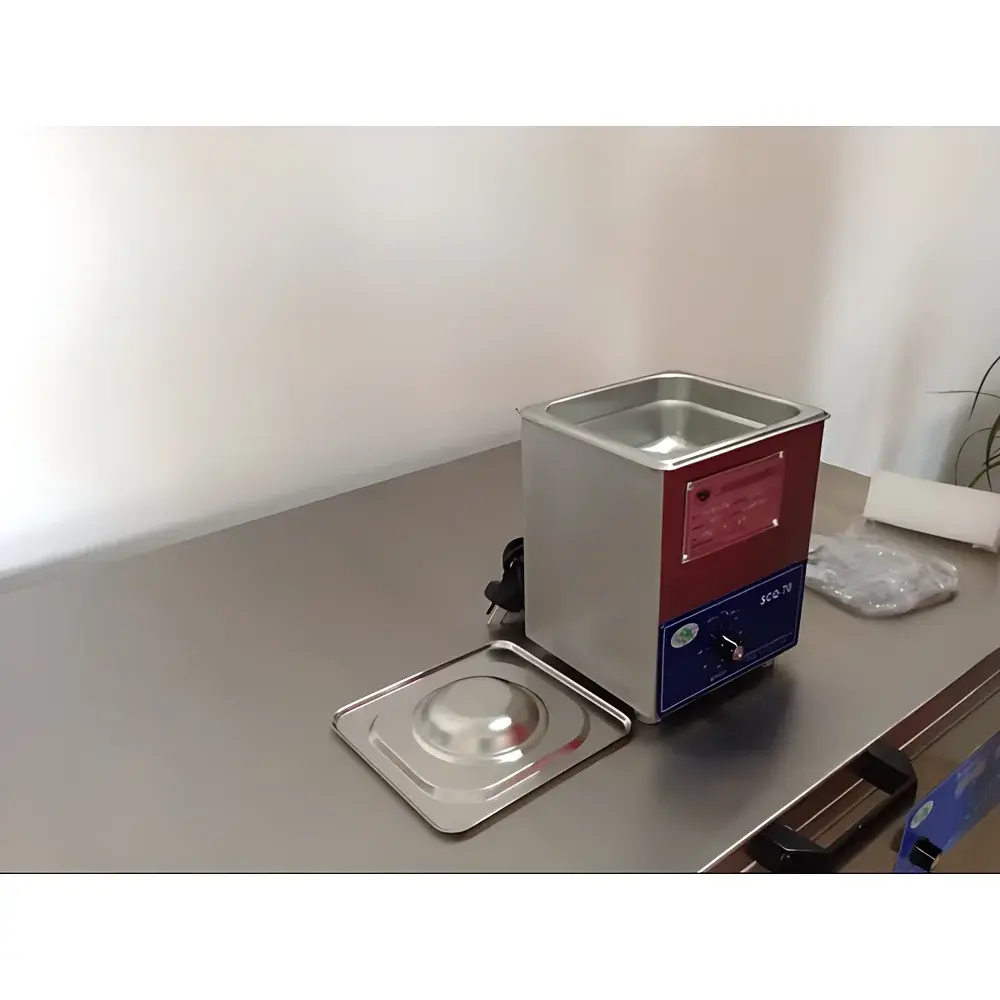
SYC Sycs SCQ-70 Benchtop Ultrasonic Cleaner
| Brand | SYC Sycs |
|---|---|
| Origin | Shanghai, China |
| Model | SCQ-70 |
| Capacity | 1.4 L |
| Ultrasonic Frequency | 40 kHz |
| Ultrasonic Power | 60 W |
| Timer Range | 1–60 min |
| Lid with Sound-Dampening Design | Yes |
| Heating Function | None |
| Adjustable Power Output | No |
| Adjustable Temperature Control | No |
| Drain Port | No |
| Tank Material | SUS304 Stainless Steel |
| Safety Protections | Overload and Overheat Protection |
| Standard Compliance | CE-marked design principles |
Overview
The SYC Sycs SCQ-70 is a compact, CE-informed benchtop ultrasonic cleaner engineered for precision cleaning of delicate and high-value components in laboratory, clinical, and technical service environments. It operates on the principle of ultrasonic cavitation: high-frequency sound waves (40 kHz) generate microscopic vacuum bubbles in an aqueous or mild solvent bath; upon collapse, these bubbles release localized energy sufficient to dislodge particulate contaminants, organic residues, and biofilms from complex surface geometries—including blind holes, crevices, and micro-textured interfaces—without mechanical abrasion. Unlike thermal or enzymatic methods, ultrasonic cleaning delivers consistent, non-contact decontamination ideal for pre-analytical sample preparation, optical component maintenance, and QC/QA workflow support. The SCQ-70 is not intended for terminal sterilization but serves as a validated first-stage cleaning step compliant with preparatory requirements outlined in ISO 15883-1 (washer-disinfectors) and referenced in USP environmental surface cleaning protocols.
Key Features
- SUS304 stainless steel tank: Fully welded, corrosion-resistant chamber exceeding industry-standard SUS201/SUS202 alternatives—critical for longevity when using mildly alkaline or citric acid-based cleaning solutions.
- Dual safety architecture: Integrated overload and overheat protection circuits prevent thermal runaway and power supply stress during extended operation or low-fluid conditions.
- Acoustically optimized transducer array: Proprietary piezoelectric elements—featuring U.S.-sourced ceramic chips—deliver uniform energy distribution across the 1.4 L tank volume while maintaining sound pressure levels ≤55 dB(A) at 1 m (with lid closed), minimizing ambient noise in shared lab spaces.
- Precision digital timer: Programmable 1–60 minute cycles with automatic shutdown; eliminates operator dependency and supports repeatable process documentation.
- Ergonomic sound-dampening lid: Hinged, weighted polycarbonate cover reduces airborne noise transmission and prevents aerosol dispersion during active cavitation.
- Modular, service-oriented design: All internal electronics—including driver board and transducer connections—are accessible without tank disassembly, facilitating field-level diagnostics and compliance with GLP-mandated maintenance logs.
Sample Compatibility & Compliance
The SCQ-70 accommodates a broad range of substrates including borosilicate glassware (vials, cuvettes, pipette tips), silicone and acrylic optics (eyeglass lenses, endoscope components), printed circuit boards (PCBs), dental prosthetics, surgical instruments (non-lumened), and jewelry-grade alloys. Its 40 kHz frequency provides optimal balance between cleaning efficacy and surface integrity for materials with tensile strength >100 MPa and hardness <600 HV. While not certified for medical device reprocessing under FDA 21 CFR Part 820 or EN ISO 13485, the unit meets baseline electrical safety (IEC 61010-1) and EMC (EN 61326-1) requirements. When integrated into documented cleaning SOPs—including defined solution chemistry, dwell time, and post-rinse validation—the SCQ-70 supports traceable, auditable cleaning processes aligned with ISO 14644-1 cleanroom pre-use conditioning and ASTM D2603 ultrasonic cleaning verification guidelines.
Software & Data Management
The SCQ-70 is a standalone hardware platform with no embedded firmware, cloud connectivity, or data export capability. This design prioritizes electromagnetic compatibility, long-term calibration stability, and regulatory simplicity—particularly where IT infrastructure constraints or cybersecurity policies prohibit networked instrumentation. All operational parameters are controlled via front-panel membrane switches with LED feedback. For laboratories requiring audit trails, integration is achieved externally: timer activation can be logged via external PLC triggers or synchronized with LIMS timestamps using dry-contact relay outputs (available on optional accessory kits). Process records—including cycle start/end times, solution lot numbers, and visual inspection outcomes—must be manually entered into paper-based or electronic batch records per 21 CFR Part 11 Annex 11 principles.
Applications
- Laboratory Pre-Cleaning: Removal of residual solvents, salts, or protein adhesion from HPLC vials, NMR tubes, and electrophoresis combs prior to analytical use.
- Optical Maintenance: Decontamination of microscope objectives, spectrometer windows, and ophthalmic lenses without micro-scratching risk.
- Electronics Service: Non-destructive cleaning of solder-joint residues, flux contaminants, and particulate ingress from PCB assemblies and sensor modules.
- Dental & Audiology Support: Preliminary cleaning of removable orthodontic appliances, hearing aid shells, and impression trays before disinfection.
- Jewelry & Precision Instrument Shops: Surface restoration of watch movements, fine-threaded fasteners, and engraved metal components without dimensional alteration.
FAQ
Is the SCQ-70 suitable for sterilization?
No. It performs cleaning and degassing only—not microbial inactivation. Sterilization requires validated thermal, ethylene oxide, or hydrogen peroxide plasma processes per ISO 17664.
Can I use flammable solvents in this unit?
Absolutely not. Only water-based or aqueous-compatible detergents (e.g., Alconox, Tergazyme) are permitted. Flammable liquids pose explosion hazards under ultrasonic cavitation.
Does it include a drain valve or built-in heater?
No. The SCQ-70 has no drain port or temperature control system. Manual decanting and external warming baths are required for heated cleaning protocols.
What is the expected service life of the transducers?
Under normal usage (≤4 hrs/day, proper solution maintenance), transducers retain ≥90% nominal output after 5 years, based on accelerated aging tests per IEC 60512-11.
Is calibration required or supported?
No formal calibration is defined for ultrasonic cleaners per ISO/IEC 17025; however, periodic verification of cavitation activity (e.g., aluminum foil test per ASTM E1755) is recommended every 6 months.



