
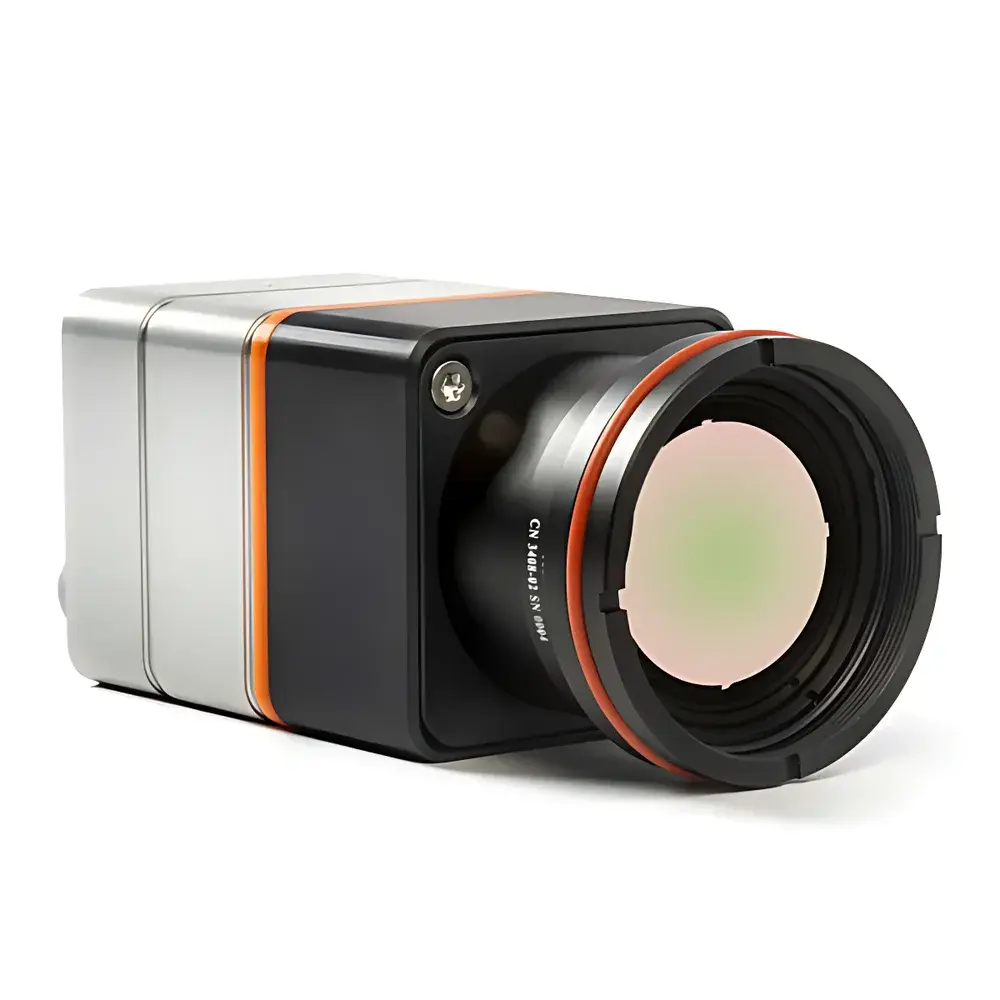
XenICs Ceres T 640 Series Long-Wave Infrared Thermal Imaging Camera
| Brand | XenICs |
|---|---|
| Origin | Belgium |
| Model | Ceres T 640 Series |
| Effective Resolution | 640 × 480 |
| Pixel Pitch | 12 µm |
| NETD | < 50 mK |
| Maximum Frame Rate | 60 Hz |
| Temperature Range | Up to 400 °C |
| Interface Options | Camera Link / GigE Vision |
| Compliance | GenICam v2.0 compliant |
| Operating Spectral Band | 8–14 µm |
Overview
The XenICs Ceres T 640 Series is a high-performance, compact long-wave infrared (LWIR) thermal imaging camera engineered for precision non-contact temperature measurement in demanding industrial and scientific environments. Based on the Dione 640 thermal core, it operates within the atmospheric transmission window of 8–14 µm, leveraging uncooled microbolometer detector technology to deliver stable radiometric output without cryogenic cooling. Its 640 × 480 pixel focal plane array (FPA), with a 12 µm pixel pitch, enables spatially resolved thermal mapping at high optical throughput and low system integration footprint. Designed for continuous operation under varying ambient conditions, the Ceres T 640 achieves thermal sensitivity better than 50 mK (NETD), supporting reliable detection of subtle temperature gradients across dynamic processes. With a calibrated radiometric output traceable to NIST-traceable blackbody references, the camera meets foundational requirements for quantitative thermography in process validation, quality assurance, and research-grade thermal analysis.
Key Features
- True radiometric calibration: Factory-calibrated output in °C per pixel, with linear response across the full 0–400 °C measurement range.
- High temporal fidelity: Sustained 60 Hz frame rate with sub-millisecond exposure control and hardware-triggered synchronization for time-critical thermal event capture.
- Low-latency digital interface: Dual-standard support for Camera Link Base configuration and GigE Vision (IEEE 1588 PTP optional), both fully compliant with GenICam v2.0 for standardized register access and feature control.
- Robust mechanical architecture: Compact housing (≤ 60 mm × 60 mm × 65 mm) with IP54-rated enclosure options, designed for integration into OEM machinery, robotic platforms, and embedded vision systems.
- Thermal stability engineering: On-board non-uniformity correction (NUC) with shutterless operation mode and adaptive drift compensation algorithms to maintain measurement repeatability over extended runtime (>8 hrs).
Sample Compatibility & Compliance
The Ceres T 640 is compatible with standard LWIR optics (e.g., f/1.0–f/1.4 germanium lenses) and supports interchangeable lens mounts (M34×0.5 or M25×0.5). It is suitable for measuring emissivity-adjusted surfaces ranging from polished metals (ε ≈ 0.1) to organic materials (ε ≈ 0.95), provided proper setup of spectral response, field-of-view, and distance-to-spot ratio. The camera conforms to CE marking requirements for electromagnetic compatibility (EN 61326-1) and safety (EN 61010-1). Its radiometric data output supports audit-ready documentation workflows aligned with ISO/IEC 17025 laboratory accreditation and FDA 21 CFR Part 11-compliant systems when integrated with validated software platforms.
Software & Data Management
The camera is supported by XenICs’ XENETH SDK (Windows/Linux), providing C/C++, Python, and MATLAB APIs for full register-level control and real-time streaming. Radiometric metadata—including integration time, lens ID, calibration coefficients, and NUC timestamps—is embedded in each frame’s header per GenICam SFNC compliance. Raw 16-bit radiance data can be exported in TIFF or HDF5 formats for post-acquisition analysis using third-party tools such as MATLAB Image Processing Toolbox or Python’s scikit-image. Optional firmware upgrades enable ROI-based averaging, alarm thresholding, and timestamped trigger logging—features essential for GLP/GMP-aligned thermal monitoring in pharmaceutical manufacturing or automotive component testing.
Applications
- Industrial process monitoring: Real-time thermal profiling of solder reflow ovens, composite curing autoclaves, and battery cell formation chambers.
- Machine vision integration: Embedded temperature feedback for closed-loop control in robotic welding, additive manufacturing, and semiconductor wafer handling.
- Research thermography: Quantitative surface temperature mapping in fluid dynamics studies, combustion analysis, and material phase-transition experiments.
- Transportation infrastructure: Thermal anomaly detection in rail axle bearings, EV motor windings, and roadway subsurface defect screening.
- Medical device R&D: Non-invasive thermal characterization of wearable sensors, transdermal drug delivery patches, and surgical tool sterilization cycles.
FAQ
Is the Ceres T 640 suitable for vacuum or high-humidity environments?
Standard units are rated IP54; custom hermetic variants with desiccant-filled housings or purge ports are available upon request for controlled atmosphere integration.
Does the camera support multi-camera synchronization?
Yes—hardware trigger input/output lines enable sub-10 µs inter-camera timing alignment; GigE Vision PTP synchronization is also supported in networked deployments.
Can I perform emissivity correction in real time?
Emissivity values (0.01–1.00, step 0.01) are configurable per acquisition session via software API and applied during radiometric conversion—no post-processing required.
What calibration documentation is provided?
Each unit ships with a factory calibration report listing NUC temperature points, gain/offset coefficients, and uncertainty budget per ISO/IEC 17025 Annex A guidelines.
Is firmware update capability accessible to end users?
Yes—XENETH includes secure firmware flashing utility with version rollback and checksum verification, enabling field updates without return-to-factory service.



