
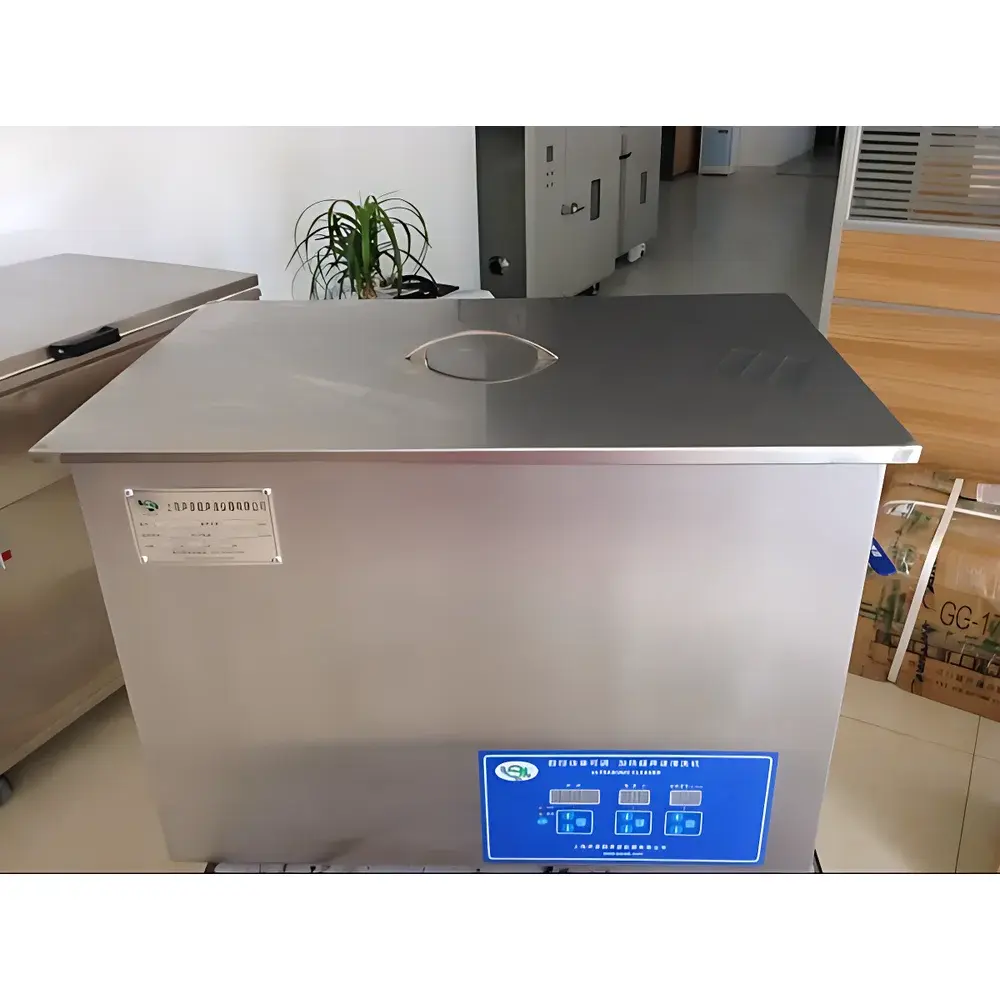
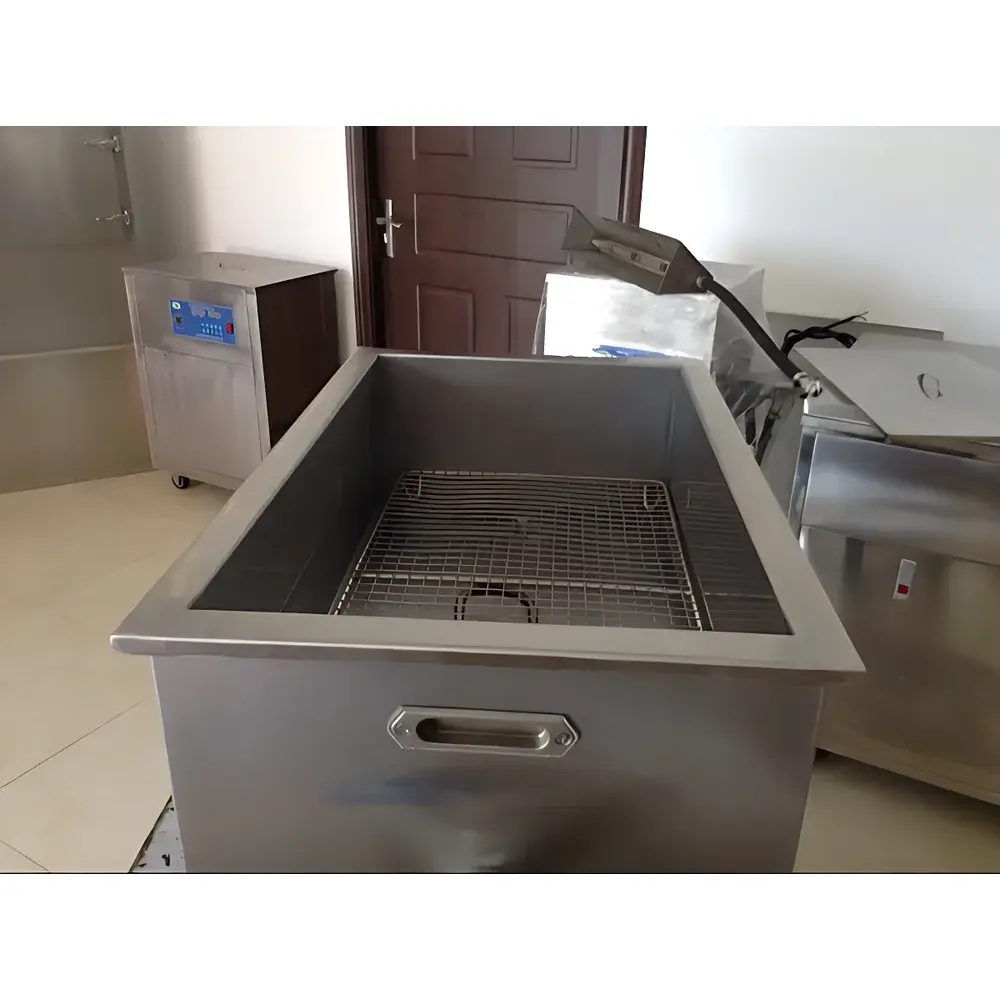
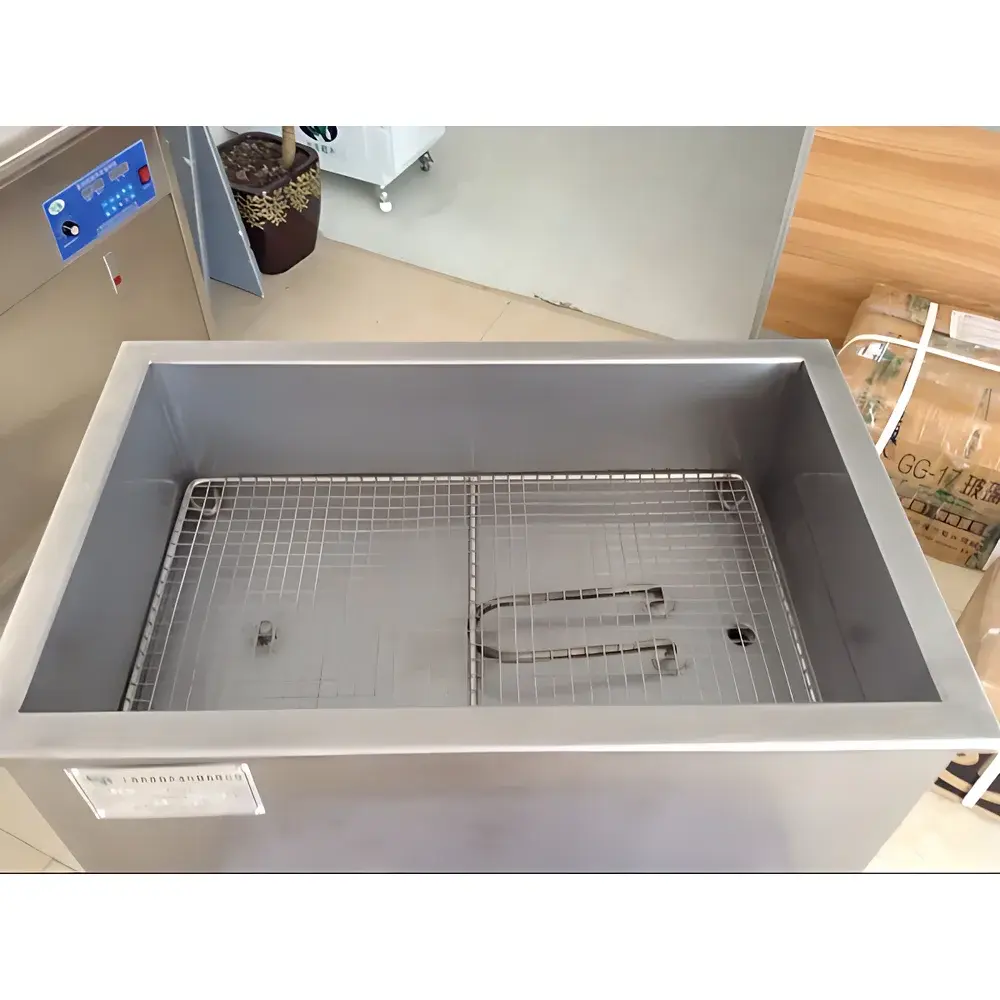
SYC Sycs SCQ-8201C 500W Programmable Digital Ultrasonic Cleaner with Heating
| Brand | SYC Sycs |
|---|---|
| Origin | Shanghai, China |
| Model | SCQ-8201C |
| Tank Capacity | 22.5 L |
| Ultrasonic Frequency Options | 25 / 28 / 40 / 60 / 80 / 100 kHz |
| Ultrasonic Power Output | 500 W |
| Power Adjustment Range | 10–100% (stepless) |
| Heating Power | 1200 W |
| Temperature Control Range | Ambient to 100 °C |
| Timer Range | 1–600 min |
| Lid | Acoustic-damping cover included |
| Drain Valve | Manual |
| Internal Tank Dimensions | 500 × 300 × 150 mm |
| Power Supply | 220 V AC, 50 Hz |
Overview
The SYC Sycs SCQ-8201C is a high-capacity, digitally controlled ultrasonic cleaner engineered for precision cleaning, degassing, emulsification, and cell disruption in laboratory, R&D, and industrial QC environments. It operates on the principle of acoustic cavitation: high-frequency electrical signals from a digital generator are converted by piezoelectric transducers into mechanical vibrations transmitted into the cleaning medium. These vibrations generate alternating compression and rarefaction cycles in the liquid, leading to the formation and violent implosion of microscopic vacuum bubbles—each collapse producing localized pressures exceeding 1,000 atm and transient temperatures up to 5,000 K. This physical phenomenon enables thorough removal of particulate contaminants, organic residues, oxides, and biofilms from complex geometries—including blind holes, micro-channels, porous matrices, and delicate optical or electronic surfaces—without mechanical abrasion or substrate damage.
Key Features
- Digital microprocessor control system with real-time display of elapsed time, set time, bath temperature, and actual temperature
- Stepless ultrasonic power adjustment (10–100%) ensures optimal energy delivery for sensitive samples or viscous media
- Programmable heating function (ambient to 100 °C) with 1200 W heating element and ±1 °C thermal stability
- Multi-frequency selection (25 / 28 / 40 / 60 / 80 / 100 kHz) allows process optimization: lower frequencies (25–40 kHz) deliver higher cavitation intensity for heavy-duty cleaning; higher frequencies (60–100 kHz) provide gentler, more uniform energy distribution ideal for fine optics, semiconductor wafers, or biological samples
- Robust stainless-steel tank (500 × 300 × 150 mm, 22.5 L capacity) with corrosion-resistant 316L-grade welds and polished interior finish
- Integrated acoustic-damping lid reduces airborne noise to ≤65 dB(A) and minimizes solvent evaporation during extended cycles
- Comprehensive safety protection: over-temperature, over-current, over-voltage, and low-level liquid detection with automatic shutdown and visual alarm indicators
- Manual drain valve and removable stainless-steel mesh basket for efficient solution exchange and part handling
Sample Compatibility & Compliance
The SCQ-8201C accommodates a broad spectrum of sample types and materials, including glassware (vials, cuvettes, chromatography columns), metal components (stainless steel surgical instruments, bearing assemblies, fuel injectors), silicon wafers, ceramic filters, polymer membranes, and biological tissue specimens. Its non-contact cleaning mechanism preserves dimensional integrity and surface finish of precision-machined or coated substrates. The unit complies with general laboratory equipment safety standards (IEC 61010-1) and supports GLP/GMP-aligned workflows through reproducible parameter logging and operator-defined protocol recall. While not certified to FDA 21 CFR Part 11 out-of-the-box, its digital interface and parameter memory facilitate integration into validated cleaning SOPs when paired with external audit-trail software.
Software & Data Management
The SCQ-8201C employs an embedded single-chip microcontroller with firmware supporting persistent storage of up to 10 user-defined cleaning protocols—each comprising frequency selection, power level, temperature setpoint, and timer duration. All operational parameters are displayed simultaneously on a high-contrast LED screen. Though the device lacks Ethernet or USB connectivity, its digital architecture ensures deterministic timing accuracy (±0.5% deviation over full 600-min range) and thermal setpoint repeatability (<±0.8 °C across three consecutive runs under identical conditions). For traceability, users may manually record cycle logs using timestamped lab notebooks or integrate the unit into facility-wide LIMS via external PLC-triggered start/stop signals.
Applications
- Removal of machining oils, polishing compounds, and flux residues from precision mechanical parts and aerospace components
- Cleaning of optical lenses, laser optics, and fiber-optic connectors prior to coating or assembly
- Preparation of HPLC vials, GC liners, and ICP-MS sample introduction systems to eliminate memory effects
- Cell lysis and nucleic acid extraction in molecular biology workflows
- Degassing of solvents prior to chromatography or spectroscopy to reduce baseline noise
- Emulsification of nanoemulsions and liposomal formulations in pharmaceutical development
- Surface activation and contaminant removal from MEMS devices and photomasks
- Restoration of antique instruments, jewelry, and archival documents without chemical exposure
FAQ
What is the recommended cleaning solution for use with this ultrasonic cleaner?
Aqueous alkaline or neutral pH detergents are preferred for most applications. Avoid halogenated solvents unless the tank and transducers are explicitly rated for them. Always verify compatibility with your sample material and consult SDS documentation.
Can the SCQ-8201C be used for sterilization?
No. This unit performs physical cleaning and decontamination via cavitation but does not achieve microbial lethality required for sterilization. Autoclaving or validated chemical disinfection must follow ultrasonic cleaning for sterile applications.
How often should the ultrasonic bath solution be changed?
Solution replacement frequency depends on load soiling and process criticality. As a general guideline, change the bath after 4–8 hours of cumulative operation or immediately upon visible turbidity, foam instability, or reduced cleaning efficacy.
Is it safe to operate the unit without the acoustic lid?
Operation without the lid is not recommended: it increases operator noise exposure, accelerates solvent evaporation, and compromises temperature uniformity and cavitation efficiency due to uncontrolled air–liquid interface dynamics.
Does the unit support continuous operation mode?
Yes—the timer can be set to maximum (600 minutes), and the system will maintain stable temperature and power output throughout. However, periodic solution refresh and transducer cooling intervals are advised for >4-hour uninterrupted runs.



