
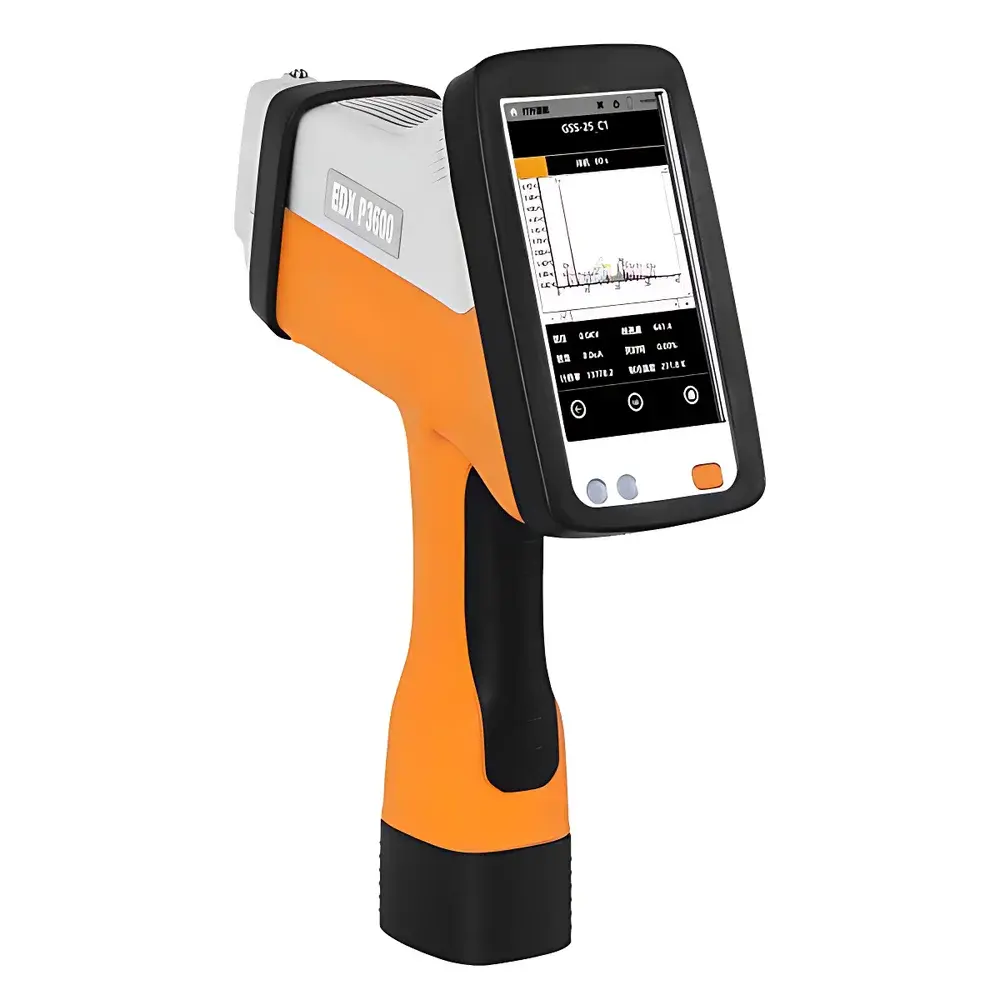
Anyty 3R-TXL Handheld XRF Rare Earth Element Analyzer
| Brand | Anyty |
|---|---|
| Model | 3R-TXL |
| Origin | Beijing, China |
| Manufacturer Type | OEM Manufacturer |
| Country of Origin | China |
| Excitation Source | 4 W micro-integrated X-ray tube (50 kV, 200 µA, Ag anode |
| Detector | Fast Silicon Drift Detector (SDD), energy resolution ≤125 eV |
| Filter System | 5-position automatic filter wheel |
| CPU | Quad-core low-power industrial processor (1.44 GHz) |
| Data Storage | 64 GB internal flash memory (≥200,000 spectra + reports) |
| Display | 5-inch high-brightness auto-adaptive LCD touchscreen |
| Operating Temperature | −20 °C to +55 °C |
| Relative Humidity | ≤95% RH (non-condensing) |
| Battery | 6800 mAh Li-ion, ≥8 h continuous operation |
| Weight | 1.8 kg |
| Dimensions | 250 × 320 × 80 mm |
| GPS | Integrated dual-frequency GNSS module with altitude and coordinate logging |
| Connectivity | USB 2.0, Wi-Fi 802.11 b/g/n, Bluetooth 4.2 |
| Safety | Interlocked beam shutter, air-gap safety design, certified exempt from radiation licensing per Chinese MEE regulatory framework |
| Software Platform | Custom industrial Windows IoT OS (Android optional) |
| Detection Range | Mg (12) to U (92) |
| Quantification Accuracy | 0.01–99.99 wt% (matrix-dependent, calibrated per ISO 18505-2 and ASTM E2811) |
| Cloud Integration | OTA firmware updates, remote diagnostics, secure data sync via encrypted TLS 1.2 channel |
Overview
The Anyty 3R-TXL Handheld XRF Rare Earth Element Analyzer is a field-deployable, bench-grade energy-dispersive X-ray fluorescence (EDXRF) spectrometer engineered for rapid, non-destructive elemental quantification in geoscientific and industrial environments. Utilizing fundamental parameter (FP)-based quantification with iA-FP algorithmic correction, the instrument delivers trace-level detection limits (LOD) for rare earth elements (REEs) without sample preparation—enabling direct analysis of unprocessed ores, drill cores, tailings, scrap metal, and customs-bound cargo. Its core measurement principle relies on primary X-ray excitation of atomic inner-shell electrons, followed by detection of characteristic secondary X-ray photons emitted during electron relaxation. The Fast SDD detector—coupled with optimized collimation, Ag-target microtube geometry, and real-time spectral deconvolution—ensures high-count-rate fidelity and robust peak separation across the Lα/Lβ and Kα/Kβ lines of adjacent REEs (e.g., Nd/Sm, Dy/Ho). Designed for compliance with international field-spectroscopy workflows, the 3R-TXL meets mechanical and electromagnetic requirements outlined in IEC 61326-1 (industrial EMC) and operates within radiation safety thresholds defined under CN-NMPA Regulation No. 12 (2021) and EPA Method 6200.
Key Features
- Field-ready ruggedization: 65% aerospace-grade aluminum chassis with passive thermal management architecture; dissipates heat >30% faster than conventional handheld XRF housings, minimizing thermal drift in extended outdoor use.
- Intelligent excitation control: Five-position motorized filter wheel automatically selects optimal attenuation and excitation conditions per element group—enhancing signal-to-background ratio for light REEs (La–Nd) and heavy REEs (Tb–Lu) alike.
- Adaptive human interface: 5-inch sunlight-readable capacitive touchscreen with ambient-light compensation; intuitive icon-driven workflow reduces operator training time to <15 minutes.
- Dual-mode positioning: Integrated dual-frequency GNSS (GPS + BeiDou) logs georeferenced assay data at sub-3-meter CEP accuracy—critical for spatially resolved grade modeling and resource estimation.
- Secure data governance: On-device AES-256 encryption, audit-trail-enabled report generation, and optional 21 CFR Part 11-compliant user authentication modules support GLP/GMP-aligned field laboratories.
Sample Compatibility & Compliance
The 3R-TXL accommodates heterogeneous, irregular, and moisture-variable samples—including raw rock chips, crushed ore fines, slag fragments, electronic waste PCBs, and catalytic converter substrates—without grinding, pressing, or fusion. Its open-beam geometry tolerates surface roughness up to 2 mm and accommodates samples ≥10 mm in minimum dimension. Calibration libraries are traceable to NIST SRM 278 and CRM GeoReM basaltic reference materials, validated per ISO 18505-2:2022 (XRF analysis of geological materials). Regulatory conformance includes exemption certification from China’s Ministry of Ecology and Environment (MEE) for portable XRF devices operating below 50 kV, as well as CE marking under Directive 2014/30/EU (EMC) and 2014/35/EU (LVD). For export markets, the unit complies with RoHS 2 (2015/863/EU) and supports documentation packages required for customs clearance under EU Regulation (EU) No 98/2013 (precursor chemicals).
Software & Data Management
Preloaded with Anyty’s FieldQuant Pro software suite, the 3R-TXL enables real-time spectrum visualization, multi-layer matrix correction, and batch reporting in PDF/XLSX formats—with embedded metadata (GPS coordinates, timestamp, operator ID, instrument serial). All spectral data and calibration files reside in a sandboxed, version-controlled file system. Over-the-air (OTA) updates deploy via TLS 1.2-secured cloud portal, ensuring alignment with evolving regulatory method updates (e.g., USGS Open-File Report 2022–1043 for REE screening). Data export supports ASTM E1301-compliant CSV templates for integration into industry-standard platforms including Leapfrog Geo, Micromine, and QGIS. Remote diagnostics allow manufacturer engineers to access anonymized performance logs—subject to explicit user consent and configurable firewall rules.
Applications
- Mineral exploration: Rapid in-field discrimination of carbonatite vs. ion-adsorption clay deposits using Ce/Nd and Y/Ho ratios; real-time delineation of REE-enriched zones during trenching or RC drilling.
- Resource evaluation: Grade control of mined material at stockpile or conveyor belt interfaces; validation of assay discrepancies between lab ICP-MS and field estimates.
- Recycling & circular economy: Identification of NdFeB magnet content in e-waste streams; quantification of Ga/Ge in spent LED substrates for secondary recovery economics modeling.
- Border security & trade compliance: Screening of imported ceramics, phosphors, and permanent magnets against WTO Annex I REE export restriction lists; verification of declared REE composition in customs declarations.
- Environmental forensics: Mapping of legacy mine drainage sediments for La–Ce anomalies indicative of upstream rare-earth processing activity.
FAQ
Does the 3R-TXL require annual recalibration?
No—factory calibration is stable for ≥12 months under normal field use. Users may perform daily verification checks using included Fe/Cu/Zn check standards; full recalibration is recommended only after mechanical shock, extreme thermal cycling (>40 °C delta), or detector replacement.
Can it quantify REEs in soil with high organic content?
Yes—iA-FP algorithms apply matrix correction for C/N/O interference; however, LOD increases ~2× compared to mineral matrices. For regulatory soil testing (e.g., EPA 6200), we recommend pairing with lab-based ICP-MS confirmation for concentrations <10 ppm.
Is spectral data export compatible with third-party chemometric tools?
Yes—raw .spc and processed .csv files include full energy-channel intensity arrays (0.1 keV–50 keV, 2048 channels), enabling PCA, PLS-R, or LIBS-XRF fusion modeling in MATLAB, Python (scikit-learn), or Unscrambler.
What radiation safety documentation is provided for international deployment?
Each unit ships with MEE Exemption Certificate, IEC 62495-compliant radiation survey report, and multilingual operator safety manual compliant with IAEA SSG-46 (Radiation Protection in Portable XRF Use).
How does the device handle overlapping L-lines of adjacent REEs (e.g., Sm/Eu)?
The 125 eV FWHM resolution of the Fast SDD, combined with iterative peak deconvolution and library-constrained fitting, achieves <90% peak separation confidence for Sm Lα (6.69 keV) and Eu Lα (6.87 keV) in typical monazite matrices.






