
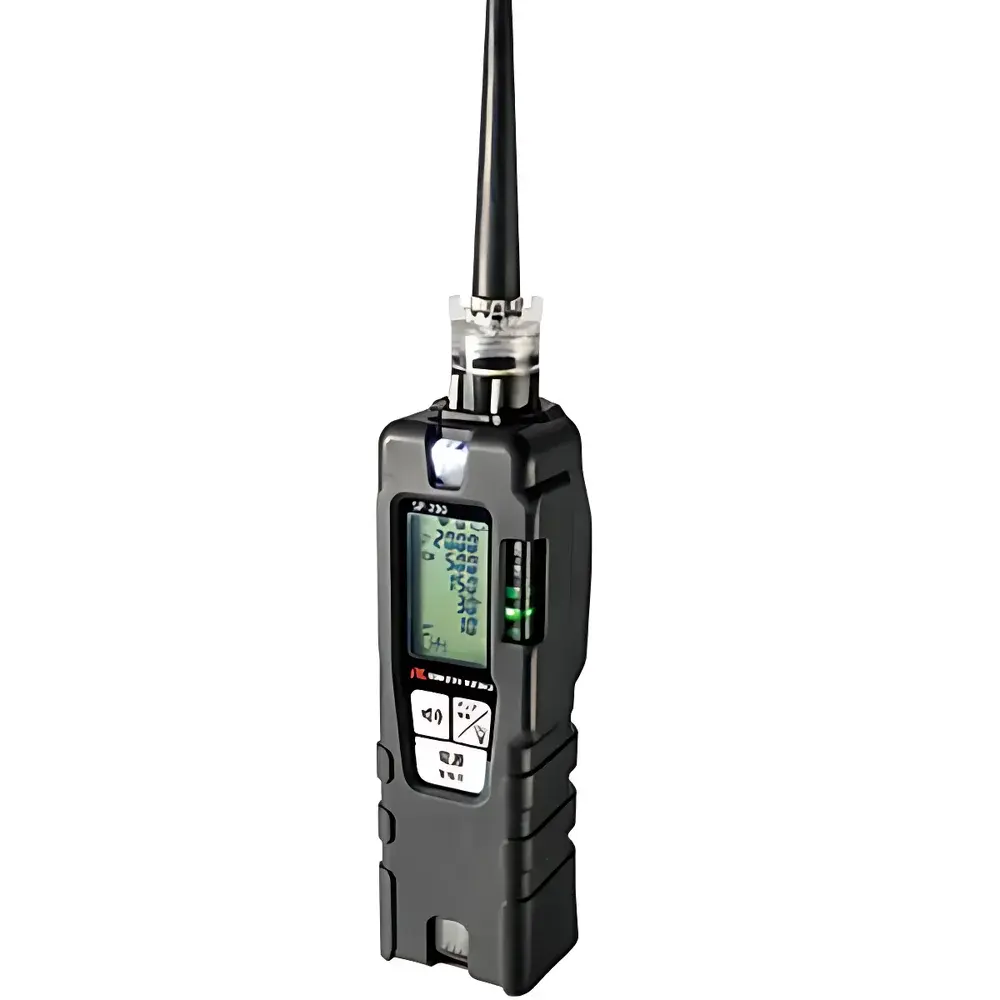
RIKEN KEIKI SP-230 ML Portable Gas Leak Detector for Natural Gas (CH₄) and Liquefied Petroleum Gas (LPG)
| Brand | RIKEN KEIKI |
|---|---|
| Origin | Japan |
| Model | SP-230 ML |
| Detection Principle | Hot-Wire Semiconductor Sensor |
| Detection Method | Draw-in (Pump-Assisted) Sampling |
| Gas Types | CH₄ (Natural Gas), i-C₄H₁₀ (LPG) |
| Measurement Range | 10–2000 ppm |
| Alarm Setpoints | 10, 30, 150, 500, 2000 ppm (default: 30 ppm) |
| Alarm Output | Visual (flashing LED), Audible (buzzer) |
| Explosion Protection | Intrinsic Safety, II 2G Ex ic IIC T4 Ga |
| IP Rating | IP67 |
| Operating Temperature | −20 to +55 °C |
| Operating Humidity | ≤95% RH (non-condensing) |
| Battery | 2 × AA alkaline, ~13 h continuous operation (25 °C, no alarm, no light, no Bluetooth) |
| Dimensions | 41 (W) × 186 (H) × 38 (D) mm (excl. probe) |
| Weight | ~220 g (excl. batteries) |
| Wireless | Bluetooth 4.2 Low Energy (BLE) |
Overview
The RIKEN KEIKI SP-230 ML is a certified intrinsically safe, portable gas leak detector engineered for rapid, field-deployable detection of combustible gases—specifically methane (CH₄) used in municipal natural gas distribution networks and isobutane (i-C₄H₁₀) as a representative component of liquefied petroleum gas (LPG). Utilizing a temperature-compensated hot-wire semiconductor sensing element, the instrument delivers stable baseline response under variable ambient conditions while maintaining high sensitivity across its 10–2000 ppm measurement range. Its draw-in sampling mechanism—integrated with a low-noise micro-pump—ensures consistent gas flow across the sensor surface, minimizing diffusion delay and enabling reliable detection even in low-velocity or confined environments such as valve pits, meter rooms, or underground utility trenches. Designed for first responders, utility field technicians, and municipal safety inspectors, the SP-230 ML complies with IEC 60079-0 and IEC 60079-11 for Group II C hazardous locations and carries the Ex ic IIC T4 Ga marking, certifying safe operation in potentially explosive atmospheres containing hydrogen-group gases.
Key Features
- Intrinsically safe construction meeting IEC 60079-11 (Ex ic) and ATEX Directive 2014/34/EU for Zone 1/21 applications
- IP67-rated enclosure ensuring dust-tightness and protection against immersion up to 1 m for 30 minutes—critical for outdoor, wet, or muddy inspection scenarios
- High-contrast LED display with dynamic color-coded status indication: green (normal), yellow (pre-alarm), red (alarm), plus real-time analog bar graph showing relative concentration
- Dedicated front-panel LED worklight and backlit tactile buttons for reliable operation in total darkness, tunnel interiors, or nighttime emergency response
- One-touch functional toggling: single press activates/deactivates audible alarm, visual alert, or illumination—no menu navigation required during time-critical inspections
- Bluetooth 4.2 Low Energy (BLE) interface enabling secure, low-power wireless transmission of timestamped measurement logs, alarm events, and device diagnostics to iOS/Android mobile devices via the official RIKEN KEIKI FieldLink™ application
Sample Compatibility & Compliance
The SP-230 ML is factory-calibrated for methane (CH₄) and isobutane (i-C₄H₁₀), serving as a representative surrogate for commercial LPG mixtures (propane/butane blends). Cross-sensitivity to other hydrocarbons (e.g., propane, ethane, pentane) falls within ±15% of CH₄-equivalent response per JIS T 8201 and ISO 24447. The device meets Japanese Industrial Standard JIS T 8201-1:2021 for portable combustible gas detectors and conforms to electromagnetic compatibility requirements per IEC 61326-1 (industrial environment). It supports traceable calibration using certified CH₄/N₂ and i-C₄H₁₀/N₂ standard gases (100 ppm and 1000 ppm), with full calibration verification logs exportable via BLE. All firmware updates and configuration changes are logged with audit-trail timestamps compliant with GLP principles.
Software & Data Management
The companion FieldLink™ mobile application (iOS v14+/Android 10+) provides secure pairing, real-time telemetry display, and offline data capture. Each recorded event includes GPS coordinates (if enabled), UTC timestamp, measured concentration, alarm status, battery level, and sensor health flag. Data exports support CSV and PDF report formats compatible with utility asset management systems (e.g., Maximo, Cityworks) and regulatory reporting frameworks including Japan’s Gas Business Act Annex IV and EU Directive 2009/142/EC. Bluetooth communication adheres to Bluetooth SIG security specifications; no persistent pairing keys are stored on the detector, and all transmitted data is encrypted using AES-128. Audit logs retain the last 500 events onboard and support remote retrieval without physical docking.
Applications
- Routine leak surveys along buried gas mains, service lines, and above-ground regulators in urban infrastructure
- Post-earthquake or flood damage assessment of gas distribution networks where rapid hazard identification is mission-critical
- Pre-commissioning integrity verification of new LPG cylinder filling stations and vaporizer installations
- Indoor leak investigation in residential basements, commercial kitchens, and industrial boiler rooms
- Regulatory compliance audits conducted by municipal gas safety authorities and third-party certification bodies
- Training and competency assessment for gas fitter apprentices under JIS K 6850-accredited programs
FAQ
What gases does the SP-230 ML detect, and how is cross-sensitivity managed?
The SP-230 ML is calibrated for CH₄ and i-C₄H₁₀. Its hot-wire semiconductor sensor exhibits predictable relative response factors for common hydrocarbons, documented in the Type Examination Report (JET No. JET-22-1789). Users may apply correction factors provided in the operator manual when assessing non-target gases.
Is the device suitable for use in classified hazardous areas?
Yes—it holds Ex ic IIC T4 Ga certification (TÜV Rheinland Certificate No. 22.0001X), permitting safe operation in Zone 1 (gas) and Zone 21 (dust) locations where methane or propane atmospheres may be present.
How is calibration verified in the field?
A dedicated “Bump Test” mode allows functional verification using a 100 ppm CH₄ challenge gas. Full span calibration requires certified gas and the optional calibration adapter kit (Cat. No. CA-SP230), traceable to NMIJ/JCSS standards.
Does Bluetooth functionality affect intrinsic safety certification?
No—BLE transmission occurs only during active user-initiated sessions and complies with IEC 60079-29-1:2015 Annex D for low-energy wireless interfaces in Ex ic equipment. Radio power output is limited to <10 dBm, and antenna integration is fully encapsulated within the explosion-proof housing.
Can measurement data be integrated into enterprise GIS or CMMS platforms?
Yes—CSV exports contain WGS84 coordinates, ISO 8601 timestamps, and structured metadata. APIs for direct ingestion into Esri ArcGIS Field Maps or IBM Maximo are available under RIKEN KEIKI’s Enterprise Integration License program.







