
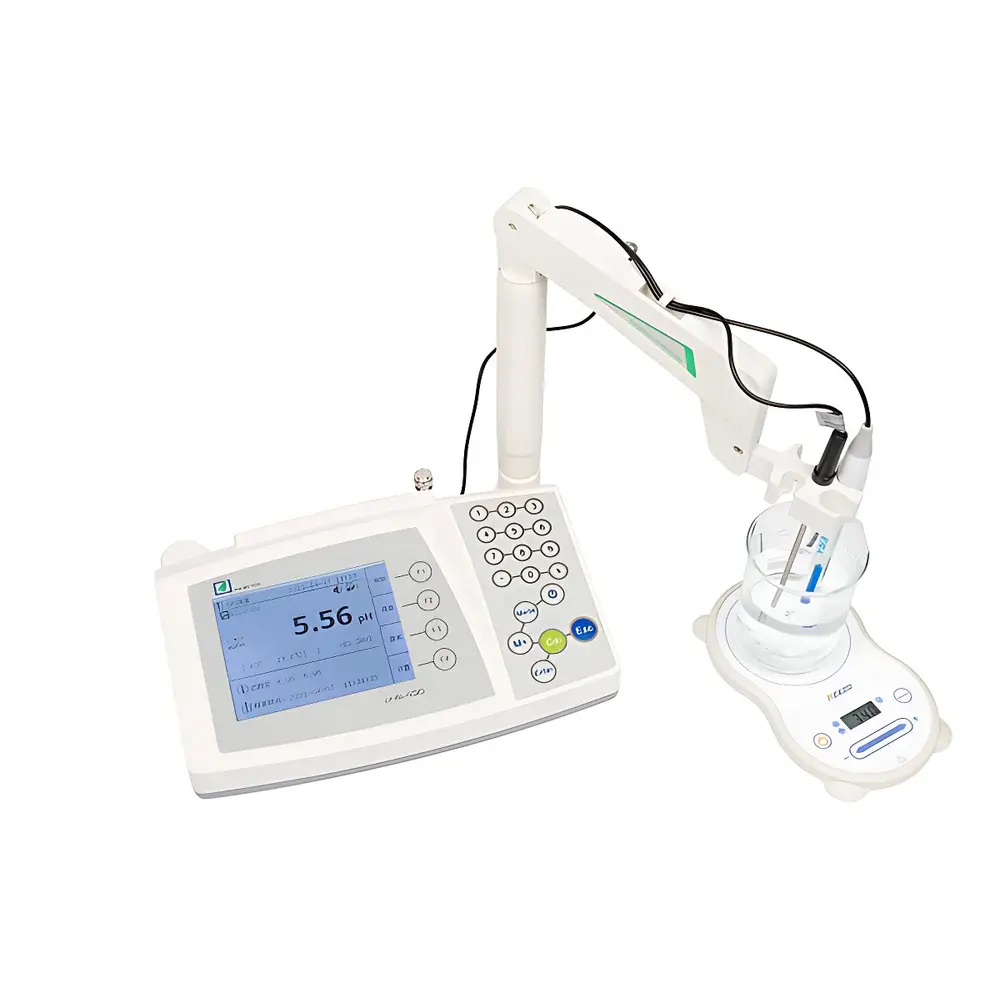
FangZhou PHS-430 High-Precision Multi-Parameter pH Meter
| Brand | FangZhou |
|---|---|
| Origin | Sichuan, China |
| Model | PHS-430 |
| Instrument Type | Multiparameter Benchtop pH Meter |
| Measurement Accuracy | ±0.002 pH |
| pH Range | (−10.000 to 20.000) pH |
| Resolution | 0.001/0.01/0.1 pH (adjustable) |
| mV Range | (−2000.00 to +2000.00) mV |
| mV Resolution | 0.01/0.1/1 mV (adjustable) |
| Temperature Range | (−20.0 to 135.0) °C |
| Temp. Resolution | 0.1 °C |
| Temp. Accuracy | ±0.2 °C ±1 digit |
| Input Impedance | ≥3 × 10¹² Ω |
| Calibration | Up to 5-point pH, 9-point ISE, auto-buffer recognition (NIST, Merck, MT Europe, China standards) |
| Data Storage | 4096 GLP-compliant records |
| Connectivity | USB, RS-232, 0–20 mV analog output |
| Power | DC 9 V, 500 mA (center-positive) |
Overview
The FangZhou PHS-430 is a laboratory-grade, multiparameter benchtop pH meter engineered for high reproducibility and traceable electrochemical measurements in regulated analytical environments. It operates on the fundamental principle of potentiometric measurement: the potential difference between a pH-sensitive glass electrode and a stable reference electrode is converted into a pH value using the Nernst equation (E = E⁰ − (RT/F) ln(10) × pH). With a certified accuracy of ±0.002 pH and adjustable resolution down to 0.001 pH, the PHS-430 meets the performance criteria of ISO 17025-accredited laboratories for routine and method validation work. Its extended pH range (−10.000 to 20.000) supports non-aqueous, highly alkaline, or strongly acidic sample analysis—common in pharmaceutical dissolution testing, battery electrolyte characterization, and semiconductor cleaning solution monitoring. The instrument integrates automatic temperature compensation (ATC) via integrated or external Pt1000 sensors and complies with thermodynamic correction protocols defined in ASTM D1293 and USP .
Key Features
- Triple-resolution pH/mV display (0.001 pH / 0.01 mV / 1 mV), configurable per measurement mode
- GLP-compliant data management: 4096 timestamped records with operator ID, calibration history, and electrode serial tracking
- Intuitive menu-driven interface with backlight LCD, tactile membrane keys, and real-time self-diagnostic status reporting
- Multi-point calibration support: up to 5-point pH calibration with automatic buffer recognition across four international standard sets (NIST, Merck, MT Europe, China GB)
- Comprehensive ion-selective electrode (ISE) functionality: 16 preloaded elements (e.g., Na⁺, K⁺, F⁻, Cl⁻, NO₃⁻, NH₄⁺), two user-defined elements, and 9-point non-linear standard curve generation
- Flexible concentration reporting: 13 selectable units (mol/L, mmol/L, μg/L, ppm, %, etc.) with automatic unit conversion based on valence and molecular weight inputs
- Dual temperature compensation: automatic (ATC) or manual entry, covering −20.0 to 135.0 °C with ±0.2 °C accuracy
- Universal electrode interface with optional converter module for BNC, DIN, and mini-DIN probe compatibility
Sample Compatibility & Compliance
The PHS-430 accommodates a broad spectrum of sample matrices—including aqueous buffers, organic solvents (e.g., methanol/water mixtures), viscous suspensions, and low-ionic-strength ultrapure water—when paired with appropriate electrodes (e.g., double-junction, low-resistance glass, or solid-state ISEs). Its input impedance exceeds 3 × 10¹² Ω, minimizing loading errors during high-impedance measurements. The instrument conforms to key regulatory frameworks: it supports audit-trail-enabled operation per FDA 21 CFR Part 11 when used with the optional FangZhou PH-Link software; maintains full GLP traceability (calibration dates, standards used, operator ID, environmental conditions); and aligns with ISO/IEC 17025 requirements for measurement uncertainty estimation. All firmware and calibration routines are validated against NIST-traceable reference materials.
Software & Data Management
The optional FangZhou PH-Link PC software enables bidirectional communication via USB or RS-232, supporting automated data export (CSV, TXT, Excel-compatible), remote instrument control, and electronic signature workflows. The software implements secure user access levels (administrator, analyst, reviewer), encrypted calibration log archiving, and time-stamped event logging—including electrode drift alerts and out-of-specification (OOS) flagging. Raw mV and temperature values are retained alongside calculated pH/ISE results, facilitating post-acquisition reprocessing and uncertainty propagation analysis. All exported datasets include metadata fields required for ISO 17025 technical records: instrument ID, sensor serial number, calibration certificate ID, ambient temperature/humidity, and analyst signature.
Applications
- Pharmaceutical QC: pH verification of injectables, buffers, and dissolution media per USP and EP 2.2.3
- Environmental labs: field-deployable calibration verification for portable meters using lab-based PHS-430 as a reference standard
- Academic research: kinetic studies of hydrolysis reactions requiring sub-millipH stability over extended periods
- Food & beverage: titratable acidity mapping and shelf-life modeling via precise pH tracking in fermented products
- Electrochemistry R&D: open-circuit potential (OCP) and redox potential (ORP) monitoring in corrosion inhibitor screening
- Water treatment: simultaneous pH, ORP, and free chlorine (via ISE) trending in disinfection process control
FAQ
Does the PHS-430 support 21 CFR Part 11 compliance?
Yes—when operated with FangZhou PH-Link software, the instrument provides electronic signatures, audit trails, and role-based access control required for FDA-regulated environments.
Can the PHS-430 measure fluoride in drinking water per EPA Method 300.0?
Yes—the built-in F⁻ ion mode, 9-point calibration capability, and μg/L concentration reporting meet detection and quantitation requirements specified in the method.
Is temperature compensation mandatory for accurate pH readings?
Temperature compensation is essential for thermodynamically correct pH values; the PHS-430 applies the full Nernst slope correction (dE/dT) and supports both ATC and manual entry for validation studies.
What electrode types are compatible with the PHS-430’s universal interface?
Standard BNC, DIN, and mini-DIN electrodes are supported via optional adapter modules; double-junction and refillable reference electrodes are recommended for samples containing sulfides, proteins, or heavy metals.
How is measurement uncertainty estimated for GLP reporting?
Uncertainty contributors include calibration standard uncertainty (NIST-certified), electrode repeatability (±0.001 pH), temperature error (±0.2 °C), and digital resolution—combined using root-sum-square (RSS) methodology per GUM (JCGM 100:2008).
Related Products




