
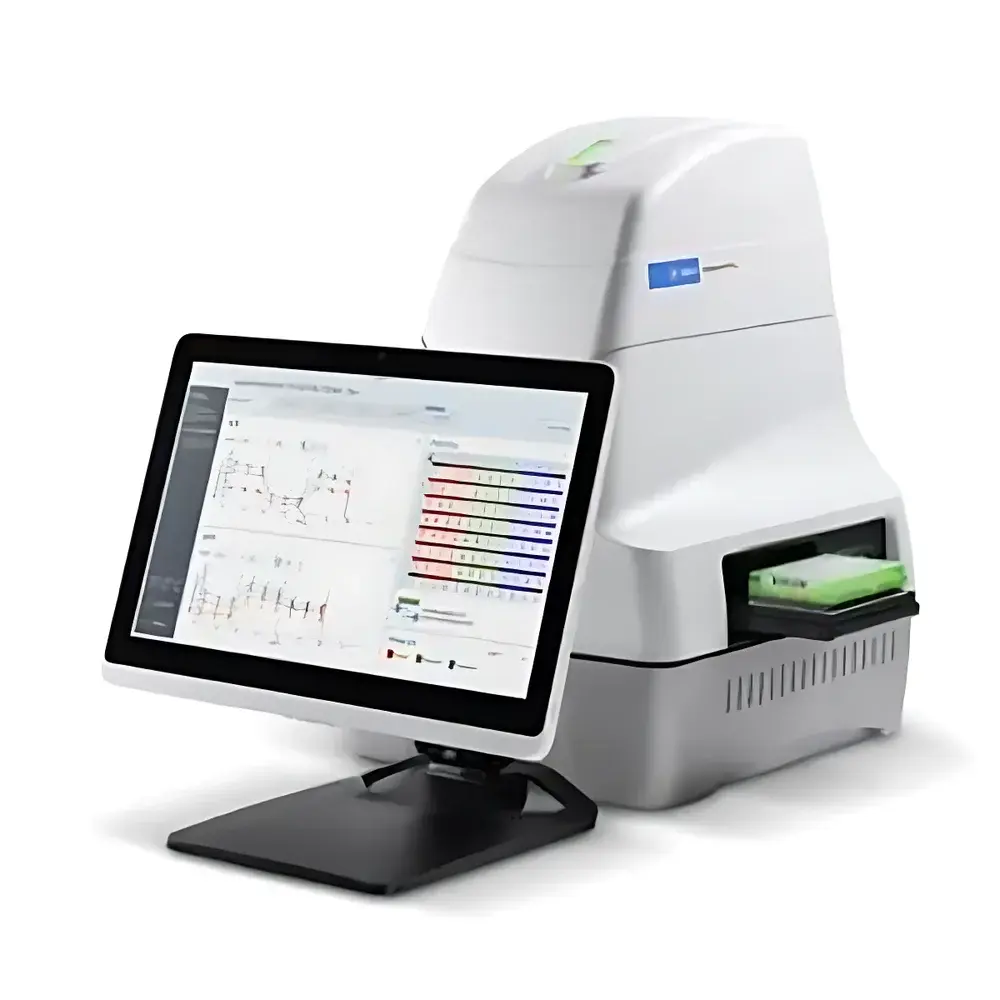
Agilent Seahorse XF Pro Real-Time Cell Metabolic Flux Analyzer
| Brand | Agilent Technologies |
|---|---|
| Origin | USA |
| Model | Seahorse XF Pro |
| Dimensions (W × D × H) | 38.74 cm × 45.72 cm × 58.42 cm |
| Sample Temperature Range | 16–42 °C |
| Operating Ambient Temperature | 4–30 °C |
| Relative Humidity | 20–80 % RH |
| Cell Seeding Density | 5,000–250,000 cells/well |
| Detection Wells | 92 per assay plate |
| Assay Volume per Well | 160–300 µL |
| Power Supply | 100–240 VAC, 9 A, 50/60 Hz |
| Controller OS | Windows 10 Enterprise (64-bit) |
| Memory | 16 GB |
| Connectivity | TCP/IP, USB, Wi-Fi |
| Weight | 22.2 kg |
Overview
The Agilent Seahorse XF Pro Real-Time Cell Metabolic Flux Analyzer is an integrated, label-free platform engineered for high-resolution, kinetic measurement of cellular bioenergetics in live, intact cells. It employs solid-state sensor probes embedded in specialized 96-well microplates to simultaneously quantify two fundamental metabolic parameters: the oxygen consumption rate (OCR), reflecting mitochondrial respiration, and the extracellular acidification rate (ECAR), primarily driven by glycolytic proton efflux. Unlike endpoint assays or genetically encoded biosensors, the XF Pro system operates on a non-invasive, real-time basis—capturing dynamic metabolic responses to pharmacological modulators, nutrient shifts, or genetic perturbations within minutes. Its design adheres to the principles of microphysiometry, where transient changes in dissolved O2 and pH near the cell monolayer are resolved via fluorescence-based optical sensors with sub-minute temporal resolution. This enables systems-level interrogation of metabolic flexibility—the capacity of cells to shift between oxidative phosphorylation and glycolysis—under physiologically relevant conditions.
Key Features
- Simultaneous dual-parameter detection: OCR and ECAR measured in parallel from the same well, eliminating inter-assay variability and enabling direct correlation of respiratory and glycolytic fluxes.
- Automated reagent injection system with up to four sequential injections per well, supporting standardized mitochondrial stress tests (e.g., oligomycin, FCCP, rotenone/antimycin A) and glycolytic stress tests (e.g., glucose, oligomycin, 2-DG).
- Integrated temperature- and CO2-controlled microchamber ensuring stable physiological conditions (16–42 °C sample temperature; ambient operation at 4–30 °C) throughout assay duration.
- Dedicated Wave Pro software running on a Windows 10 Enterprise controller workstation with touchscreen interface—providing end-to-end workflow support from experimental design and instrument control to kinetic data visualization and export.
- Validated compatibility with diverse biological models: adherent cell lines (e.g., HeLa, HEK293), suspension cells (e.g., Jurkat, PBMCs), primary isolates (e.g., cardiomyocytes, neurons, macrophages), and stem cell-derived cultures.
- Robust architecture compliant with laboratory infrastructure standards: TCP/IP network integration, USB peripheral support, and optional Wi-Fi connectivity for remote monitoring and data archival.
Sample Compatibility & Compliance
The XF Pro platform supports a broad range of mammalian cell types without requiring transfection, labeling, or lysis. Its assay format accommodates standard seeding densities (5,000–250,000 cells/well), enabling reproducible measurements across low- and high-metabolic-activity samples. All consumables—including XF Cell Culture Microplates, assay kits, and calibration reagents—are manufactured under ISO 13485-certified processes and qualified for use in GLP-compliant environments. The Wave Pro software includes audit trail functionality aligned with FDA 21 CFR Part 11 requirements, supporting electronic signatures, user access controls, and immutable data logging. While not a diagnostic device, the system meets applicable IEC 61010-1 safety standards for laboratory equipment and conforms to electromagnetic compatibility (EMC) directives (EN 61326-1).
Software & Data Management
Wave Pro is the native analytical suite for the XF Pro system, delivering deterministic experiment scheduling, real-time sensor calibration, and automated baseline correction. It features built-in analysis modules for calculating key bioenergetic parameters—including basal respiration, ATP-linked respiration, maximal respiratory capacity, spare respiratory capacity, proton leak, non-mitochondrial respiration, basal glycolysis, glycolytic capacity, and glycolytic reserve. Export options include CSV, Excel, and PDF formats compatible with downstream statistical tools (e.g., GraphPad Prism, R). Data files are timestamped, versioned, and stored locally on the controller’s 16 GB RAM system with persistent SSD storage. Networked deployment allows centralized data backup via SMB or FTP protocols, facilitating multi-user lab environments and longitudinal study tracking.
Applications
The XF Pro analyzer serves as a foundational tool in translational and basic research domains where metabolic phenotype dictates functional outcome. In immunology, it characterizes activation-induced metabolic reprogramming in T cells and macrophages. In oncology, it identifies vulnerabilities in tumor cell metabolism linked to drug resistance or hypoxia adaptation. In neurodegeneration studies, it assesses mitochondrial dysfunction in iPSC-derived neurons exposed to pathogenic aggregates. In cardiometabolic research, it evaluates substrate utilization shifts in primary cardiomyocytes under insulin resistance or ischemic stress. Additionally, it supports preclinical toxicology screening—detecting early metabolic perturbations preceding cytotoxicity—and facilitates mechanistic validation of targets in mitochondrial biology, redox signaling, and nutrient sensing pathways (e.g., AMPK, mTOR, HIF-1α).
FAQ
What cell types are compatible with the XF Pro system?
Primary cells, immortalized adherent lines, suspension cultures, and stem cell–derived differentiated cells have all been validated in peer-reviewed literature using XF Pro assay protocols.
Is the system suitable for kinetic measurements over extended time courses?
Yes—the XF Pro supports assay durations up to 2 hours with continuous sampling intervals as short as 3 minutes, enabling resolution of rapid metabolic transitions following stimulus addition.
How does the XF Pro differ from earlier Seahorse platforms (e.g., XFe96)?
The XF Pro introduces enhanced sensor sensitivity, improved thermal uniformity across the plate, expanded reagent injection precision, and deeper integration with Wave Pro’s advanced analytics engine—including automated outlier detection and batch-normalized comparative analysis.
Can data be exported for regulatory submission?
Yes—Wave Pro generates ALCOA+ compliant data packages, including raw sensor traces, processed parameter tables, metadata logs, and electronic signatures, meeting expectations for IND-enabling studies and CMC documentation.
What maintenance is required for long-term operational reliability?
Routine calibration using XF Calibrant and periodic verification with XF Mito Stress Test Kit are recommended quarterly; no routine hardware servicing is required under normal usage conditions.




