
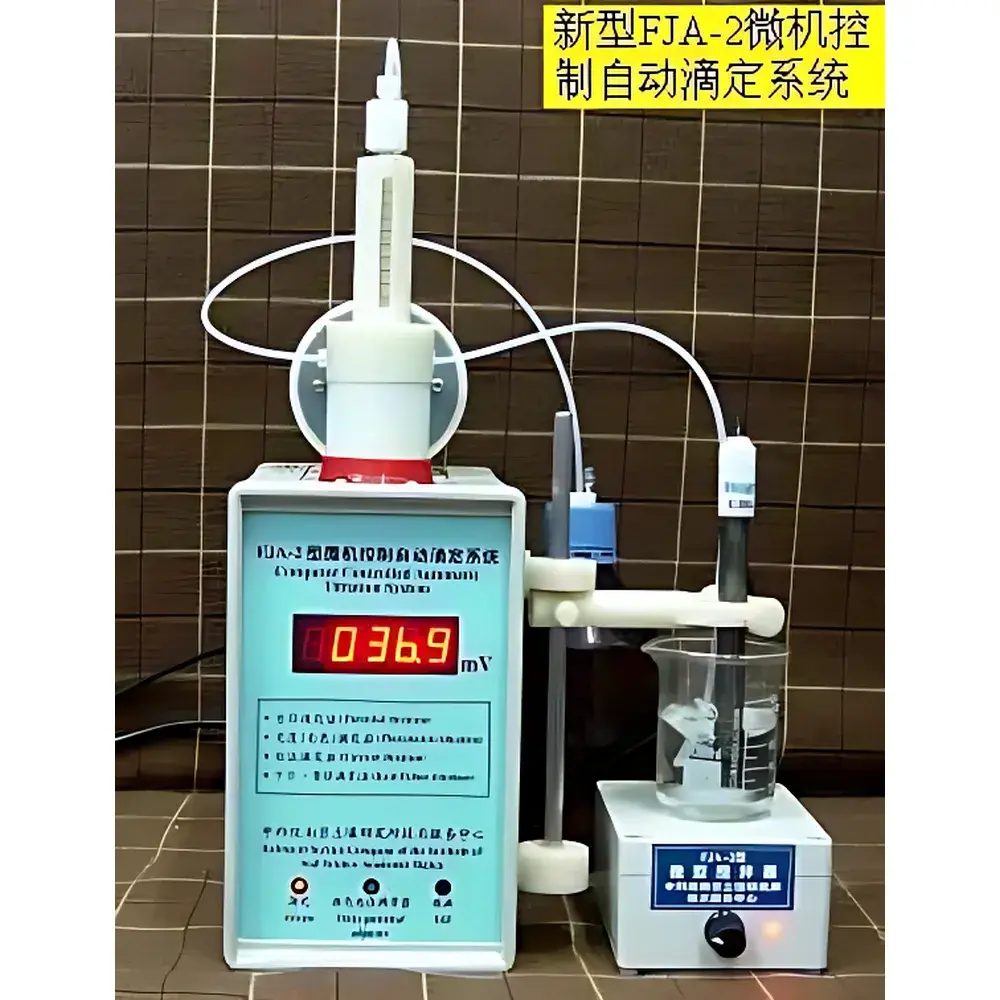
Kew FJA-2 Computer-Controlled Automatic Potentiometric Titrator
| Origin | Jiangsu, China |
|---|---|
| Manufacturer Type | Authorized Distributor |
| Origin Category | Domestic (PRC) |
| Model | FJA-2 |
| Instrument Type | Universal Potentiometric Titrator |
| Voltage Measurement Range | −1999.9 to +1999.9 mV |
| Resolution | 0.1 mV |
| Voltage Accuracy | ±0.025% of reading ±2 digits |
| Input Impedance | >10¹² Ω |
| Titration Precision | 0.01 mL |
| Minimum Dispensed Volume | 0.001 mL |
| Titration Error | ≤0.2% (using 0.1 mol/L HCl vs. 0.1 mol/L NaOH) |
| Compliance | GB/T 1792–1988 (mercaptan sulfur in petroleum products) |
Overview
The Kew FJA-2 Computer-Controlled Automatic Potentiometric Titrator is a modular, PC-based analytical platform engineered for high-reproducibility potentiometric, photometric, amperometric, and coulometric titrations. It operates on the fundamental principle of endpoint detection via real-time monitoring of electrode potential (E) versus volume of titrant added—enabling precise identification of stoichiometric equivalence points through first-derivative maxima, inflection-point analysis, or pre-set potential thresholds. Designed for laboratory environments requiring trace-level quantification and regulatory traceability, the system integrates a dedicated titration console with Windows-native software, supporting both classical redox, acid-base, precipitation, and complexometric reactions, as well as specialized methods including Karl Fischer water determination, mercaptan sulfur analysis per GB/T 1792–1988, and non-aqueous titrations for weakly ionized species. Its architecture supports dual-electrode configurations (e.g., Ag/AgS reference and thiol-selective indicator electrodes), ensuring robust performance across heterogeneous sample matrices—from hydrocarbon fuels and pharmaceutical intermediates to environmental extracts and polymer additives.
Key Features
- High-impedance analog front-end (>10¹² Ω input impedance) optimized for low-current electrochemical sensing, minimizing polarization errors during potentiometric measurements.
- Dual-mode titrant delivery: precision syringe pump with 0.001 mL minimum dispensing resolution and programmable flow rate control (0.01–20 mL/min), coupled with gravity-assisted burette option for extended reagent capacity.
- Real-time titration curve visualization: simultaneous plotting of E (mV) vs. V (mL), dE/dV vs. V, and second-derivative profiles during acquisition—enabling immediate endpoint validation without post-run processing.
- Multi-method software suite: 11 validated application modules covering potentiometric (differential, smoothed-curve, dead-stop, preset-endpoint), photometric, amperometric, and Karl Fischer titrations; plus 7 ion-selective electrode (ISE) protocols—including pH, fluoride, calcium, and sulfide—and 4 photometer-integration drivers for UV-Vis spectrophotometric endpoint detection.
- RS-232 serial interface (USB-to-RS232 adapter included) compliant with ANSI/TIA/EIA-232-F standards; full bidirectional command protocol support for external LIMS integration and automated report generation.
- Built-in calibration verification tools: integrated microbalance (100 g / 0.01 g) for gravimetric validation of delivered volumes; anti-diffusion titration tip design minimizes carryover and improves inter-sample reproducibility.
Sample Compatibility & Compliance
The FJA-2 accommodates aqueous, alcoholic, and mixed-solvent systems—including anhydrous methanol, isopropanol/acetic acid blends, and chlorinated hydrocarbons—enabling direct analysis of samples conforming to ASTM D3229 (mercaptan sulfur), ISO 8217 (marine fuel testing), USP (water content), and GB/T 1792–1988 (petroleum distillates). Electrode compatibility includes glass pH, silver/silver sulfide, platinum, calomel, and custom ISEs (e.g., lead, cyanide, nitrate). All data acquisition and storage comply with ALCOA+ principles: timestamps, operator ID, method version, and raw sensor output are embedded in each result file. Audit trail functionality satisfies GLP and GMP documentation requirements under FDA 21 CFR Part 11 when deployed with validated Windows OS configurations and controlled user access.
Software & Data Management
The native Windows application provides template-driven method creation, with configurable parameters for stirring speed, delay times, equivalence point algorithms (tangent, Gran’s plot, derivative threshold), and automatic blank subtraction. All titration curves, derivative plots, and numerical outputs are saved in proprietary .TIT binary format—with ASCII export options (CSV, TXT) for third-party statistical analysis. Data files include metadata headers specifying instrument ID, calibration history, electrode serial numbers, ambient temperature, and atmospheric pressure. Version-controlled method libraries support multi-user environments; password-protected administrator mode enables SOP locking and electronic signature enforcement. Backups synchronize automatically to network drives or cloud storage endpoints configured via Group Policy.
Applications
- Quantification of mercaptan sulfur in gasoline and jet fuel per GB/T 1792–1988 using AgNO₃ in isopropanolic sodium acetate medium with thiol-selective indicator electrode.
- Determination of total acid number (TAN) and hydroxyl value in lubricants and polyols via non-aqueous KOH titration.
- Simultaneous carbonate/bicarbonate alkalinity profiling in wastewater effluents using double-inflection analysis.
- Redox titration of COD (Chemical Oxygen Demand) in municipal influent using standardized KMnO₄ or K₂Cr₂O₇ protocols.
- Karl Fischer coulometric and volumetric water determination in hygroscopic APIs, excipients, and battery electrolytes.
- Amperometric titration of halides (Cl⁻, Br⁻, I⁻) using silver indicator electrode and potentiostatic control.
- pH-metric titration of amino acid zwitterion transitions and pKa mapping in biopharmaceutical formulation development.
- Complexometric EDTA titration of Ca²⁺/Mg²⁺ in hard water and industrial cooling circuits.
FAQ
Does the FJA-2 support Good Laboratory Practice (GLP) documentation requirements?
Yes—the system records full audit trails including operator login, method revision history, raw voltage/time stamps, and electronic signatures. When deployed on validated Windows platforms with time-synced domain controllers, it meets core GLP and 21 CFR Part 11 criteria for regulated laboratories.
Can the software interface with Laboratory Information Management Systems (LIMS)?
Yes—via RS-232 ASCII command set and configurable CSV export templates, enabling bidirectional data exchange with major LIMS vendors including LabWare, Thermo Fisher SampleManager, and STARLIMS.
What electrode types are natively supported?
Standard configurations include combination pH electrodes, Ag/AgCl reference electrodes, platinum indicator electrodes, and custom thiol-selective sensors. Third-party ISEs with BNC or DIN connectors are compatible upon impedance matching verification.
Is method validation support provided?
Kew supplies IQ/OQ documentation templates aligned with ISO/IEC 17025 and ASTM E2656. Installation qualification checklists, operational parameter verification procedures, and linearity/precision test protocols are included with each unit.
How is滴定 accuracy verified during routine operation?
The included 100 g / 0.01 g microbalance allows daily gravimetric verification of delivered titrant volumes against certified reference standards (e.g., NIST-traceable KHP for acid-base calibration). The system logs all verification events with digital signatures.
Related Products




