
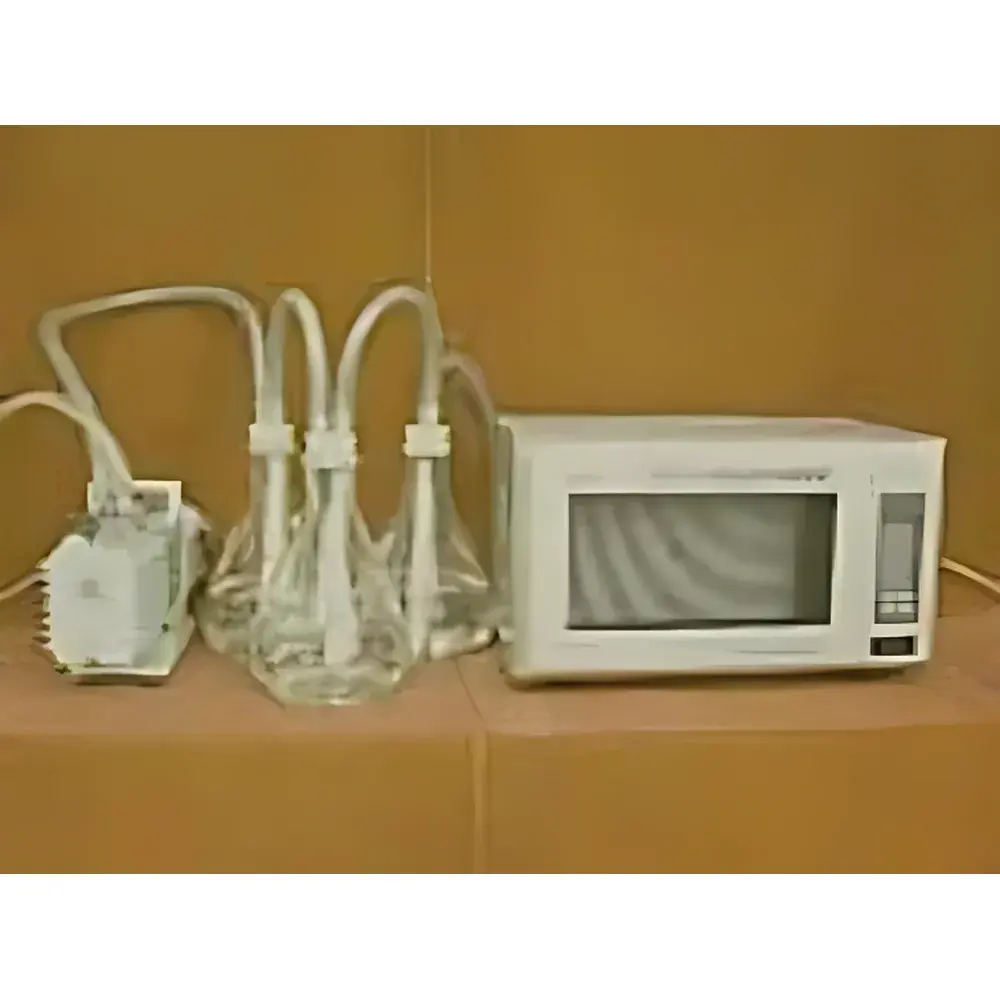
Kew MWD-2 Microwave Digestion System
| Origin | Jiangsu, China |
|---|---|
| Manufacturer Type | Authorized Distributor |
| Model | MWD-2 |
| Output Power | 800 W |
| Input Power | 1300 W |
| Voltage/Frequency | 220 V / 50 Hz |
| Digestion Chamber Capacity | 15 L |
| Net Weight (incl. chamber) | 20.1 kg |
| Dimensions (W×D×H) | Not specified |
| Chamber Material | PTFE |
| Ventilation System | Integrated acid/alkali scrubbing exhaust with vacuum pump |
| Control | Microprocessor-based power/time programming |
| Chamber Design | Stirred-mode (rotating waveguide) 3D microwave field generation |
| Effective Cavity Volume Increase | ~25% vs. turntable-based systems |
Overview
The Kew MWD-2 Microwave Digestion System is a benchtop, open-vessel sample preparation instrument engineered for rapid, controlled, and reproducible acid digestion of solid and semi-solid matrices prior to elemental analysis by ICP-OES, ICP-MS, AAS, or ion chromatography. Unlike closed-vessel high-pressure microwave systems, the MWD-2 employs a stirred-mode (rotating waveguide) 3D microwave architecture that eliminates the mechanical turntable—replacing it with dynamic microwave scattering via rotating stirrer blades. This design ensures uniform energy distribution across the entire 15 L PTFE digestion chamber, enabling simultaneous heating of multiple samples without hot-spot formation or thermal gradient limitations. The system operates at a nominal output power of 800 W (input 1300 W, 220 V / 50 Hz), delivering efficient volumetric dielectric heating through dipole rotation and ionic conduction in polar solvents—primarily concentrated nitric, hydrochloric, and hydrofluoric acid mixtures. As a non-pressurized platform, it complies with standard laboratory safety protocols for low-risk, high-throughput sample throughput in regulated environments where pressure-rated vessels are not required.
Key Features
- Stirred-Mode 3D Microwave Field: Advanced waveguide agitation generates isotropic microwave distribution—eliminating cold zones and improving thermal homogeneity versus conventional turntable designs (e.g., legacy MWD-1). Effective cavity volume increased by ~25% due to removal of rotating platter mechanics.
- Open-Vessel PTFE Digestion Chamber: Chemically inert 15 L chamber constructed from high-purity polytetrafluoroethylene, resistant to aggressive mineral acids including HF, aqua regia, and perchloric acid (when used under appropriate ventilation).
- Integrated Acid/Vapor Scrubbing Exhaust: Dedicated vacuum pump draws fumes through dual-stage absorption bottles containing neutralizing solutions (e.g., NaOH for acidic vapors, H2SO4 for basic fumes), minimizing lab ambient contamination and operator exposure per OSHA and EU Directive 2004/37/EC (carcinogens/mutagens).
- Microprocessor-Controlled Digestion Protocols: Programmable time–power profiles allow method-specific optimization for diverse sample types—including soils (N, P, K, organic matter), coal, biological tissues, pharmaceutical excipients, and foodstuffs. Default soil digestion templates included; custom protocol development support available.
- Robust Mechanical Architecture: All-metal chassis with reinforced door interlock, PTFE-lined interior surfaces, and modular accessory layout (10 × 30 mL PTFE crucibles, 10 × 50 mL Erlenmeyer flasks, bent-neck funnels, four exhaust hoses, three stopper adapters, and full chamber vent interface kit).
Sample Compatibility & Compliance
The MWD-2 supports digestion of heterogeneous, high-moisture, or volatile-rich samples unsuitable for sealed-vessel systems—including plant biomass, sediments, sludges, dairy powders, and herbal extracts. Its open configuration avoids pressure buildup risks while maintaining sufficient thermal energy for complete matrix decomposition. While not certified to ASTM D5511 or ISO 11885 for regulatory reporting, the system meets general laboratory practice requirements for QC/QA workflows under GLP-aligned SOPs. Exhaust treatment conforms to local emissions guidelines when paired with appropriate scrubber media. Instrument operation aligns with ISO/IEC 17025:2017 clause 6.4.7 (environmental conditions for equipment) and supports traceability via manual logbook entries or external LIMS integration.
Software & Data Management
The MWD-2 utilizes embedded firmware—not PC-hosted software—for method execution and real-time power/time monitoring. All parameters (ramp time, hold time, wattage setpoint) are stored locally in non-volatile memory with timestamped run records accessible via front-panel display. No proprietary drivers or cloud connectivity are implemented; data export requires manual transcription or optional RS-232 interface (available upon request). For laboratories requiring audit trails compliant with FDA 21 CFR Part 11, third-party electronic lab notebook (ELN) systems may be configured to capture method IDs, operator initials, and start/stop timestamps during each digestion cycle.
Applications
- Soil testing laboratories performing routine NPK and total organic carbon (TOC) analysis per USDA NRCS Method 4B-107 and EPA Method 3050B (modified open-vessel variant)
- Environmental monitoring labs digesting sediment, fly ash, and wastewater sludge for heavy metal screening (Pb, Cd, As, Cr, Ni) prior to ICP-MS quantification
- Food safety centers analyzing pesticide residues in fruits/vegetables following AOAC 2007.01 extraction workflows
- Pharmaceutical R&D labs assessing elemental impurities in APIs per ICH Q3D guidelines using HNO3/H2O2 oxidative digestion
- Geological survey units preparing rock and ore samples for multi-element geochemical profiling via XRF fusion prep or ICP-OES
FAQ
Is the MWD-2 suitable for HF-based digestions?
Yes—the entire digestion chamber, crucibles, and funnel components are fabricated from virgin PTFE and rated for continuous exposure to ≤40% hydrofluoric acid at temperatures up to 120 °C.
Can the system be validated for GMP-compliant laboratories?
While the MWD-2 lacks factory-installed 21 CFR Part 11 features, it can be qualified per IQ/OQ protocols using external calibration standards (e.g., NIST SRM 2710a for recovery verification) and documented operational checks.
What safety certifications does the unit carry?
The instrument complies with GB 4706.21 (China’s household and similar electrical appliances safety standard for microwave ovens) and meets CE electromagnetic compatibility (EMC) Class B limits per EN 55011.
How is temperature monitored during digestion?
The MWD-2 does not include in-chamber temperature sensors; users rely on empirical method validation and external IR thermometry for process verification.
Is technical support available outside China?
Kew provides remote application assistance and method optimization guidance globally through authorized regional distributors—documentation and firmware updates are delivered in English and Chinese.



