
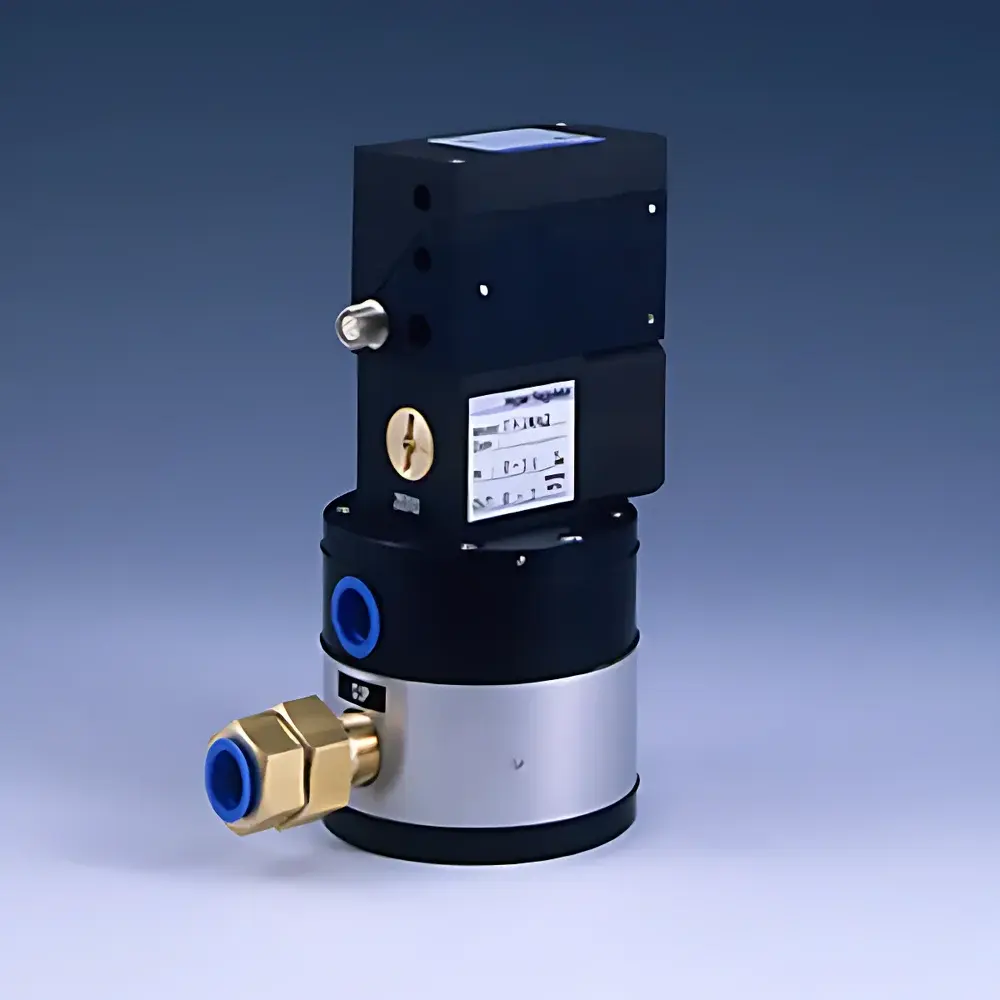
ASAHI Precision 944BA1 High-Performance Pneumatic Proportional Pressure Regulator
| Brand | ASAHI Precision (A&D) |
|---|---|
| Origin | Japan |
| Model | 944BA1 |
| Operating Pressure Range | Up to 1.0 MPa |
| Input Signal Options | 0–5 V, 0–10 V, or 4–20 mA (configurable via model suffix) |
| Pilot Pressure Requirement | ≤ 2/3 × max. operating pressure + α |
| Power Supply | 24 VDC |
| Port Size | 1/2″ |
| Fluid Compatibility | Liquids and gases non-corrosive to PTFE, Viton®, and brass |
| Diaphragm Material | PTFE |
| Seal Material | Viton® |
| Valve Body Material | Brass |
| Full-Scale Orifice Diameter | Φ16 mm |
| Zero Drift | ±1% FS (orientation-dependent) |
| Control Principle | Force-balance + PI feedback control |
| Hysteresis | ≤ ±0.2% FS |
| Linearity | ≤ ±1% FS |
| Response Time (no-load) | < 0.5 s |
| Air Consumption | ≤ 5 L/min (high-speed variant) |
| Weight | 2.3 kg |
| Insulation Resistance | > 1 MΩ |
| Input Impedance | ≥ 1 kΩ (voltage), ≤ 300 Ω (current) |
Overview
The ASAHI Precision 944BA1 is a high-accuracy, electrically actuated proportional pressure regulator engineered for precise, dynamic control of pneumatic and hydraulic pressure in analytical, process, and laboratory automation systems. Based on a dual-stage force-balance architecture with integrated PI (proportional-integral) closed-loop control, the 944BA1 maintains stable setpoint tracking across variable flow conditions and load disturbances. Unlike simple solenoid valves or mechanical regulators, this device delivers continuous, analog pressure modulation—enabling fine-grained ratio control in gas mixing, liquid dispensing, sensor calibration loops, and closed-loop feedback systems incorporating concentration, flow, or temperature transducers. Its design conforms to industrial expectations for long-term stability, minimal hysteresis, and immunity to ambient orientation effects—making it suitable for integration into ISO/IEC 17025-compliant test benches and GLP-regulated instrumentation platforms.
Key Features
- Proportional control architecture with real-time PI compensation ensures high repeatability (< ±0.2% hysteresis) and linearity (≤ ±1% FS) across full-scale range.
- Configurable analog input compatibility: factory-set for 0–5 V, 0–10 V, or 4–20 mA signals—model suffix (e.g., “944BA3”) denotes current-input variants per ASAHI’s coding convention.
- Robust wetted materials: PTFE diaphragm, Viton® seals, and brass valve body provide broad chemical resistance against common process fluids—including compressed air, nitrogen, deionized water, alcohols, and hydrocarbon-free solvents.
- Wide operational flexibility: supports mounting in any orientation; pilot pressure derived internally (≤ 2/3 × max. inlet pressure + safety margin α) eliminates need for external pilot supply.
- Low thermal drift design: validated for stable zero and span performance up to 70 °C ambient; optional pilot-separated configuration available for elevated-temperature environments.
- Compact, modular footprint (1/2″ NPT ports) and lightweight construction (2.3 kg) facilitate integration into space-constrained OEM equipment and automated fluidic workstations.
Sample Compatibility & Compliance
The 944BA1 is certified for use with non-aggressive liquids and gases compatible with PTFE, fluorocarbon elastomers (Viton®), and copper alloys. It is not rated for steam, chlorine, ammonia, strong oxidizers, or halogenated hydrocarbons. Per ASAHI Precision documentation, the regulator meets JIS B 8391 (pneumatic control components) and complies with RoHS Directive 2011/65/EU. While not intrinsically safe, it may be deployed in Zone 2/Class I, Div. 2 environments when installed per IEC 60079-14 guidelines. For applications requiring audit-trail capability under FDA 21 CFR Part 11 or EU Annex 11, integration must occur via validated host controllers—this unit itself provides no onboard data logging or electronic signature functionality.
Software & Data Management
The 944BA1 operates as a standalone analog actuator without embedded firmware, communication protocols (e.g., Modbus, EtherCAT), or digital interfaces. All setpoint commands originate from external PLCs, DAQ systems, or programmable logic controllers delivering standardized voltage/current signals. System-level data acquisition, trending, and alarm management must be implemented upstream—consistent with ISA-88 and ISA-95 architectural frameworks. When paired with calibrated flow or pressure transmitters, the regulator enables closed-loop PID routines compliant with ASTM D3574 (foam testing), ISO 8503-2 (surface profile measurement), or USP <1058> (analytical instrument qualification) workflows.
Applications
- Precise blending of carrier and sample gases in GC and GC-MS sample introduction modules.
- Dynamic back-pressure regulation in HPLC and UHPLC solvent delivery manifolds.
- Ratio-controlled dilution systems for environmental air monitoring analyzers (e.g., NOx, SO2 calibrators).
- Stable pressure sourcing for MEMS sensor characterization rigs and microfluidic chip testing stations.
- Feedback-regulated purge gas supply in moisture analyzers (e.g., Karl Fischer titrators) and thermal gravimetric analysis (TGA) furnaces.
FAQ
Does the 944BA1 provide absolute shutoff capability?
No. The standard configuration uses metal-to-metal sealing and is designed for proportional throttling—not bubble-tight closure. For zero-leakage applications, contact ASAHI Precision for custom configurations with elastomeric shut-off elements.
Can the 944BA1 be used with corrosive media such as HCl or HF?
No. Its PTFE/Viton®/brass material set is incompatible with strong acids, halogens, or amines. Consult technical support for alternative models with Hastelloy C-276 or PFA-wetted components.
Is field calibration supported?
Zero and span adjustments require dedicated calibration fixtures and traceable pressure standards. ASAHI recommends annual verification per ISO/IEC 17025 Clause 6.6; no user-accessible trim pots or software calibration menus are provided.
What is the maximum allowable ambient temperature during operation?
Standard units are rated to 70 °C. Above this threshold, thermal expansion effects may exceed ±1% zero drift limits; pilot-separated variants (e.g., 944BA1-PD) are required for sustained operation up to 120 °C.
Are dimensional drawings and flow coefficient (Cv) data publicly available?
Yes—official CAD models, porting schematics, and Cv vs. ΔP curves are distributed under NDA upon request to authorized A&D distributors or directly through ASAHI Precision’s engineering support portal.



