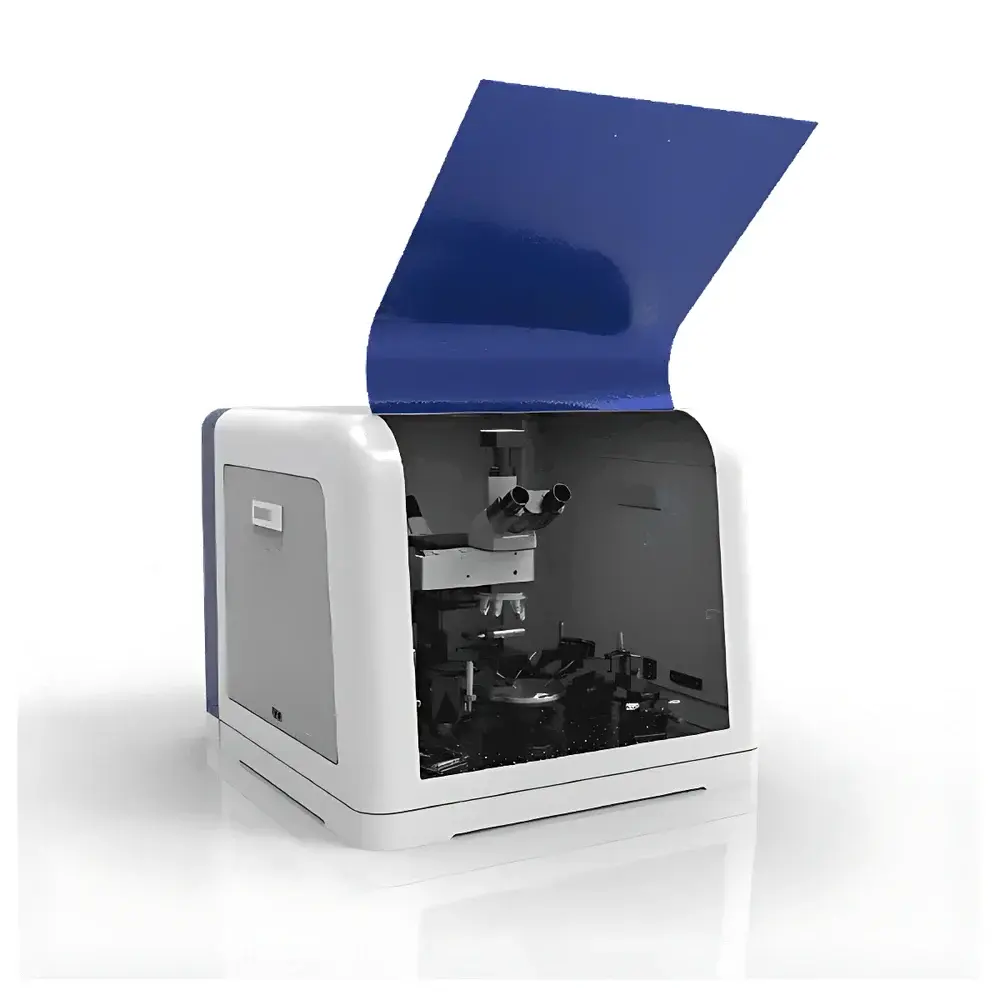
Abner ABN-MPS-001 Manual Probe Station
| Brand | Abner |
|---|---|
| Origin | Jiangsu, China |
| Model | ABN-MPS-001 |
| Type | Temperature-Controlled Manual Probe Station |
| Operation | Manual |
| XY Travel Range | 70 mm × 70 mm (with 360° rotation) |
| Z-Axis Stroke | 65 mm |
| Sample Stage Dimensions | 600 mm × 600 mm × 200 mm |
| Max Load Capacity | 10 kg |
| Microscope Compatibility | Stereo or Metallurgical Microscope with C-mount interface |
| Eyepiece Magnification | 20× |
| Working Distance | 18.9–33.61 mm |
| Optical Magnification Options | 5×/10×/20×/50×/100× |
| Imaging Resolution | ≤1.2 µm |
| CCD Camera | 640×480 resolution |
| Vertical Lift Range | 0–50 mm (motorized, speed 0.02–4 mm/s) |
| Electrical Rating | 220 V AC, max 1 A |
| Max Bias Voltage Support | ±1500 V |
| Control PC | Intel i7-7500T, 16 GB DDR4, 256 GB SSD, Windows 10 OS |
| Display | 1920×1080 Full HD |
Overview
The Abner ABN-MPS-001 Manual Probe Station is a precision-engineered platform designed for low-noise, high-fidelity electrical characterization of semiconductor devices, microelectromechanical systems (MEMS), two-dimensional (2D) materials, and emerging nanoscale structures. Built upon a rigid mechanical architecture with vibration-damping optical table integration, the system operates on manual XYZ micropositioning principles—leveraging mechanical translation stages to achieve repeatable probe-to-device contact without automated motion artifacts. Its core functionality centers on establishing stable, controllable electrical interfaces between calibrated probes and device under test (DUT) while enabling real-time visual alignment via integrated microscopy. Unlike automated handlers, this station prioritizes operator control fidelity, signal integrity, and experimental flexibility—making it especially suitable for research-grade DC and low-frequency AC measurements including I-V, C-V, R-V, and transport property analysis under ambient or temperature-controlled conditions.
Key Features
- High-rigidity mechanical frame with anti-vibration optical platform base, minimizing positional drift during long-duration measurements.
- Manual XYZ micropositioning system with 70 mm × 70 mm XY travel range and 65 mm Z-axis stroke; fine-adjustment resolution supports sub-micrometer alignment accuracy.
- Rotatable sample stage with full 360° orientation capability, facilitating multi-angle probing of asymmetric or non-planar devices.
- Modular probe holder design accommodating single or multiple tungsten, beryllium-copper, or coaxial probes; tip angle and pitch are manually adjustable to match DUT geometry.
- Optical integration-ready platform compatible with stereo zoom microscopes (e.g., Olympus SZX series) or metallurgical microscopes (e.g., Nikon ECLIPSE MA200); includes C-mount adapter and parfocal lens options.
- Motorized vertical lift mechanism (0–50 mm range, 0.02–4 mm/s variable speed) for rapid coarse positioning without compromising stage stability.
- Integrated Windows 10 control PC (Intel i7-7500T, 16 GB DDR4 RAM, 256 GB SSD) with dedicated acquisition software supporting analog input/output, image capture, and synchronized parameter logging.
Sample Compatibility & Compliance
The ABN-MPS-001 accommodates wafers up to 6-inch diameter, diced dies, discrete components, MEMS cantilevers, graphene/TMDs flakes on SiO₂/Si substrates, and custom PCB-mounted test structures. Its open-stage architecture allows direct access for cryogenic inserts, environmental chambers, or external stimulus sources (e.g., laser excitation, magnetic field coils). All electrical pathways support ±1500 V biasing with guarded connections to reduce leakage and noise. While not certified to ISO/IEC 17025 or GLP standards out-of-the-box, the system’s traceable stage calibration, documented repeatability (<±0.5 µm positional hysteresis over 100 cycles), and audit-ready data export (CSV, TIFF, HDF5) enable compliance with internal QA protocols and academic reproducibility requirements. It meets CE safety directives for laboratory equipment and conforms to IEC 61000-4 electromagnetic immunity standards when operated in shielded environments.
Software & Data Management
The embedded acquisition suite runs natively on Windows 10 and provides synchronized control of stage movement, microscope focus, camera capture, and source-measure unit (SMU) interfacing via GPIB, USB-TMC, or LAN. Data streams—including voltage/current traces, time-stamped images, and stage coordinates—are time-aligned and exported in machine-readable formats compliant with MATLAB, Python (NumPy/Pandas), and LabVIEW import conventions. Image metadata embeds magnification, exposure time, and stage position. Software supports user-defined measurement sequences, pass/fail thresholding, and batch export for statistical analysis. Audit trails record operator login, session timestamps, and configuration changes—facilitating adherence to basic GLP documentation practices in university and industrial R&D labs.
Applications
- Semiconductor process development: Contact resistance mapping, gate oxide integrity testing, and parametric validation of front-end-of-line (FEOL) and back-end-of-line (BEOL) test structures.
- MEMS reliability assessment: Contact-based actuation testing, stiction evaluation, and dynamic response characterization under controlled humidity or vacuum.
- 2D material transport studies: Four-point probe resistivity, Hall effect, and quantum oscillation measurements on exfoliated or CVD-grown monolayers.
- Fault isolation and failure analysis: Precise localization of short circuits, opens, or leakage paths using current imaging (EMMI) or lock-in thermography-compatible probing.
- Teaching laboratories: Hands-on training in device physics, probe metrology fundamentals, and measurement uncertainty analysis aligned with IEEE Std 100 and ASTM F39-22 guidelines.
FAQ
Is the ABN-MPS-001 compatible with third-party SMUs and oscilloscopes?
Yes—it features standard BNC and triax connectors, GPIB/USB/LAN ports, and configurable trigger I/O for seamless integration with Keysight, Keithley, Tektronix, and Zurich Instruments equipment.
Can it be upgraded to semi-automated operation?
The mechanical stage accepts optional stepper motor retrofit kits and encoder feedback modules; Abner offers OEM integration support for custom automation layers.
What is the thermal stability specification under temperature-controlled operation?
When paired with external hot/cold stages (e.g., Linkam TS1500), the platform maintains positional stability within ±0.8 µm over 2 hours at 150 °C or −40 °C, verified via interferometric calibration.
Does the system include calibration certificates for stage positioning?
A NIST-traceable stage calibration report is available upon request; standard delivery includes factory verification data per ISO 230-2 Annex B.
How is electrostatic discharge (ESD) protection implemented?
All probe holders, stage surfaces, and grounding points comply with ANSI/ESD S20.20; wrist strap and common-point ground terminals are pre-installed.
Related Products