
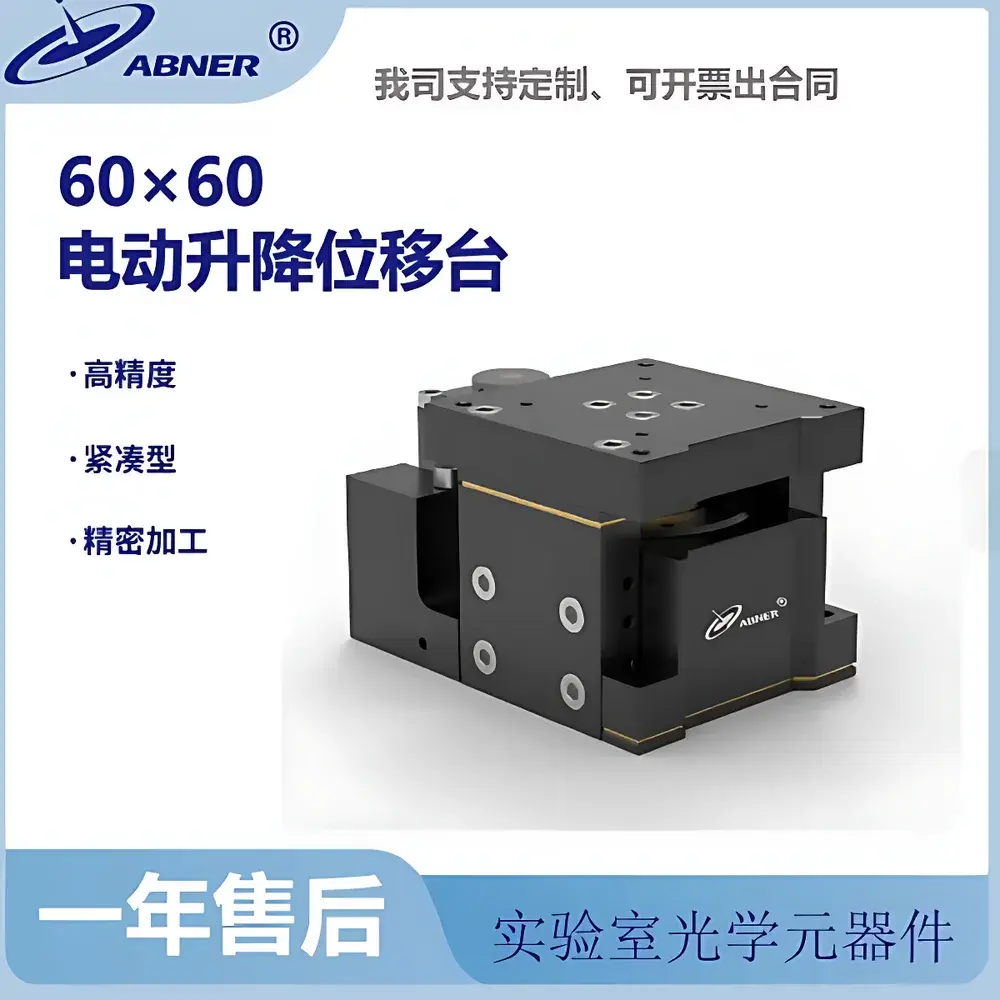
Abner Z-Axis Manual Translation Stage with Crossed-Roller Bearings and Micrometer Drive
| Brand | Abner |
|---|---|
| Origin | Jiangsu, China |
| Model | AB-ZM-100 |
| Type | Manual Vertical Translation Stage |
| Construction | Anodized Aluminum Alloy |
| Bearing System | Preloaded Crossed-Roller Bearings |
| Drive Mechanism | Precision Micrometer with 10 µm Graduation |
| Travel Range | 13 mm |
| Load Capacity (Axial) | 25 kg |
| Repeatability | ±1 µm |
| Flatness | ≤2 µm over full travel |
| Mounting Pattern | Standard M4 and M6 Thread Arrays on Base and Top Plate |
| Compliance | ISO 9001 Manufactured |
Overview
The Abner AB-ZM-100 is a high-precision manual Z-axis translation stage engineered for stable, repeatable vertical positioning in optical and metrological applications. It operates on the principle of mechanical displacement amplification via a calibrated micrometer screw coupled to a preloaded crossed-roller linear bearing system. Unlike motorized alternatives, this stage delivers deterministic, backlash-free motion without electromagnetic interference—critical for interferometric setups, laser cavity alignment, or vibration-sensitive microscopy. Its 13 mm vertical travel range is achieved through a hardened stainless steel micrometer spindle with 10 µm graduation and vernier-assisted reading, enabling sub-micron incremental adjustments under tactile feedback. The stage’s structural integrity derives from a monolithic anodized 6061-T6 aluminum body, CNC-machined to maintain parallelism between base and top plate within 2 µm across full extension—ensuring collimation stability during multi-axis stacking.
Key Features
- Preloaded crossed-roller bearing guides providing <0.5 µm axial runout and zero lateral play, eliminating wobble during fine-height adjustment
- Micrometer drive with dual-scale readout (main scale + vernier), factory-calibrated traceable to NIST standards
- Integrated M4 and M6 threaded arrays on both base and platform surfaces—compatible with Thorlabs, Newport, and Standa mounting accessories
- Anodized surface finish (hardness ≥60 HV) offering corrosion resistance per ASTM B580 and wear resistance exceeding 10⁶ cycles under 10 kg load
- Compact footprint (100 × 100 × 65 mm) optimized for integration into confined optical breadboards or multi-stage kinematic mounts
- No-lubrication design: bearings operate dry under cleanroom-compatible conditions (ISO Class 5 compatible)
Sample Compatibility & Compliance
The AB-ZM-100 is designed for passive integration into optical trains requiring static or quasi-static height tuning—not for dynamic scanning or closed-loop servo control. It accommodates payloads up to 25 kg axially with maintained repeatability (±1 µm, 3σ, per ISO 230-2 Annex C). All metallic components comply with RoHS Directive 2011/65/EU and REACH Regulation (EC) No. 1907/2006. Manufacturing adheres to ISO 9001:2015 quality management protocols; calibration documentation includes uncertainty budgets per GUM (JCGM 100:2008). While not certified to FDA 21 CFR Part 11, its mechanical traceability supports GLP-compliant lab notebooks when paired with digital microscope-based position logging.
Software & Data Management
As a manually operated stage, the AB-ZM-100 requires no firmware, drivers, or software stack. Position data is recorded directly from the micrometer scale or optionally digitized using third-party USB microscopes (e.g., Dino-Lite AM4113X) interfaced with open-source tools such as ImageJ or Python-based OpenCV pipelines. For audit trails in regulated environments, users may log readings in CSV format with timestamps, operator ID, and environmental metadata (temperature/humidity)—a practice aligned with ALCOA+ principles for raw data integrity.
Applications
- Laser beam height optimization in Ti:sapphire oscillator cavities and fiber coupling stages
- Focal plane stabilization in confocal and super-resolution microscopy (STED, PALM)
- Vertical alignment of objective lenses, CCD sensors, and diffractive optical elements (DOEs)
- Calibration artifact positioning in coordinate measuring machines (CMMs) and profilometers
- Strain-controlled sample elevation in nanoindentation and AFM cantilever alignment fixtures
- Modular integration into XYZ stacked stages for wafer-level photonic device testing
FAQ
Is this stage compatible with vacuum environments?
Yes—when specified with vacuum-rated grease (optional upgrade) and without elastomeric seals, it operates at pressures down to 10⁻⁵ mbar per ISO 10110-7.
Can I mount it inverted for downward-force applications?
Yes—the symmetrical thread pattern and bidirectional load rating allow ceiling-mount configurations with appropriate support brackets.
What is the thermal drift coefficient over 20–30 °C?
Linear expansion is governed by 6061-T6 aluminum (α = 23.6 × 10⁻⁶ /°C); positional drift remains below 0.3 µm over 10 °C ambient variation across full travel.
Does Abner provide calibration certificates?
Standard units ship with factory verification report; accredited ISO/IEC 17025 calibration is available upon request (lead time: 10 business days).
How do I minimize cosine error during off-axis loading?
Apply loads concentrically within the central 30 mm diameter zone and avoid cantilevered masses exceeding 15% of rated capacity.




