
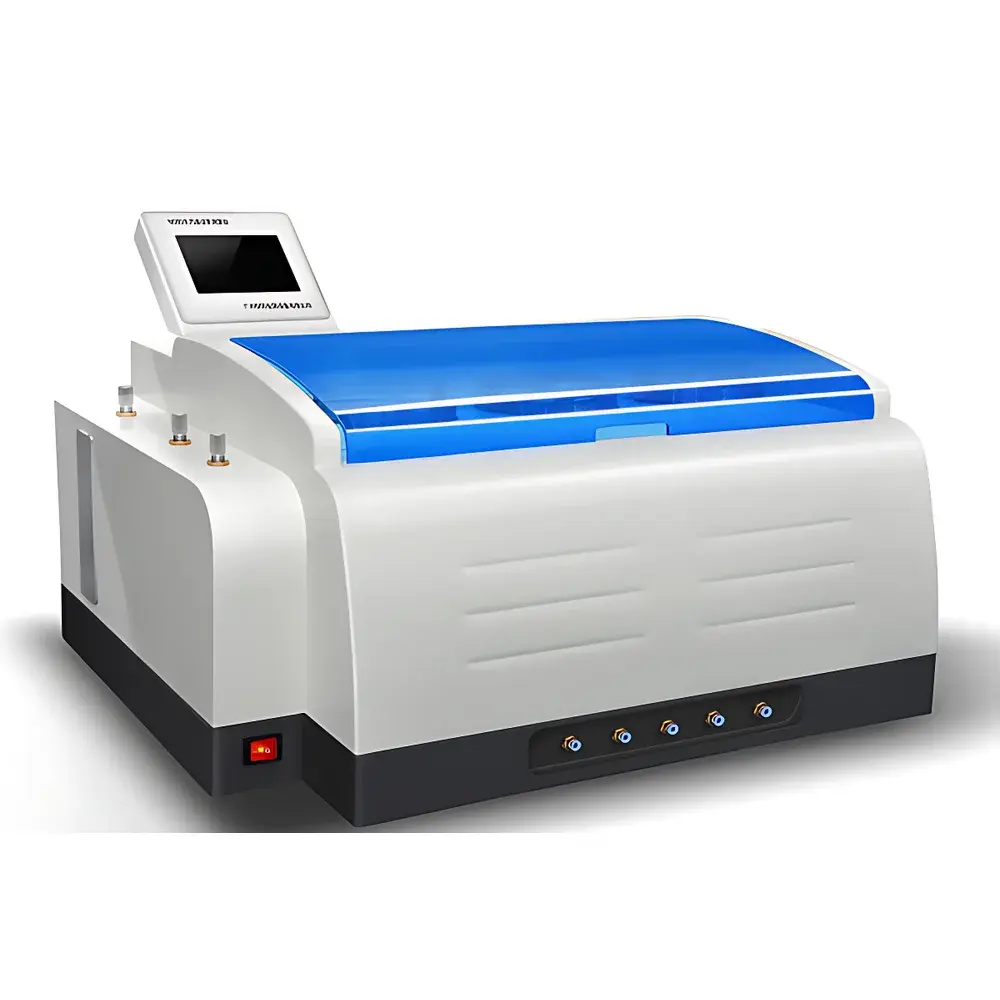
GBPI W405 Infrared Sensor-Based Water Vapor Transmission Rate (WVTR) Tester
| Brand | GBPI |
|---|---|
| Origin | Guangdong, China |
| Manufacturer Type | Manufacturer |
| Country of Origin | Domestic (China) |
| Model | W405 |
| Test Range | 0.0005–500 g/(m²·24h) |
| Accuracy | 0.001 g/(m²·24h) |
| Temperature Control Range | 15–45 °C (optional up to 60 °C) |
| Temp. Stability | ±0.1 °C |
| Humidity Control Range | 30–90 %RH, 100 %RH |
| RH Stability | ±1 %RH |
| Test Area | 50.24 cm² (down to 0.785 cm² with optional fixtures) |
| Specimen Diameter | Φ100 mm |
| Max. Thickness | ≤3 mm |
| Sample Capacity | 1–3 specimens per test cycle |
| Carrier Gas | ≥99.999 % N₂, pressure ≥0.1 MPa, flow rate 5–120 mL/min |
| Gas Interface | 1/8″ metal tubing |
| Dimensions | 700 × 560 × 370 mm |
| Weight | 80 kg |
| Power | 750 W, AC 220 V, 50 Hz (110 V optional) |
Overview
The GBPI W405 Infrared Sensor-Based Water Vapor Transmission Rate (WVTR) Tester is an ISO- and ASTM-compliant gravimetric-equivalent instrument engineered for precise, non-destructive measurement of water vapor permeation through barrier materials. Unlike traditional cup-based or electrolytic sensor methods, the W405 employs a dual-chamber, modulated humidity gradient design coupled with high-sensitivity infrared absorption detection—enabling real-time quantification of water vapor flux across films, laminates, and rigid containers. Its operational principle relies on controlled vapor diffusion under defined temperature and relative humidity conditions, followed by optical detection of transmitted H₂O molecules in the carrier gas stream via near-infrared (NIR) spectroscopy at 1.93 µm—a wavelength exhibiting strong, selective absorbance for water vapor with minimal interference from CO₂, O₂, or N₂. This methodology delivers trace-level sensitivity and eliminates drift associated with electrochemical sensors, making it suitable for regulatory-grade testing in pharmaceutical packaging, medical device barrier validation, and high-barrier solar backsheet qualification.
Key Features
- Triple-test chamber architecture enabling simultaneous, independent evaluation of up to three specimens—including heterogeneous materials—with individual start/stop control and separate report generation.
- High-fidelity environmental control: electromagnetic step-programmed temperature regulation (±0.1 °C stability) and dual-gas (dry/wet air) humidity generation (±1 %RH accuracy across 30–100 %RH range).
- ARM-based embedded control system supporting standalone operation—no external PC required for routine testing; integrated 7-inch color touchscreen displays real-time curves for temperature, RH, vapor concentration, and cumulative WVTR.
- GMP-aligned software compliant with FDA 21 CFR Part 11 and EU Annex 11 requirements: role-based user access (administrator, operator, reviewer), full audit trail (system, method, run-level), electronic signatures, and immutable data logging.
- Modular hardware design with protected IR sensor module featuring automatic over-range shutdown to prevent optical damage during out-of-spec conditions.
- Calibration traceability to national standard reference materials (GBW(E)130543/4), certified by the State Administration for Market Regulation (SAMR), ensuring metrological equivalence with international interlaboratory comparisons.
Sample Compatibility & Compliance
The W405 accommodates flat specimens (films, foils, sheets) up to 3 mm thick and Ø100 mm diameter, as well as 3D packaging formats—including bottles, pouches, trays, and blister cavities—via optional fixture kits. It supports materials ranging from ultra-high-barrier aluminum-coated PET (WVTR 100 g/m²·24h). Regulatory compliance includes ISO 15106-2:2005 (infrared detection method), ASTM F1249-2013, JIS K 7129:2008, TAPPI T557, and GB/T 26253-2010. All test protocols adhere to GLP and GMP documentation standards, with raw data stored in encrypted SQLite databases meeting ALCOA+ principles (Attributable, Legible, Contemporaneous, Original, Accurate, Complete, Consistent, Enduring, Available).
Software & Data Management
The GBPI TestMaster™ software provides intuitive workflow configuration—users define test parameters (T/RH setpoints, duration, flow rate), initiate automated sequences (baseline acquisition, purge, equilibration, measurement), and monitor progress via dynamic multi-parameter plots. Reports are generated in PDF and Office-compatible formats (XLSX, DOCX), embedding metadata such as instrument ID, calibration status, operator ID, environmental logs, and uncertainty estimates per ISO/IEC 17025. Database queries support retrospective analysis across batches, methods, or material types. Audit trails record all actions—including parameter edits, result overrides, and user logins—with timestamps and IP addresses where networked.
Applications
This instrument serves critical quality assurance functions across regulated industries: pharmaceutical primary packaging (blister lidding, cold-form foil, PTP strips), medical device sterile barrier systems (Tyvek® pouches, peelable lids), food packaging (retort pouches, vacuum-sealed trays), flexible electronics encapsulation (OLED moisture barriers), photovoltaic module backsheets, and transdermal drug delivery patches. Its sub-milligram sensitivity enables validation of accelerated aging studies and shelf-life modeling per ICH Q5C guidelines.
FAQ
What carrier gas is required?
Ultra-high-purity nitrogen (≥99.999 %) is mandatory; compressed air or other gases introduce spectral interference and compromise IR detection accuracy.
Is calibration using national standard reference materials included?
Yes—the instrument ships with certified GBW(E)130543/4 reference films and built-in calibration routines that comply with JJG 812-2016 verification procedures.
Can the W405 test rigid containers without modification?
No—container testing requires optional custom fixtures (e.g., bottle cradles, pouch clamps) to establish sealed, reproducible diffusion paths; these are validated per ASTM F2622 Annex A3.
Does the system support 21 CFR Part 11 compliance out-of-the-box?
Yes—role-based authentication, electronic signatures, and tamper-evident audit logs are enabled by default; no third-party validation packages are needed.
What maintenance is required for long-term IR sensor stability?
Annual verification using reference films and biannual inspection of gas path integrity (filters, tubing, seals) are recommended; the sensor itself requires no routine recalibration under normal operating conditions.
Related Products





