
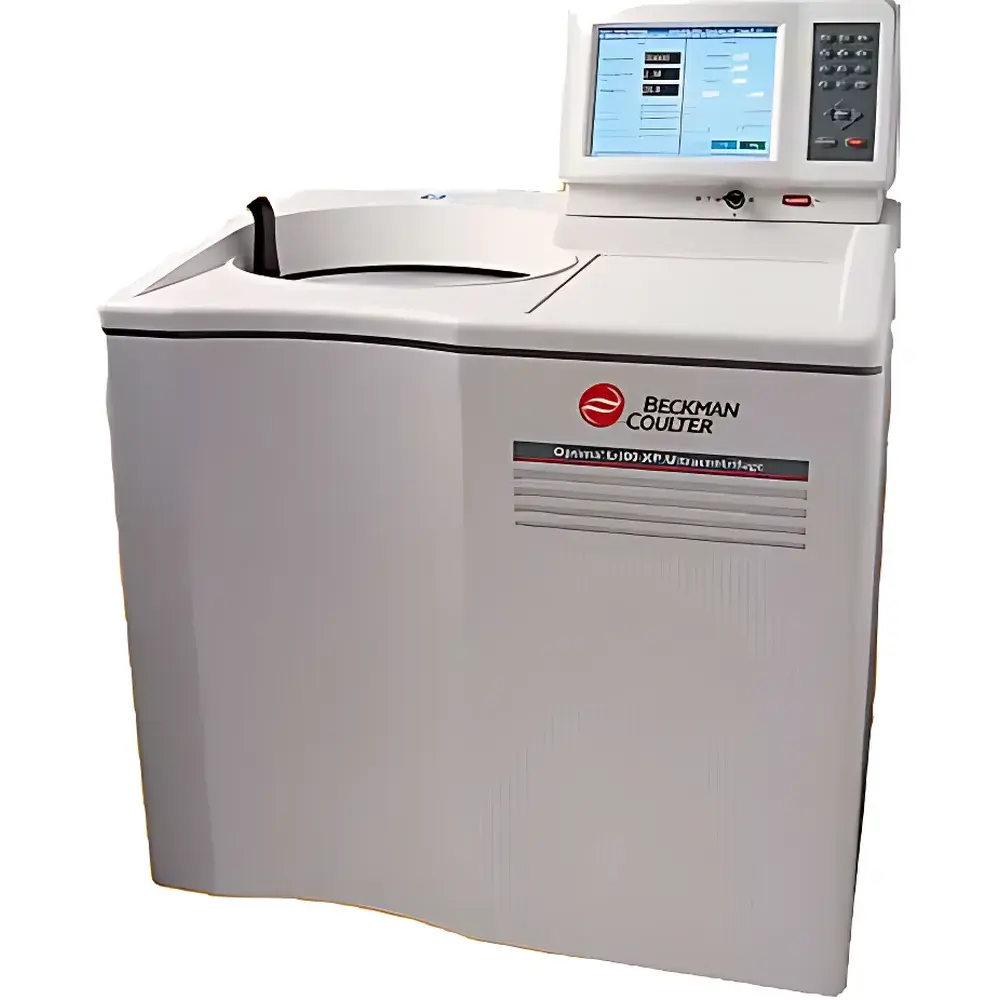
Beckman Coulter Optima L-100XP / L-80XP / L-100K / L-90K Floor-standing & Benchtop Ultracentrifuges
| Brand | Beckman Coulter |
|---|---|
| Origin | USA |
| Model Series | Optima L-100XP, L-80XP, L-100K, L-90K |
| Max RCF | 802,400 × g (L-100XP/L-100K), 602,000 × g (L-80XP), 694,000 × g (L-90K) |
| Max Speed | 100,000 rpm (L-100XP/L-100K), 80,000 rpm (L-80XP), 90,000 rpm (L-90K) |
| Temperature Control Accuracy | ±0.3 °C (L-100XP), ±0.5 °C (L-80XP/L-100K/L-90K) |
| Software | eXPert Centrifuge Software (full version) |
| Vacuum System | Oil-free, dehydration-based |
| Motor Drive | Hermetically sealed vacuum drive |
| Safety | Dynamic rotor inertia monitoring, automatic rotor recognition, HEPA-filtered exhaust |
| Compliance | Designed for GLP/GMP environments |
Overview
The Beckman Coulter Optima L-series ultracentrifuges represent a benchmark in high-performance preparative and analytical centrifugation for life science, biopharmaceutical, and materials research laboratories. Engineered for precision, reliability, and operator safety, these floor-standing and benchtop instruments operate on the principle of sedimentation under ultra-high gravitational fields—enabling separation of macromolecules, subcellular organelles, viruses, lipoproteins, and nanoparticles based on differences in sedimentation coefficient (S-value), buoyant density, and size distribution. The L-100XP and L-100K models deliver up to 802,400 × g at 100,000 rpm, while the L-80XP and L-90K provide optimized performance envelopes for routine high-speed applications requiring enhanced thermal stability or extended run times. All models feature a hermetically sealed vacuum drive system that minimizes mechanical wear, eliminates oil contamination risks, and ensures long-term rotational stability—even during overnight density-gradient runs.
Key Features
- 12-inch capacitive touchscreen interface with intuitive, icon-driven navigation—designed for glove-compatible operation in BSL-2 and cleanroom environments.
- eXPert Centrifuge Software v4.x: A full-featured, Windows-based platform supporting method creation, real-time parameter monitoring, multi-step gradient programming, and ESP (Efficient Sedimentation Protocol) simulation for predictive run optimization.
- Vacuum-assisted dehydration system reduces internal humidity accumulation by >95%, significantly extending bearing service life and minimizing maintenance intervals.
- Dynamic inertia detection continuously monitors rotor mass distribution during acceleration and deceleration—automatically halting operation if imbalance exceeds ±5 mL tolerance, ensuring compliance with ISO 15197 and IEC 61010-2-020 safety standards.
- HEPA-filtered exhaust path (optional on all L-series models) captures ≥99.97% of particles ≥0.3 µm, enabling safe operation within chemical fume hoods or biosafety cabinets without aerosol release.
- Benchtop variants (e.g., Optima MAX-XP, TLX) are certified for Class II Type A2 cabinet integration per NSF/ANSI 49, supporting containment-sensitive workflows involving viral vectors or mRNA-LNPs.
Sample Compatibility & Compliance
The Optima L-series accommodates a broad spectrum of sample formats—including Beckman Coulter’s proprietary Quick-Seal™, polyallomer conical seal, high-strength titanium fixed-angle, and vertical rotors (e.g., VTi 65.2, Vti 90). Compatible tube types include ultra-thick-walled polycarbonate (for >500,000 × g), borosilicate glass (for density gradient integrity), and certified RNase/DNase-free disposable tubes. All rotors undergo individual certification per ASTM F2119 and are traceable to NIST-traceable calibration records. Instrument firmware and eXPert software support configurable electronic logbooks, user-access controls, and audit trail generation aligned with FDA 21 CFR Part 11 requirements when deployed in regulated QC/QA settings.
Software & Data Management
eXPert software provides native support for SOP-driven workflows, including pre-run validation checks (rotor ID, speed/RCF limits, temperature setpoint verification), automated data export to CSV or LIMS-ready XML, and encrypted local storage with optional network backup. Method templates can be locked, version-controlled, and assigned to specific user roles—facilitating consistent execution across shifts and departments. For GxP environments, optional IQ/OQ documentation packages and 21 CFR Part 11 add-ons are available through Beckman Coulter Validation Services, covering electronic signatures, change control logs, and periodic performance verification protocols.
Applications
- Preparative isolation of exosomes, EVs, and ribonucleoprotein complexes via rate-zonal or isopycnic centrifugation.
- Characterization of monoclonal antibody aggregates and subvisible particles per USP <787> and <788> guidelines.
- Subcellular fractionation of mitochondria, lysosomes, and synaptic vesicles using differential and density-gradient protocols.
- Nanoparticle synthesis validation (e.g., lipid nanoparticles, quantum dots) through pelleting efficiency and size-distribution correlation studies.
- Virion purification and concentration for vaccine development, gene therapy vector production, and structural virology.
FAQ
What is the difference between the L-100XP and L-100K models?
The L-100XP includes full eXPert software functionality, ESP simulation, and unlimited method storage; the L-100K offers identical mechanical specifications but ships with basic control firmware and limited method capacity (9 protocols).
Can the L-series be used for continuous-flow separations?
Yes—the L-100XP and L-90K support continuous-flow and zonal rotor configurations (e.g., CF-34, CF-39) for large-volume processing of cell lysates or plasma fractions.
Is remote monitoring supported?
Via Beckman Coulter’s CentriLink™ cloud gateway (optional), users can receive real-time alerts, view instrument status, and initiate emergency stop commands from any authorized device.
Are rotor lifetime and calibration records included?
Each rotor ships with a serialized certificate of conformance, cumulative run-hour tracking, and a recommended recalibration interval based on usage intensity and regulatory requirements.



