
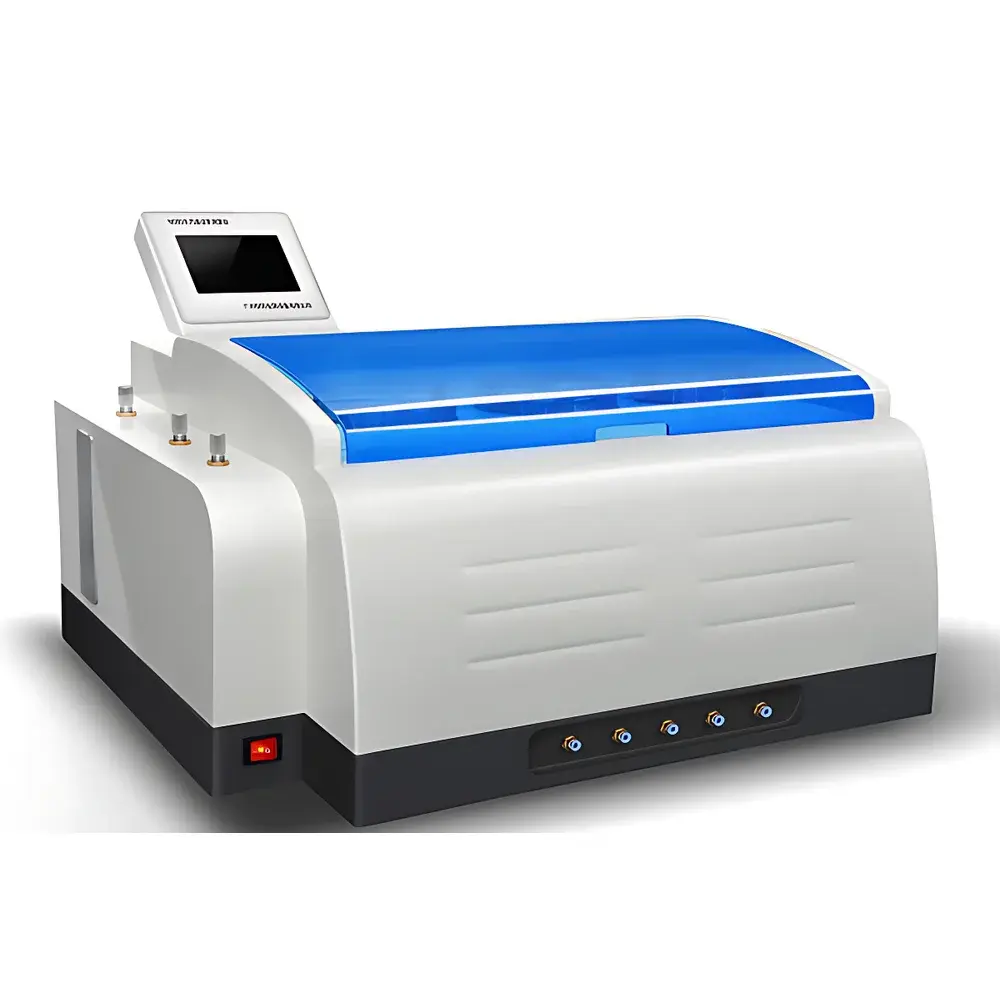
GBPI W405D Water Vapor Transmission Rate (WVTR) Tester for Pharmaceutical Packaging Compliance
| Key | Brand: GBPI |
|---|---|
| Model | W405D |
| Origin | Guangdong, China |
| Manufacturer Type | Direct Manufacturer |
| Country of Origin | Domestic (China) |
| Test Range | 0.0005–500 g/(m²·24h) |
| Accuracy | ±0.001 g/(m²·24h) |
| Temperature Control Range | 15–45 °C (optional up to 60 °C) |
| Temp. Stability | ±0.1 °C |
| Humidity Range | 30–90 %RH (including 100 %RH) |
| RH Stability | ±1 %RH |
| Test Area | 50.24 cm² (down to 0.785 cm² with optional fixtures) |
| Specimen Size | Φ100 mm |
| Max. Thickness | ≤3 mm |
| Sample Capacity | 1–3 independent chambers |
| Carrier Gas | ≥99.999% N₂, 0.1 MPa min. pressure, 5–120 mL/min flow |
| Interface | 1/8″ metal tubing |
| Dimensions | 700 × 560 × 370 mm |
| Weight | 80 kg |
| Power | 750 W, AC 220 V / 50 Hz (110 V available on request) |
Overview
The GBPI W405D Water Vapor Transmission Rate (WVTR) Tester is a gravimetric-coulometric hybrid instrument engineered for precise, traceable, and regulatory-compliant measurement of water vapor permeation through packaging materials used in pharmaceutical, medical device, and high-barrier industrial applications. It operates on the principle of dynamic relative humidity gradient generation across a test specimen—using dual-stream (dry/wet) gas control to establish stable, programmable RH conditions—while an ultra-sensitive infrared moisture sensor quantifies real-time water vapor flux. The system conforms to core international standards including ISO 15106-2:2005 (infrared detection method), ASTM F1249-2013, JIS K 7129:2008, TAPPI T557, and GB/T 26253-2010, making it suitable for quality control laboratories operating under GMP, GLP, or ISO/IEC 17025 frameworks.
Key Features
- Triple independent test chambers enable concurrent evaluation of up to three specimens—identical or dissimilar—with fully autonomous start/stop, data logging, and report generation per chamber.
- High-resolution infrared moisture sensing (detection limit: 0.0005 g/(m²·24h)) ensures reliable quantification of ultra-low-permeability materials such as aluminum foil, PVDC-coated films, and multilayer barrier laminates.
- Electromagnetic stepwise temperature control and dual-gas humidity regulation deliver ±0.1 °C thermal stability and ±1 %RH hygrometric precision across the full operational range (15–45 °C; optional 60 °C).
- ARM-based embedded control architecture supports standalone operation via integrated 7-inch color touchscreen—eliminating dependency on external PCs while maintaining full method configuration and real-time curve visualization (temperature, RH, concentration, WVTR).
- Modular hardware design facilitates field serviceability: sensor modules, gas manifolds, and environmental chambers are mechanically and electrically decoupled for rapid replacement and calibration verification.
- Comprehensive audit trail functionality complies with FDA 21 CFR Part 11 and EU Annex 11 requirements—recording user logins, parameter changes, method edits, report exports, and sensor calibration events with immutable timestamps.
Sample Compatibility & Compliance
The W405D accommodates flat specimens (films, foils, sheets) up to Φ100 mm and 3 mm thickness, with standardized test area of 50.24 cm². Optional mini-chamber fixtures reduce effective area to 0.785 cm² for micro-scale validation or high-precision replicate testing. Container testing (bottles, pouches, trays) is supported via custom sealing adapters that maintain hermetic integrity during dynamic RH cycling. All configurations maintain compliance with pharmacopoeial requirements for primary and secondary packaging qualification—including USP , Ph. Eur. 3.2.1, and ICH Q5C stability guidance. Instrument traceability is reinforced by GBPI’s certified reference materials (CRM): GBW(E)130543 and GBW(E)130544, accredited by the State Administration for Market Regulation (SAMR) of China, enabling on-site verification without third-party intervention.
Software & Data Management
GBPI’s proprietary WinWVTR software provides role-based access control (administrator, operator, reviewer, observer) aligned with Annex 11 and GAMP 5 principles. Each user account enforces password policies, session timeouts, and multi-factor authentication readiness. Method templates are version-controlled and digitally signed; deviations trigger automatic flagging and electronic approval workflows. Raw data resides in an encrypted SQLite database with daily auto-backup, supporting SQL query export and integration with LIMS via ODBC. Reports conform to 21 CFR Part 11 Annex A: digital signatures, electronic records retention (≥15 years), and tamper-evident audit logs for all data transformations. Export formats include PDF/A-2, XLSX, and CSV with metadata embedding (instrument ID, operator, calibration status, environmental logs).
Applications
- Pharmaceutical packaging validation: blister foil lamination integrity, sachet seal performance, desiccant-containing vial closures.
- Medical device packaging: Tyvek®/PET pouch permeability, sterile barrier system (SBS) qualification per ISO 11607-1.
- Flexible electronics encapsulation: OLED display backsheet moisture ingress modeling, solar panel EVA encapsulant aging studies.
- Food packaging R&D: comparative WVTR screening of bio-based polymers, nanocomposite films, and edible coatings.
- Regulatory submission support: generation of validated datasets for ANDA, NDA, and MDR technical documentation packages.
FAQ
Does the W405D meet FDA 21 CFR Part 11 requirements for electronic records and signatures?
Yes—the system implements full Part 11 compliance: audit trails, electronic signatures with identity verification, secure login protocols, and data integrity safeguards throughout the acquisition-to-report lifecycle.
Can the instrument be calibrated using in-house reference standards?
Yes—GBPI supplies NIST-traceable certified reference materials (GBW(E)130543/4) for routine performance verification; calibration procedures are documented in the IQ/OQ/PQ protocol package.
Is container testing performed under real-world storage conditions?
Container tests replicate accelerated aging environments per ICH Q1A(R2); temperature and RH profiles are programmable to simulate tropical, temperate, or controlled room conditions.
What maintenance intervals are recommended for long-term accuracy?
Sensor zero-point verification every 30 days; full system calibration annually or after any hardware replacement; dry gas filter replacement every 6 months under continuous operation.
How is data security ensured during networked operation?
All communications use TLS 1.2 encryption; local database access requires authenticated credentials; remote desktop or cloud sync is disabled by default and must be explicitly enabled via administrator override.






