
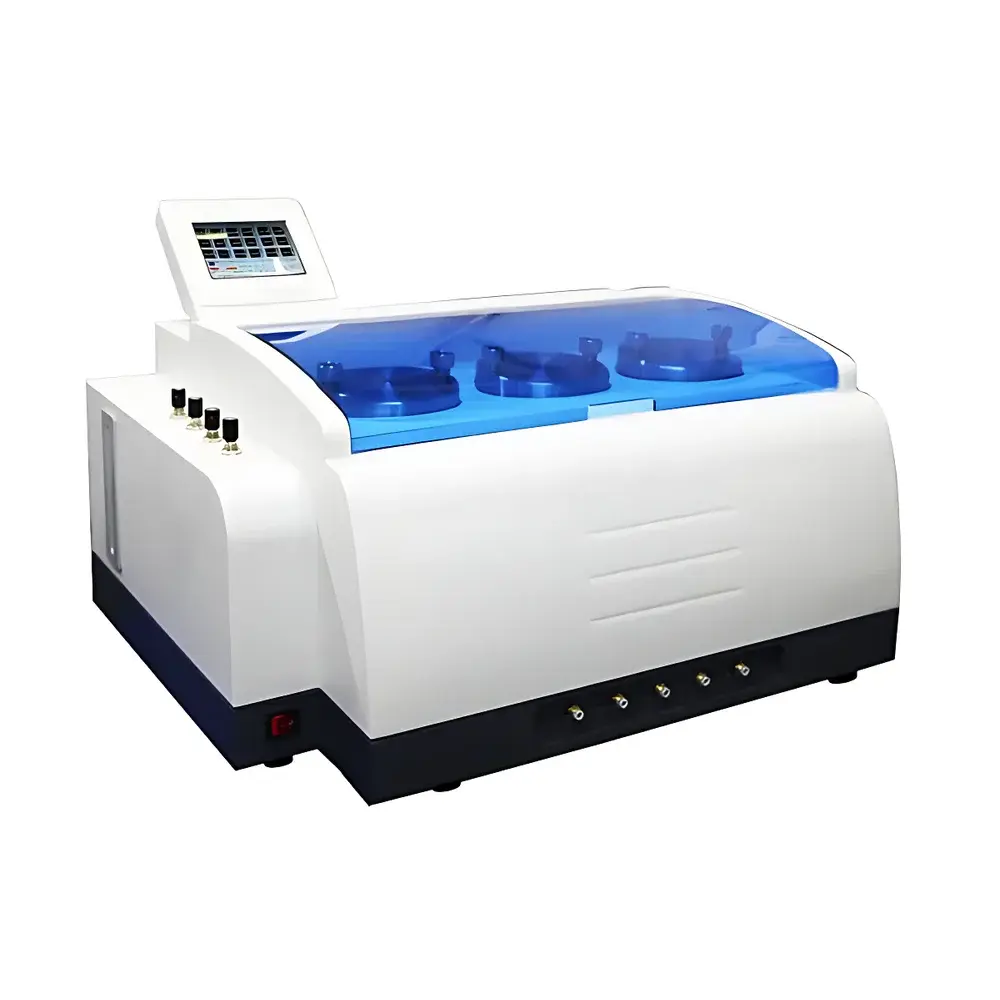
GBPI W403 Infrared Three-Chamber Water Vapor Transmission Rate (WVTR) Analyzer
| Brand | GBPI |
|---|---|
| Origin | Guangdong, China |
| Manufacturer Type | Direct Manufacturer |
| Origin Category | Domestic (China) |
| Model | W403 |
| Price Range | USD 150–15,000 (FOB Guangdong) |
| Measurement Principle | Infrared Sensor Method |
| Standards Compliance | ISO 15106-2, ASTM F1249, TAPPI T557, JIS K7129, GB/T 26253 |
| WVTR Range | 0.001–100 g/(m²·24h) |
| Resolution | 0.001 g/(m²·24h) (for films & sheets) |
| Temperature Control | 15–45 °C (optional 5–55 °C), ±0.1 °C accuracy |
| Humidity Control | 0%, 30–90% RH, 100% RH, ±1% RH accuracy |
| Test Chambers | 3 independent chambers |
| Sensor Count | 3 infrared hygrometric sensors |
| Specimen Size | Ø100 mm (50.24 cm² test area), thickness ≤2 mm |
| Carrier Gas | Ultra-high-purity nitrogen (99.999%), inlet pressure ≥0.1 MPa, flow rate 0–100 mL/min |
| Interface | 1/8″ stainless steel tubing |
| Dimensions | 610 × 550 × 400 mm |
| Weight | 80 kg |
| Power | 220 V, 50 Hz (110 V optional) |
| Power Consumption | 500 W |
Overview
The GBPI W403 Infrared Three-Chamber Water Vapor Transmission Rate (WVTR) Analyzer is a precision gravimetric-equivalent instrument engineered for high-reproducibility measurement of water vapor permeation through packaging materials and rigid or flexible containers. It operates on the principle of modulated infrared absorption spectroscopy—specifically calibrated for H₂O vapor detection—within a dual-gas differential humidity cell architecture. Unlike traditional cup-based or electrolytic sensor methods, the W403 employs three parallel, independently controlled test chambers, each integrating an IR hygrometer positioned in the dry-side carrier gas stream. A humidity gradient is established across the specimen: humidified nitrogen (controlled RH) flows over the upstream surface, while ultra-dry nitrogen sweeps the downstream side. Water molecules diffusing through the barrier are quantitatively detected by the IR sensor via characteristic 2.7 µm absorbance, enabling real-time, non-destructive, and trace-level (down to 0.001 g/(m²·24h)) WVTR calculation per ISO 15106-2 and ASTM F1249 protocols. This method eliminates baseline drift associated with desiccant saturation and provides inherent immunity to interference from CO₂, O₂, or volatile organics—critical for pharmaceutical blister packaging, sterile medical device pouches, and high-barrier photovoltaic backsheet evaluation.
Key Features
- Triple-chamber architecture enables simultaneous, statistically independent testing of up to three specimens—reducing inter-test variability and accelerating throughput for QC laboratories.
- Electromagnetic PID temperature control system delivers ±0.1 °C stability across 15–45 °C (extendable to 5–55 °C), eliminating thermal lag and external chiller dependencies.
- Dual-stream humidity generation uses precision mass flow controllers and saturated salt/temperature-controlled humidity generators—achieving stable, repeatable RH setpoints from 0% to 100% RH at ±1% RH accuracy without auxiliary humidification modules.
- Three certified IR hygrometers (NIST-traceable calibration path) ensure cross-chamber comparability and long-term signal linearity; each sensor is individually addressable and auto-compensated for zero drift.
- Integrated dual-mode calibration: certified reference gases (per GB/T 26253 Annex B) and NIST-traceable standard films—enabling metrological traceability aligned with national primary standards laboratories.
- Fully autonomous operation: embedded Linux-based controller supports standalone testing, real-time curve logging (WVTR, T, RH, flow), automated endpoint detection, and power-fail data retention.
- Modular software architecture separates configuration, baseline acquisition, calibration, test execution, and reporting—facilitating 21 CFR Part 11-compliant audit trails, electronic signatures, and GLP/GMP validation documentation.
- USB-host interface enables firmware updates, encrypted data export (CSV/PDF), and remote diagnostic logging without network dependency.
Sample Compatibility & Compliance
The W403 accommodates flat specimens (Ø100 mm, ≤2 mm thick) and sealed containers (bottles, pouches, trays, tubes) via optional fixtures. Validated applications include polymeric films (e.g., EVOH, PVDC, SiOₓ-coated PET), laminates (Alu/PET/PE), foils, paperboard composites, pharmaceutical blister foils (PVC/PVDC, cold-forming aluminum), IV bags (PVC, TPE), solar backsheet (PET/EVA/PE), and automotive fuel tanks (HDPE/PA6 blends). All measurements comply with ISO 15106-2 (infrared detection), ASTM F1249 (moisture-specific IR), TAPPI T557 (container WVTR), JIS K7129 (polymer film permeation), and Chinese national standard GB/T 26253. Instrument design adheres to IEC 61000-4 electromagnetic compatibility requirements and meets CE safety directives (EN 61010-1).
Software & Data Management
GBPI’s WinWVTR v4.x software runs on Windows OS and supports multi-user role-based access control. It records time-synchronized datasets for WVTR, chamber temperature, relative humidity, carrier gas flow, and sensor voltage output at user-defined intervals (1–600 s). Data is stored in encrypted SQLite databases with immutable timestamps and operator ID tagging. Reporting modules generate compliant PDF certificates containing raw curves, statistical summaries (mean, SD, RSD), calibration history, and uncertainty budgets per GUM (JCGM 100). Audit logs track all configuration changes, calibration events, and report exports—fully satisfying FDA 21 CFR Part 11 requirements for electronic records and signatures. Raw CSV exports enable integration with LIMS platforms via ODBC drivers.
Applications
- Pharmaceutical packaging: Quantifying moisture ingress into blister packs, HDPE bottles, and aluminum-laminated sachets to support shelf-life modeling per ICH Q5C.
- Food packaging R&D: Evaluating barrier performance of metallized CPP, SiOx-coated PET, and multilayer coextrusions under accelerated aging conditions.
- Medical device sterilization: Validating peel strength retention and microbial barrier integrity of Tyvek®/PET pouches after EO or gamma exposure.
- Renewable energy: Measuring WVTR of photovoltaic backsheets to predict delamination risk and encapsulant hydrolysis per IEC 61215.
- Consumer electronics: Assessing moisture protection efficacy of conformal coatings and flexible OLED encapsulation films.
- Automotive components: Characterizing fuel permeation resistance of polymer fuel tanks and EV battery enclosures per SAE J1742.
FAQ
What carrier gas purity is required for compliant testing?
Ultra-high-purity nitrogen (99.999% minimum, oxygen and moisture content <1 ppm) is mandatory to prevent sensor poisoning and ensure baseline stability per ASTM F1249 Section 6.3.
Can the W403 test irregularly shaped containers without custom fixtures?
No—rigid or semi-rigid containers require application-specific sealing fixtures (e.g., bottle adapters, pouch clamps) to establish leak-tight boundary conditions; fixture designs must be validated per ASTM F1249 Annex A4.
Is humidity control verified during routine operation?
Yes—built-in RH verification ports allow periodic insertion of NIST-traceable handheld hygrometers; internal humidity sensors are auto-zeroed against dry nitrogen purge cycles every 24 hours.
How does the W403 handle condensation on cold surfaces during low-RH testing?
The instrument maintains all gas pathways above dew point via heated transfer lines (60 °C) and thermally insulated chambers—preventing condensate formation that could skew diffusion kinetics.
Does GBPI provide IQ/OQ/PQ documentation for regulated environments?
Yes—validated protocol templates, installation qualification checklists, operational qualification test scripts, and performance qualification acceptance criteria are supplied with the system and supported by GBPI’s global validation services team.




