
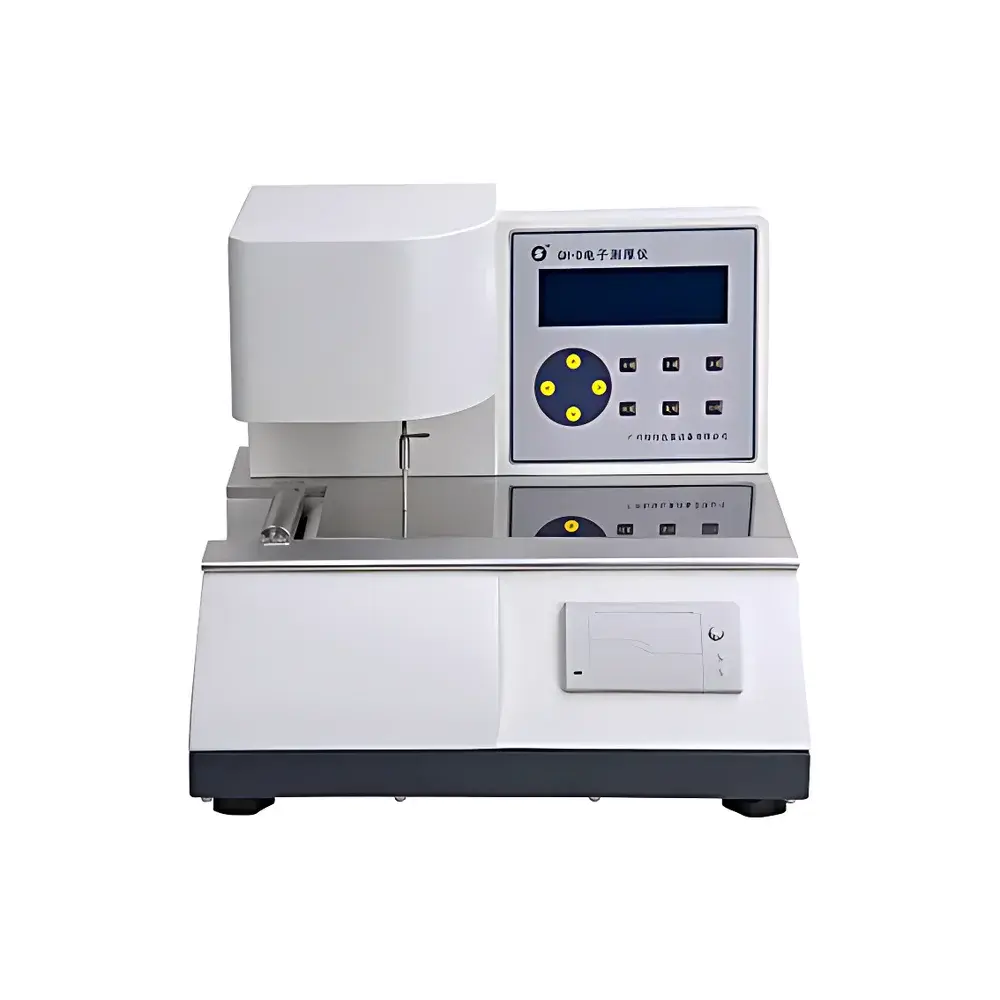
GBPI GH-D Advanced Digital Thickness Gauge
| Brand | GBPI |
|---|---|
| Origin | Guangdong, China |
| Manufacturer Type | OEM/ODM Manufacturer |
| Country of Origin | China |
| Model | GH-D |
| Price | Upon Request |
| Measurement Range | 0–5 mm |
| Resolution | 0.1 µm |
| Sample Feed Interval | 0–1000 mm |
| Measurement Points per Scan | 1–10 |
| Display | LCD with Real-Time Statistical Output (Max/Min/Avg/Current) |
| Interface | RS-232 or USB for PC Connectivity |
| Operating Mode | Manual & Motorized Auto-Scan |
| Data Export | CSV, TXT, or via Optional GBPI ThicknessMaster™ Software |
Overview
The GBPI GH-D Advanced Digital Thickness Gauge is a precision-engineered metrology instrument designed for non-destructive, contact-based thickness measurement of flexible sheet materials in laboratory and quality control environments. It operates on the principle of high-resolution mechanical displacement sensing using a calibrated anvil-and-spindle assembly, compliant with ASTM D6988 and ISO 4593 standards for thickness determination of plastic films and thin sheets. Unlike optical or ultrasonic alternatives, the GH-D employs direct mechanical compression under controlled, low-force loading (typically < 0.5 N), ensuring repeatable, traceable measurements unaffected by material transparency, surface gloss, or dielectric properties. Its architecture integrates a temperature-stabilized linear variable differential transformer (LVDT) sensor and hardened stainless-steel measuring surfaces to minimize hysteresis and thermal drift—critical for compliance with GLP and GMP documentation requirements in regulated packaging validation workflows.
Key Features
- Precision mechanical measurement with 0.1 µm resolution and ±0.5 µm accuracy across the full 0–5 mm range, verified per ISO/IEC 17025-accredited calibration protocols.
- Dual-mode operation: manual single-point measurement for rapid spot checks; programmable motorized auto-scan for multi-point profiling (1–10 points per sample), with adjustable feed interval (0–1000 mm) and dwell time.
- Real-time statistical display on integrated backlit LCD: simultaneous readout of current value, maximum, minimum, and arithmetic mean—enabling immediate assessment of thickness uniformity.
- RS-232 and USB 2.0 interfaces support bidirectional communication with host PCs; compatible with Windows-based GBPI ThicknessMaster™ software (optional add-on) for automated report generation, SPC charting (X̄-R, Cp/Cpk), and audit-trail-enabled data archiving.
- Modular mechanical design with interchangeable anvils (flat, concave, or custom radius) to accommodate films, laminates, foils, paperboard, and coated substrates without edge compression artifacts.
- Compliant with ISO 2768-mK general tolerances and designed for integration into IQ/OQ/PQ qualification packages per FDA 21 CFR Part 11 when used with validated software configurations.
Sample Compatibility & Compliance
The GH-D is optimized for planar, compressible sheet materials up to 5 mm thick and 300 mm wide, including biaxially oriented polypropylene (BOPP), PET, PE, aluminum foil, metallized films, kraft paper, and pharmaceutical blister lidding. It meets the dimensional stability requirements outlined in ASTM F1929 (for peel strength substrate thickness verification) and supports thickness-related pass/fail criteria in ISO 15378 (primary packaging for pharmaceuticals). All mechanical components are constructed from corrosion-resistant 316 stainless steel and hardened tool steel, conforming to RoHS Directive 2011/65/EU. Calibration certificates include traceability to NIM (National Institute of Metrology, China) and optional UKAS or DAkkS accreditation upon request.
Software & Data Management
When paired with ThicknessMaster™ (v3.2+), the GH-D enables full data lifecycle management: automated test method definition (e.g., “ASTM D6988 – 5-point centerline scan”), user-level access control, electronic signatures, and tamper-evident audit logs meeting 21 CFR Part 11 Subpart B requirements. Raw measurement data is stored in encrypted SQLite databases with SHA-256 hash integrity verification. Reports export to PDF/A-1b or CSV with embedded metadata (operator ID, timestamp, environmental conditions, calibration ID). Batch export supports LIMS integration via HL7 or ASTM E1384-compliant XML schemas.
Applications
- QC release testing of packaging films per USP and EU Pharmacopoeia 3.2.1 for thickness-dependent barrier performance (e.g., OTR correlation studies).
- Process validation of extrusion, coating, and calendering lines—monitoring thickness deviation trends across reel width and longitudinal position.
- R&D evaluation of nanocomposite film homogeneity, including layer-thickness mapping in coextruded structures.
- Supplier qualification audits requiring documented thickness repeatability (r ≤ 0.8 µm) and reproducibility (R ≤ 1.2 µm) per ISO 5725-2.
- Regulatory submission support: generating Annex 15-compliant validation reports for packaging integrity assessments in medical device and pharmaceutical manufacturing.
FAQ
What standards does the GH-D comply with for thickness measurement?
It conforms to ASTM D6988, ISO 4593, ISO 2768-mK, and supports validation against ISO 5725 for precision testing.
Can the GH-D measure textured or embossed films without indentation error?
Yes—the low-force probe (<0.5 N) and optional contoured anvils minimize surface deformation; users may select “peak-to-valley” or “mean-plane” measurement modes via software.
Is calibration traceable to international standards?
All factory calibrations are traceable to NIM (China) with optional UKAS or DAkkS certification; annual recalibration services include uncertainty budgets per GUM (JCGM 100:2008).
Does ThicknessMaster™ support multi-user environments with role-based permissions?
Yes—administrator, analyst, and reviewer roles enforce separation of duties; all actions generate time-stamped, immutable audit trails.
What environmental conditions are required for optimal accuracy?
Operation is rated for 15–30 °C and 30–70% RH non-condensing; built-in thermal compensation corrects for ambient drift within ±0.02 µm/°C over the operating range.



